Veritone Misses On VDR Slippage, Cuts Guidance Again And Pivots To A Refinancing Race
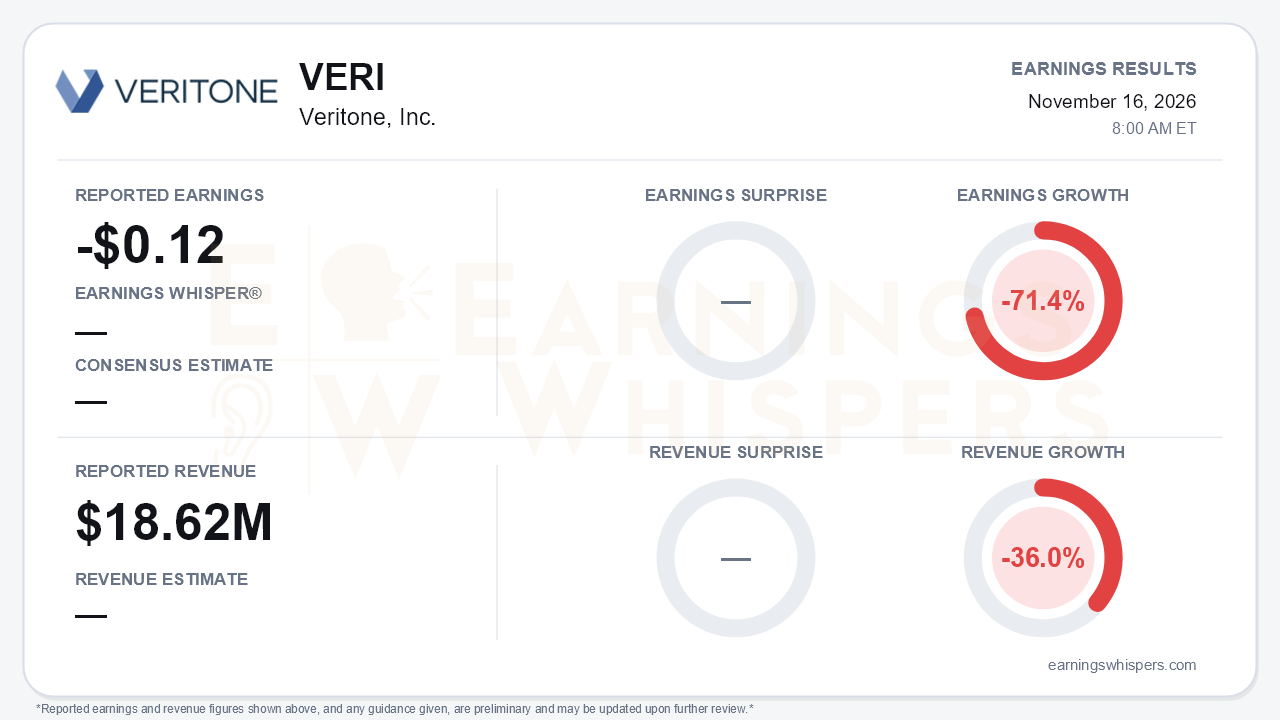
Veritone (NASDAQ: VERI) reported an adjusted loss of $0.12 per share on revenue of $18.62 million for the September quarter. Earnings Whispers data show earnings down 71.4% year over year and revenue down 36.0%. The company's own comparison puts the revenue decline at 30.1% from $26.6 million. There was no consensus to measure against, but management supplied its own benchmark: on the second-quarter call it had softly guided to $24 million to $28 million or more. The quarter missed that range badly because the Veritone Data Refinery (VDR) deliveries the outlook depended on never arrived. The central development is not the miss itself. It is that the investment case has shifted from an AI growth story to a question of whether the company can refinance roughly $45 million of convertible notes coming due within weeks.
The quality of the quarter deserves scrutiny. GAAP net loss narrowed to $19.2 million from $29.2 million, and GAAP loss per share improved to $0.19 from $0.45. That improvement came almost entirely from below the operating line. The prior-year period included an $8.0 million earnout revaluation loss and $2.6 million more in interest expense, and the share count rose by more than 55%. Operating loss actually widened to $19.4 million. Non-GAAP net loss grew 31.2% to $10.7 million, as a 42.7% collapse in high-margin Software Products & Services revenue overwhelmed more than $3 million of operating-expense savings. Managed Services grew 11.3%, but that shift in mix pushed non-GAAP gross margin down to 66.5% from 68.3%.
The operating metrics beneath the headline are deteriorating steadily:
- Total new bookings fell for a fourth straight quarter, from $19.0 million a year ago to $10.8 million.
- SaaS ARR slid to $41.1 million from $50.0 million, hurt by the loss of iHeart and weaker talent-acquisition subscriptions.
- The software customer count dropped 8.1% to 2,775.
The guidance pattern is equally telling. Full-year revenue guidance has moved from $130 million to $145 million at the start of the year, to $100 million to $150 million last quarter, to $100 million to $105 million now. The new non-GAAP net loss range of $30.8 million to $32.2 million sits at the top of the prior $22 million to $32 million band. The call summary cited a slightly narrower loss figure, but the release reconciliation is the formal guide. Even the reduced revenue target requires Q4 revenue roughly double Q3's level, including $17 million to $23 million of consumption-based VDR revenue that just slipped once. Breakeven has been pushed out again, to as early as the third quarter of 2027. Management's illustrative 2027 revenue of about $108 million is down from $125 million to $130 million discussed last quarter, and it still implies a non-GAAP loss of up to $10 million.
The balance sheet is now the story. Cash stood at $7.3 million at quarter-end, plus a $15 million receivable from a direct offering priced at $0.75 per share, against $45.5 million of current convertible notes. The note exchange bought only one month, extending $38.7 million of principal to December 15 and adding 1.6 million shares. The $6.8 million balance came due November 16. The $40 million Blue Torch term loan is only a commitment letter, and it is conditioned on raising another $25 million, possibly from the largest stockholders. If completed, it would lift annual cash debt costs from about $0.8 million to roughly $5 million in year one and more than $8 million afterward. The release's risk factors explicitly cite the company's ability to continue as a going concern, and management declined to disclose a post-transaction cash balance.
The call did preserve some real catalysts:
- Annualized cost cuts now exceed $18 million, with a target of roughly a $75 million operating-expense run rate.
- The active VDR pipeline grew to about $25 million.
- Public sector added 80 net new customers and won an eight-year UK Blue Light framework with a ceiling of up to £960 million.
- A U.S. investigative-body award could reach $10 million a year at peak.
- Partners including Box, Getac and JustFOIA are beginning to generate bookings.
Bears have legitimate ammunition, however. A framework ceiling is not revenue, the Defense Department project remains unfunded, and management expects Broadbean to be flat in 2027. The tone also diverged sharply between documents. The press release said the CEO was "confident" in accelerating growth in 2027, while on the call he acknowledged a "step sideways or backwards."
The market has already been pricing in strain. Shares opened at $1.14 after the August report. At-the-market sales during the quarter averaged $1.04 per share, versus $1.68 in Q2, and the September direct offering was priced at $0.75. All three are well below the $1.66 200-day moving average. Shares outstanding have climbed to about 121.6 million from roughly 99 million last quarter, and the company flagged Nasdaq minimum-price compliance as a risk.
The bottom line is that Veritone's third quarter turned a growth narrative into a liquidity test. Cost discipline and public-sector wins offer a plausible long-term path, but near-term value depends on closing conditional financing before mid-December and on VDR deliveries that have repeatedly failed to arrive on schedule. Further dilution looks likely either way.
This earnings review was originally published on Earnings Whispers.
This article is for informational purposes only and is not investment advice. Earnings Whispers and its staff may hold positions in the securities mentioned. It is AI-assisted, based on proprietary Earnings Whispers data and company reports, and edited by Earnings Whispers staff.
Mentioned In This Article
Latest News
| Nov-16 | |
| Nov-16 | |
| Nov-12 | |
| Nov-11 | |
| Oct-29 | |
| Oct-20 | |
| Oct-01 | |
| Sep-29 | |
| Sep-21 | |
| Sep-10 | |
| Sep-10 | |
| Sep-09 | |
| Aug-14 | |
| Aug-13 | |
| Aug-04 |
