Target vs. Walmart Stock: Which is the Better Buy Ahead of Q3 Earnings?
Retail giants Target TGT) and Walmart WMT) are preparing to report their much-anticipated Q3 results this week, with Wall Street looking for insight into consumer spending trends ahead of the critical holiday shopping season.
With inflation and affordability concerns still influencing purchasing decisions, investors will be particularly focused on comparable-store sales, e-commerce growth, and demand for discretionary merchandise versus everyday essentials.
That said, let’s compare Target and Walmart's Q3 expectations, stock performance, valuations, and dividends to determine which may be the better investment.
Target & Walmart Q3 Expectations
Target reports Wednesday, November 18, before the opening bell. The Zacks Consensus Estimate calls for Q3 earnings of $2.04 per share, representing nearly 15% year-over-year growth, on revenue of $26.41 billion, up more than 4%.
Walmart reports Thursday, November 19, before the market opens. The Zacks Consensus Estimate calls for Q3 earnings of $0.64 per share, up 3% YoY, on revenue of $186.52 billion, a nearly 4% increase.
Walmart's competitive pricing, grocery dominance, and expanding e-commerce operations remain key growth drivers, while Target is benefiting from improving profitability and efforts to strengthen discretionary sales.
Both retailers' holiday outlooks will be particularly important as consumers balance spending on necessities and nonessential purchases.
Stock Performance & Valuation Comparison
Target has significantly outperformed Walmart in 2026, posting a year-to-date total return of 70% compared with Walmart's 16%.
However, Walmart has delivered stronger long-term performance, generating a three-year total return of +155%, noticeably outpacing Target's 39%, the Zacks Retail-Wholesale sector’s 57%, and the benchmark S&P 500’s 80%.
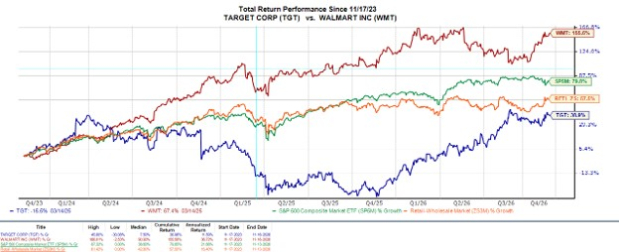
Image Source: Zacks Investment Research
Still, Target has a far more attractive valuation, trading at 17X forward earnings compared with the Zacks Retail-Wholesale sector average of 22X and Walmart's 40X.
Target’s substantial discount may appeal to value-oriented investors, although Walmart's consistent sales growth, defensive business model, and expanding digital capabilities help justify its premium.
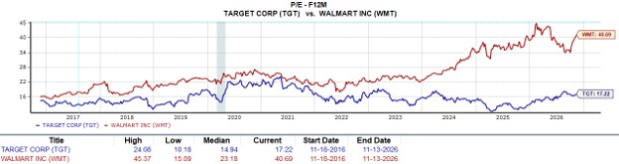
Image Source: Zacks Investment Research
TGT & WMT Dividend Comparison
Both retailers have impressive dividend histories, although Target offers substantially higher income.
Target pays a quarterly dividend of $1.16 per share, translating to an annual payout of $4.64 and a yield near 3%. Walmart pays $0.2475 quarterly, equating to $0.99 annually and a yield of roughly 0.8%.
Notably, both companies are Dividend Kings, with Target on track for its 55th consecutive year of annual dividend increases and Walmart having raised its dividend for 53 consecutive years.
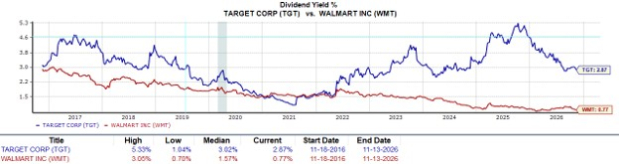
Image Source: Zacks Investment Research
Bottom Line: Should Investors Buy TGT or WMT Stock?
Walmart's consistent operating performance, grocery dominance, and expanding e-commerce business make it the stronger defensive investment. Conversely, Target's significantly lower valuation and higher dividend yield offer an intriguing alternative, particularly if its turnaround keeps gaining momentum.
For now, Walmart stock lands a Zacks Rank #3 (Hold), while Target sports a Zacks Rank #2 (Buy), suggesting a more favorable near-term outlook for TGT amid positive earnings estimate revisions.
However, with Target's extraordinary rally this year and Walmart's premium valuation, investors may want to be selective ahead of earnings. Strong Q3 results and upbeat holiday guidance will be essential to maintaining momentum for both retail giants.
Want the latest recommendations from Zacks Investment Research? Today, you can download 7 Best Stocks for the Next 30 Days. Click to get this free report
Target Corporation (TGT): Free Stock Analysis Report
Walmart Inc. (WMT): Free Stock Analysis Report
This article originally published on Zacks Investment Research (zacks.com).
Mentioned In This Article
Latest News
| 15 min | |
| 26 min | |
| 1 hour | |
| 2 hours | |
| 2 hours | |
| 4 hours | |
| 5 hours | |
| 5 hours | |
| 9 hours | |
| 9 hours | |
| Nov-15 | |
| Nov-13 | |
| Nov-13 | |
| Nov-13 | |
| Nov-13 |
