Glass House Brands Beats On Revenue, But A Price-Mix Collapse, Slipping Cost Targets And Governance Noise Leave The Story On Defense
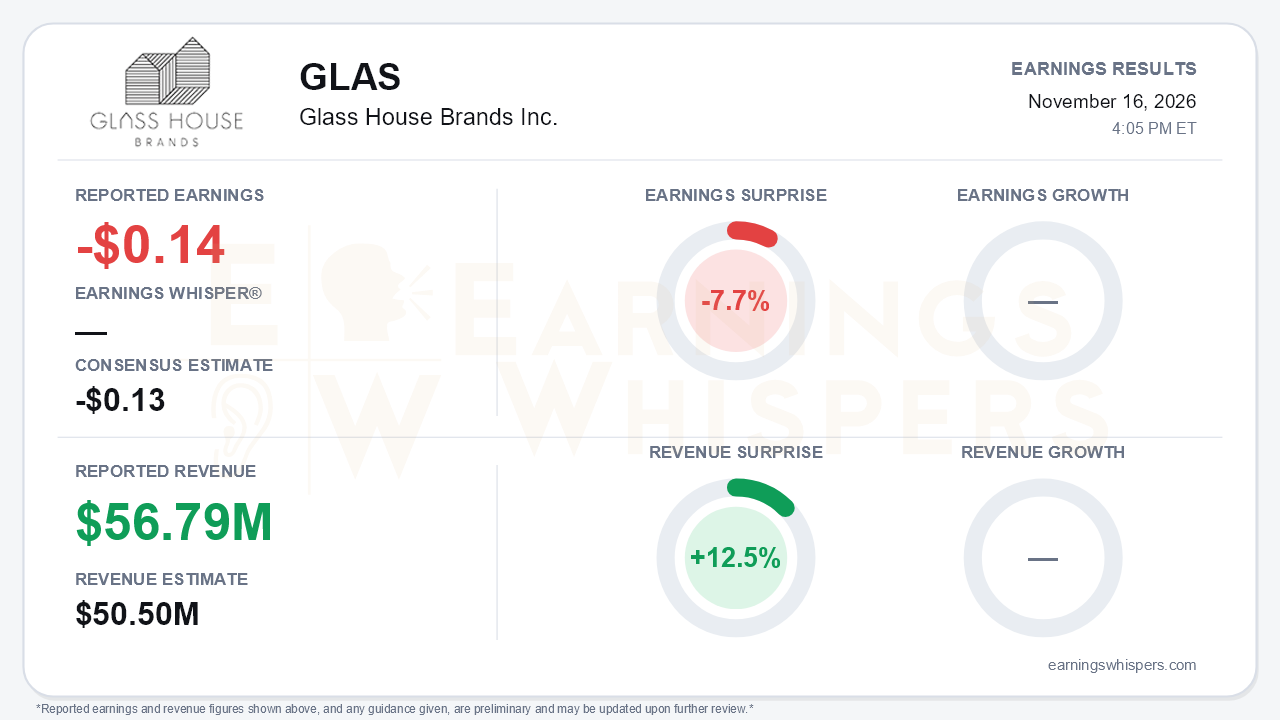
Glass House Brands (NYSE: GLAS) delivered a split third quarter that leaned decidedly negative beneath the headline. The company lost $0.14 per share, missing the -$0.13 consensus by 7.7%, while revenue of $56.79 million beat the $50.5 million estimate by 12.5%. On the release's continuing-operations basis, sales rose from $47.0 million in Q2 and $26.2 million a year ago, driven by record biomass output of roughly 319,000 pounds. That is the central tension: Glass House is growing far more pounds at lower cost, but it is getting paid much less for each one, and the economics of the extra volume are not reaching the bottom line.
The quality of the revenue beat deserves scrutiny. Average selling price fell to $151 per pound from $211 in Q2, and also trailed the mid-$180s management had pointed to on the Q1 call. Trim made up about 63% of pounds sold, a mix problem management estimated cost more than $10 million. Gross margin fell to 26% from 34% in Q2, well short of the high-40s level discussed earlier in the year. Gross profit actually declined to $14.6 million despite about $10 million more revenue. Operating expenses moved the wrong way at the same time. G&A rose to $16.2 million from $13.4 million, and professional fees doubled to $3.2 million on NYSE uplisting and SOX work. Adjusted EBITDA shrank to $0.8 million from $5.7 million. The GAAP loss from continuing operations more than doubled sequentially to $10.1 million, and operating cash flow was slightly negative.
The operational story is not broken. Cost of production fell to $109 per pound from $122 in Q2 and $175 in Q1. The flower-yield gap versus the company's historical best narrowed from about 25% to about 10%, with single digits so far in Q4. Management also reaffirmed roughly 1 million pounds of 2026 production and its long-term $95 target. The forward bar, however, keeps moving lower:
- **Cost targets:** Earlier calls targeted sub-$95 costs, then a sub-$100 exit. Q4 is now expected around $109.
- **Production run-rate:** The implied Q4 production of about 285,000 pounds falls short of the earlier talk of a run-rate above 1.1 million pounds.
- **Q4 outlook:** Q4 gross margin is guided to a similar 26-28%, with flat ASP and flower pricing slipping to the low $300s. Mix relief is not expected until 1Q27.
- **Full-year guidance:** Revenue, EBITDA and cash guidance remain withdrawn.
The tone shifted from offensive to defensive.
Catalysts are real but largely regulatory and back-dated. GACP certifications at the Casitas and Padaro farms open a theoretical path to German, U.K. and Swiss medical markets. The CEO stressed that Glass House is already DEA-registered and operating under a Schedule III medical designation. The cogeneration unit is returning to service for Greenhouse 2, and a roughly $20 million program targets yield and mix at Greenhouses 5 and 6. Against that, the supply agreements management promised by year-end did not materialize, there is no export timeline, and hemp operations are paused. DEA show-cause letters to adult-use dispensaries also cloud the interstate path. Bears have further ammunition:
- The CFO is retiring.
- A director resigned.
- An auditor reversal left a disclosed, unresolved disagreement.
The balance sheet bought time rather than strength. Cash rose to $39.7 million from $22.1 million, but only because of $18 million in ATM sales and $10 million of warrant exercises. Shares were then issued in October at $5.16, down from an $8.11 Q3 average. The lender extended a covenant waiver on the $50 million facility for four more quarters. Management also flagged the option to pay preferred dividends in kind, saving about $12 million a year in cash. Each of those levers is useful, and each signals a company managing liquidity. The unwinding of related-party contracts and the scheduled June 2027 expiration of multiple-voting shares are constructive governance steps, though they arrive amid the auditor and board turnover.
The market had already rendered a harsh verdict. Shares stood at $1.27 heading into the release, down 86.7% from the $9.56 open after the August report and about 83% below the 200-day moving average of $7.40. That is far below even the October ATM price. Investor sentiment flipped from modestly positive (0.14) to modestly negative (-0.11), a meaningful swing for a single quarter. AVWAP readings also remain negative. Much of the disappointment appears priced in, but the call offered little near-term evidence to reverse it.
The bottom line is that Glass House proved it can grow volume and cut costs, yet the quarter exposed how little of that reaches earnings when pricing and mix turn against it. With margin relief pushed to 2027, cost targets repeatedly reset, guidance still withdrawn, and dilution and governance questions mounting, the recovery case now rests on regulatory and export catalysts that remain undated.
Read our earnings preview for Glass House Brands Inc.: https://www.earningswhispers.com/article/GLAS/23201
This earnings review was originally published on Earnings Whispers.
This article is for informational purposes only and is not investment advice. Earnings Whispers and its staff may hold positions in the securities mentioned. It is AI-assisted, based on proprietary Earnings Whispers data and company reports, and edited by Earnings Whispers staff.
Mentioned In This Article
Latest News
| Nov-16 | |
| Nov-16 | |
| Nov-15 | |
| Nov-11 | |
| Nov-10 | |
| Oct-19 | |
| Oct-14 | |
| Sep-29 | |
| Sep-14 | |
| Sep-04 | |
| Aug-28 | |
| Aug-14 | |
| Aug-13 | |
| Aug-10 | |
| Jul-27 |
