Faraday Future Narrows Losses And Ramps Robotics, But The Parent's Liquidity Crisis Dominates The Quarter
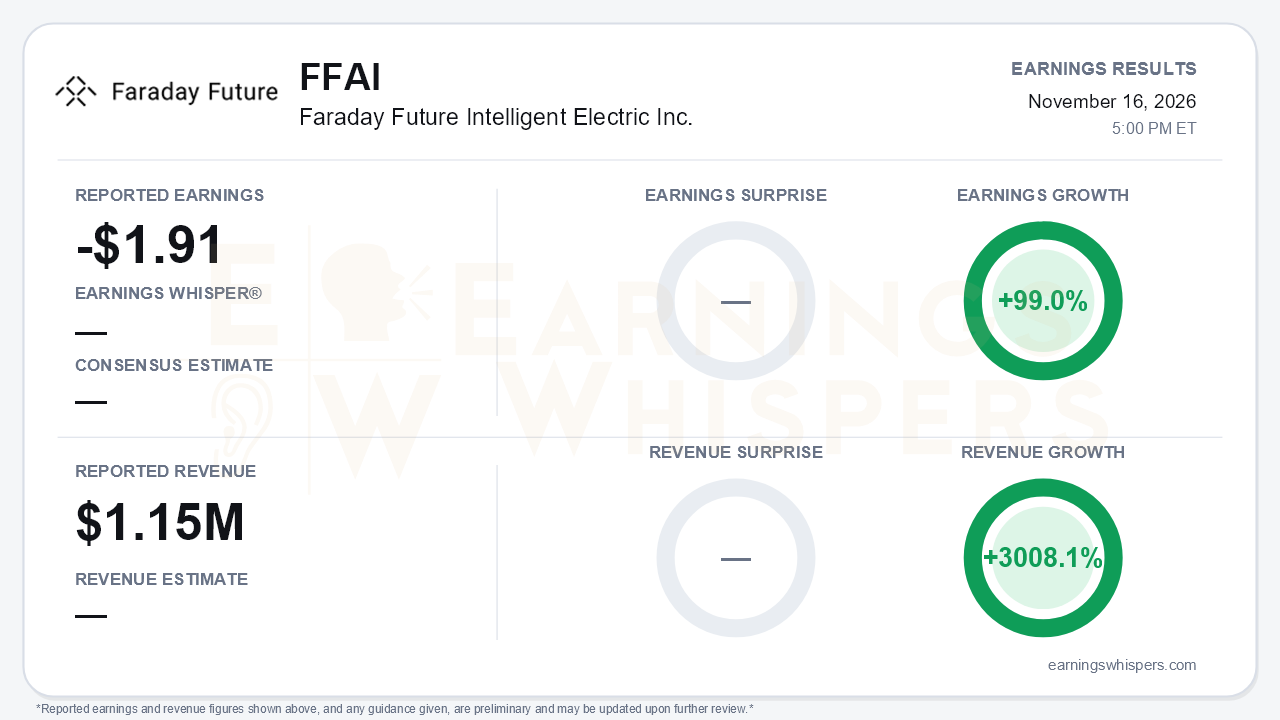
Faraday Future reported a third-quarter loss of $1.91 per share on revenue of $1.15 million. By Earnings Whispers' calculations, earnings improved 99.0% year over year and revenue grew 3,008.1%. No consensus estimate was available. Net loss shrank from $222.2 million to $9.8 million, and revenue rose from a negligible $37,000 a year ago. Those figures describe a company that has stopped burning money on an EV program and started selling robots. They do not describe a company that has solved its central problem. Quarter-end cash was only $7.2 million against a $74.6 million working capital deficit. Going-concern doubt is explicit. Management's answer to that gap so far is stock, not cash. That is the central tension.
The quality of the improvement deserves scrutiny. Operating expenses fell to $10.9 million from $172.6 million. Part of that decline came from the absence of last year's large impairment and from expense reversals, not only from lower run-rate spending. The company still posted an $8.6 million gross loss on $1.15 million of revenue, so the consolidated cost base remains far larger than the revenue it generates. Sequentially the direction is better:
- Gross loss narrowed from $10.7 million in the second quarter.
- Net loss fell from about $39 million.
- Revenue has climbed from $512,000 in Q1 to $836,000 in Q2 to $1.15 million in Q3.
Cash consumption has not slowed. Nine-month operating cash use reached $75.6 million, compared with $56.5 million through the first half.
The robotics business is real, but small and heavily subsidized. On a standalone basis it generated about $2.3 million of revenue over nine months, with a gross margin of roughly 26%. It lost $27.4 million over that period, about $3.0 million a month. Faraday Future funded $24.4 million of those costs as capital contributions and waived $7.5 million of bridge financing. Unit momentum is the strongest part of the story:
- October shipments hit a record 351 units.
- Cumulative shipments reached 1,168, up from 242 at the end of Q2.
- The full-year target of roughly 2,000 units with positive unit gross margins was reaffirmed.
That target has been raised three times this year, from 1,000 to 1,500 to 2,000. Hitting it now requires roughly 830 units in November and December, well above even the October record. The mix also matters. Products range from a $299 educational device to $100,000-class industrial machines, so unit counts say little about revenue quality.
The October spin of the robotics business into Nasdaq-listed FF Robotics is the quarter's defining structural event. FFR acquired the business in an all-stock deal valued at about $200 million. Faraday Future holds about 66% on an as-converted, fully diluted basis, subject to an 18-month lock-up. The deal produced no cash, and a previously contemplated special dividend was dropped. The parent's value is now largely a locked-up stake in a volatile small-cap. The remaining operating plans are thin:
- Robotaxi operations and AI VisiCabin licensing came without targets or a funding plan.
- The FF and FX EV brands will be paced to whatever funding is secured.
On the call, Q2 commitments went unmentioned, including cutting liabilities below $100 million, 50,000 data-collection hours and a 200-member developer community. Management's tone shifted from expansive to defensive.
There are genuine catalysts on the robotics side:
- OmniMind ranked first on the RoboColiseum leaderboard.
- The Data Factory completed a pilot for a frontier research lab and is collecting paid orders.
- Security and inspection contracts were signed with North American integrators.
- FFR is targeting its first U.S.-produced robot in Q1 2027.
These accrue first to FFR, however, and the parent participates only through its locked-up stake. Meanwhile, shareholders will vote December 15 on a reverse split of up to 1-for-80, only months after the July 1-for-150 split.
The market has rendered a harsh verdict. Shares fell 95.9% from the $4.56 open after the August report to $0.19. The stock hit a 52-week low of $0.18 on November 13, just before this release, leaving it at the very bottom of its inter-earnings range. It also sits more than 99% below its 200-day moving average, a gap distorted by the earlier reverse split but still telling. Investor sentiment swung from solidly positive at 0.49 to modestly negative at -0.14, a meaningful reversal in expectations. The AVWAP trend remains negative, consistent with sustained selling pressure.
The bottom line is that Faraday Future delivered the operational progress robotics bulls wanted: rising revenue, record shipments and dramatically narrower losses. It delivered them inside a parent company that is running out of cash, has monetized its best asset only in locked-up paper and is reaching for a second reverse split. Until the company closes a financing that addresses the working capital deficit, the robotics ramp is a story about FFR. For FFAI shareholders, the story remains about survival and dilution.
Read our earnings preview for Faraday Future Intelligent Electric Inc.: https://www.earningswhispers.com/article/FFAI/23151
This earnings review was originally published on Earnings Whispers.
This article is for informational purposes only and is not investment advice. Earnings Whispers and its staff may hold positions in the securities mentioned. It is AI-assisted, based on proprietary Earnings Whispers data and company reports, and edited by Earnings Whispers staff.
Mentioned In This Article
Latest News
| Nov-16 | |
| Nov-16 | |
| Nov-15 | |
| Nov-12 | |
| Nov-11 | |
| Nov-10 | |
| Nov-08 | |
| Nov-06 | |
| Nov-05 | |
| Nov-01 | |
| Oct-26 | |
| Oct-26 | |
| Oct-26 | |
| Oct-26 | |
| Oct-25 |
