Stem Beats On A Narrower Loss And Record Margins, But Guidance Cuts And Going-Concern Language Overshadow The Quarter
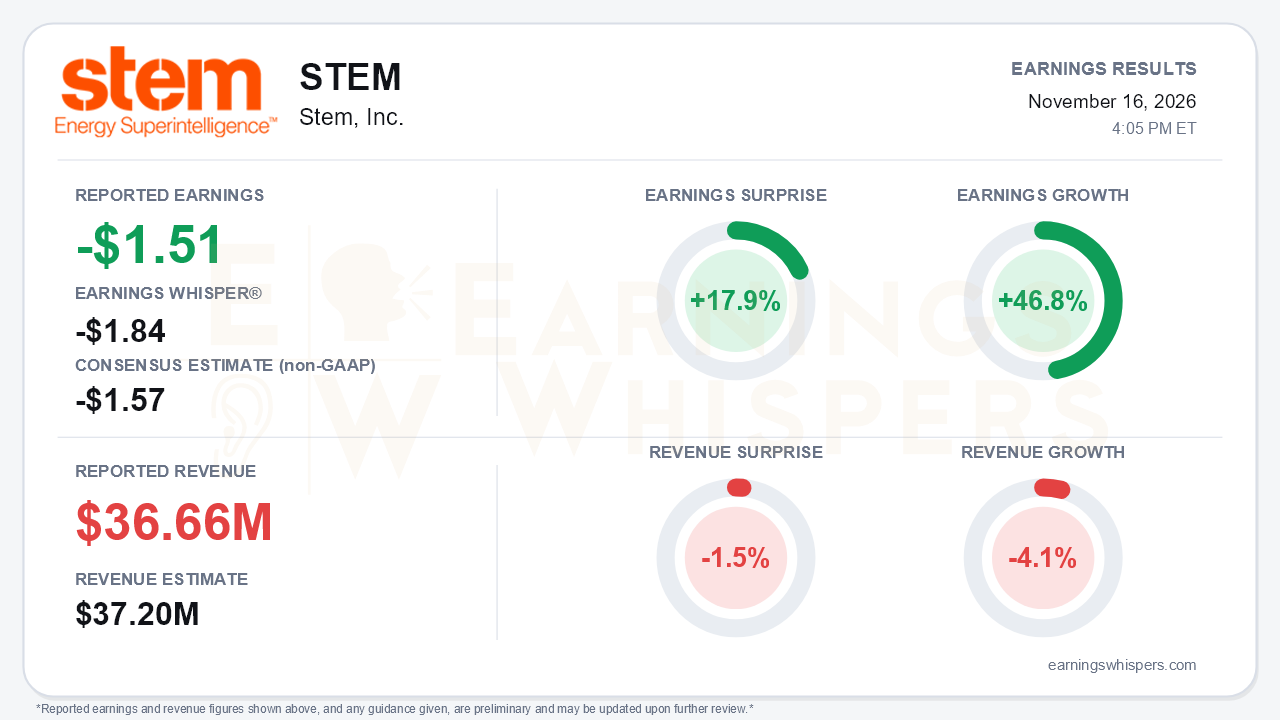
Stem delivered the cleanest earnings print in its recent history and one of its most unsettling outlooks. The company reported a third-quarter loss of $1.51 per share, beating the $1.57 consensus by 17.9% and clearing the more bearish -$1.84 Earnings Whisper number. The loss narrowed 46.8% from a year ago, when Stem lost $2.84 per share. Revenue told a different story. Sales of $36.66 million missed the $37.2 million consensus by 1.5% and fell 4.1% year over year. Management then cut full-year revenue, ARR, and operating cash flow guidance. That is the central tension: Stem is becoming a more profitable business, but it is also becoming a smaller one, and it is doing so under clear balance-sheet strain.
The beat deserves some scrutiny. The reported figure is a GAAP net loss per share, and the quarter included a $3.2 million gain on the sale of energy storage systems tied to the exit from legacy financing entities. That gain roughly offset a $2.9 million impairment of storage assets. The more durable improvement sits in gross margin. Non-GAAP gross margin reached a record 58%, up from 47% a year ago and from 55% in Q2 and 52% in Q1. Adjusted EBITDA more than tripled to $7.1 million, and year-to-date EBITDA of $15.3 million has already passed the top of the original full-year range. Cash operating expenses fell 17%. The mix shift explains most of this. Hardware revenue dropped to $15.2 million from $19.8 million as battery resale faded, while services and other revenue rose to $21.5 million. Still, interest expense of $8.0 million exceeded the quarter's adjusted EBITDA, and that comparison frames the problem.
The call preserved a credible growth story for PowerTrack itself:
- PowerTrack software revenue growth reaccelerated to 18% year over year, up from 11% in Q2.
- PowerTrack ARR reached $44.4 million, up 14% year over year.
- PowerTrack software gross margin climbed to 80%.
- Solar assets under management crossed 40 GW.
The surrounding business is weakening, however. Bookings fell to $27.6 million from $36.8 million in Q2, and backlog dropped to $22.3 million from $27.1 million. Edge hardware revenue declined 11% year over year. US bookings slipped roughly 6% sequentially as the investment tax credit phase-out weighed on commercial and industrial solar. Management guided fourth-quarter EBITDA and margins below Q3. That shift leaves roughly $10 million of ARR and about $3 million of quarterly managed services revenue tied to the exited financing entities rolling off. The tone shifted noticeably as well. Earlier quarters featured repeated reaffirmations of every metric, while this call was more defensive and offered no 2027 numbers.
The guidance reset formalizes Stem's pivot:
- Raised: non-GAAP gross margin to 45%-55% and adjusted EBITDA to $15-$20 million.
- Cut: revenue to $132-$142 million from $140-$190 million.
- Cut: battery hardware resale to up to $2 million from up to $40 million.
- Cut: year-end ARR to $50-$55 million from $65-$70 million.
- Cut: operating cash flow to a range of negative $5 million to positive $5 million.
Stem is no longer pursuing new Managed Services contracts or battery resale. It sold the Athena optimization IP to Voltus for $10 million in cash and shed about $30 million of liabilities through the financing-entity exit. International wins add some optionality, including Georgia's first utility-scale solar plant and an expanded Copec Flux partnership in Latin America. Bears have legitimate ammunition, though. The 10-Q carries going-concern language, the NYSE issued a continued-listing non-compliance notice, and the Board launched a strategic alternatives review that could end in a sale, recapitalization, or nothing at all. Against roughly $320 million of convertible and senior secured notes, cash fell to $36.9 million from about $49 million at the end of 2025. Stockholders' deficit widened to $284 million.
Investor sentiment swung sharply, from -0.56 at the prior report to +0.24. That is a meaningful shift from clearly negative to modestly positive, likely reflecting the margin trajectory and the strategic-review optionality. Price action has been far harsher. Shares spiked to $7.02 on the day after the August report and then gave all of it back. At $2.24, the stock was down 61% from the post-report open and sat about 70% below its 200-day moving average of $7.59. It was trading only 4.2% above the October 30 low of $2.15, which was also a 52-week low. The Earnings Whispers price and AVWAP trends remain negative.
The market setup is more complicated than the surprise implies. Profitability is improving, but the improvement comes from a shrinking revenue base and does not yet cover interest costs. The equity's fate may hinge more on the strategic review and capital structure than on PowerTrack's operating momentum.
The bottom line is that Stem beat on earnings and showed real progress in PowerTrack margins and growth, but the quarter's defining developments were the guidance cuts, the going-concern disclosure, and the strategic review. Investors are being asked to value a focused, higher-margin software business whose standalone path remains uncertain.
This earnings review was originally published on Earnings Whispers.
This article is for informational purposes only and is not investment advice. Earnings Whispers and its staff may hold positions in the securities mentioned. It is AI-assisted, based on proprietary Earnings Whispers data and company reports, and edited by Earnings Whispers staff.
Mentioned In This Article
Latest News
| Nov-16 | |
| Nov-16 | |
| Nov-16 | |
| Nov-16 | |
| Nov-12 | |
| Nov-04 | |
| Nov-03 | |
| Oct-28 | |
| Oct-26 | |
| Oct-23 | |
| Oct-14 | |
| Aug-12 | |
| Aug-12 | |
| Jul-27 | |
| Jul-22 |
