Euroseas Beats On Adjusted EPS As Charter Coverage Builds, But Management Warns Of A Tougher 2H27-2028
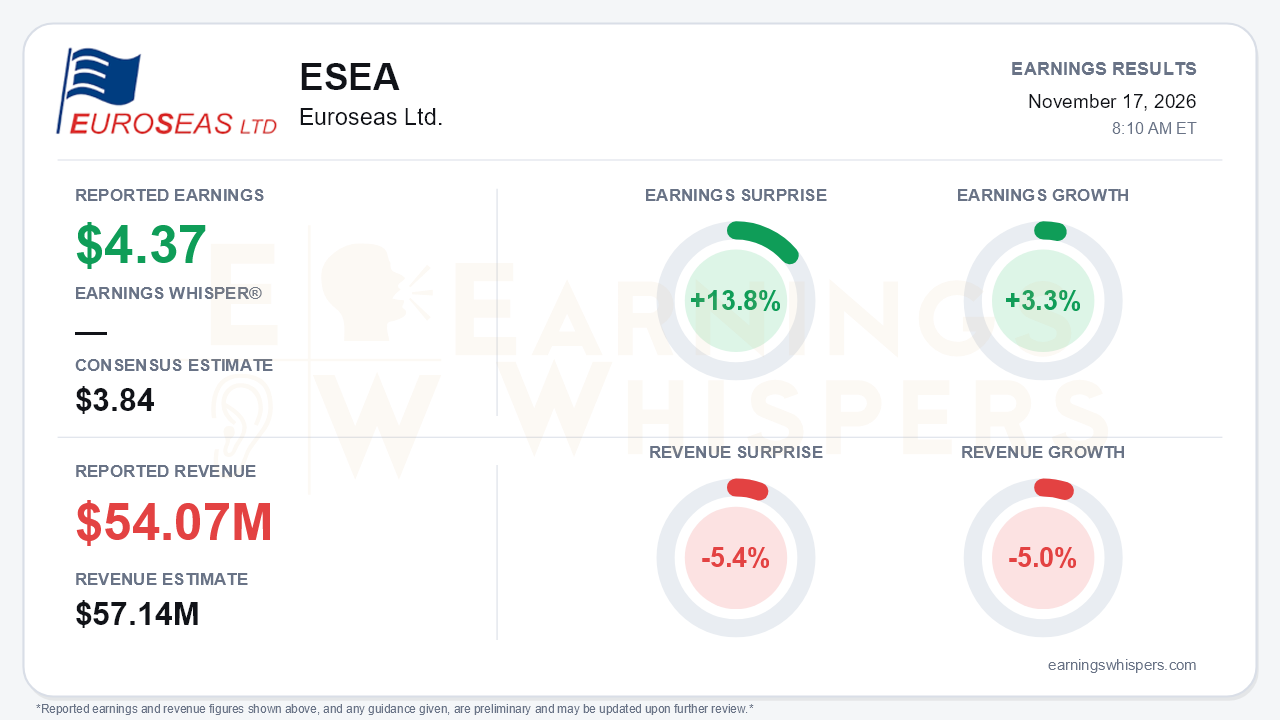
Euroseas (NASDAQ: ESEA) delivered a clean-looking earnings beat on a shrinking top line. Adjusted EPS of $4.37 topped the $3.84 consensus by 13.8% and grew 3.3% year over year. Revenue of $54.07 million missed the $57.14 million estimate by 5.4% and fell 5.0% from a year ago. The central tension is not this quarter, which is largely locked in by charters. It is the widening gap between near-term visibility, which keeps improving, and management's own warning that container shipping fundamentals could deteriorate significantly from the second half of 2027 into 2028.
The quality of the beat deserves scrutiny. On a GAAP basis, diluted EPS fell to $3.65 from $4.25, and net income attributable to shareholders dropped to $25.6 million from $29.7 million. The adjusted figure excludes two items:
- $4.3 million of drydocking costs on M/V Evridiki G, a 2001-built vessel that was being prepared for sale;
- a $0.7 million unrealized loss on equity securities.
A further $3.5 million unrealized loss on debt securities bypassed the income statement entirely through other comprehensive income. That loss was up sharply from roughly $0.24 million in Q2, an unwelcome result for what was described as a short-term liquidity strategy. Below the operating line, financing helped: interest costs fell to $2.2 million from $3.7 million, and interest income rose to $1.3 million. Operating income fell to $27.3 million from $32.5 million. In short, the beat leaned on lower financing costs and adjustments rather than stronger vessel economics.
Sequentially, the trend softened across the board:
- Revenue slipped from $56.5 million in Q2.
- Adjusted EBITDA eased to $38.3 million from $40.1 million.
- Adjusted EPS declined from $4.70.
- Fleet TCE dipped to $29,705 per day from $30,306.
The year-over-year revenue decline reflects a smaller fleet: 21.0 average vessels versus 22.0. TCE rose only 1.4%. Costs are moving the wrong way, with total daily operating expenses of $7,903 per vessel versus $7,246 a year earlier. Management attributed that to higher supply costs tied to the Middle East conflict, plus increased G&A from stock compensation and professional fees. Drydocking pressure is not over either: Q3 carried 69 scheduled off-hire days, and roughly 120 are expected in Q4.
The call preserved a credible near-term story. Charter coverage climbed further:
- 2026 is now fully covered.
- 2027 coverage rose to roughly 90–91% at about $32,353 per day, up from 81% last quarter.
- 2028 coverage is near 50%.
According to the call, the charterer exercised five-year options on four intermediate newbuilds at $32,500 per day. That trades a higher headline rate for longer duration. Older tonnage was monetized well. Evridiki G sold for about $26 million rather than going to scrap, which should produce a gain of roughly $22.5 million in Q4. The 2001-built EM Corfu was fixed at $62,500 per day. The quarterly dividend rose to $0.85 from $0.80. Management's NAV estimate edged up to about $105.9 per share. The balance sheet carries $183.3 million of cash against $203.6 million of debt, with a 12-vessel newbuild program that runs into early 2029.
Bears have legitimate ammunition, and some of it came from management. The press release describes the feeder and intermediate orderbook as modest relative to larger segments. Yet the call cited a feeder orderbook near 20% and an intermediate orderbook near 31%, both rising, and an overall orderbook of 44.4% of the fleet, up from about 35% in February. Clarksons expects TEU-miles to turn slightly negative in 2027. Eight newbuilds remain unfixed, and management says it won't lock them in at low rates. Spot rates are firm today, with 1-year 2,500 TEU rates at $42,000. However, that leaves meaningful re-chartering exposure precisely when management expects conditions to weaken. The average contracted 2028 rate also slipped to about $31,183 from about $32,000.
Investor sentiment improved sharply, from -0.83 to -0.31, but remains negative. The stock tells a similar story. Shares at $65.36 are 12.2% below the $74.48 open after the August report. They sit 5.2% under the 200-day moving average and 17.8% below the September 1 high of $79.50, just 4.5% above the November 6 low. Earnings Whispers price and AVWAP trend readings remain negative, while momentum has turned positive, a mixed backdrop. The market is valuing the shares well below management's NAV estimate, signaling skepticism about late-decade earnings power rather than doubts about the contracted 2026–2027 cash flows.
The bottom line is that Euroseas posted a beat of modest quality on declining revenue and rising costs, but strengthened its forward visibility, raised its dividend and set up a sizable Q4 sale gain. The investment debate has shifted beyond quarterly prints toward whether contract coverage and fleet renewal can carry the company through the more difficult 2H27–2028 environment management now openly anticipates.
Read our earnings preview for Euroseas Ltd.: https://www.earningswhispers.com/article/ESEA/23189
This earnings review was originally published on Earnings Whispers.
This article is for informational purposes only and is not investment advice. Earnings Whispers and its staff may hold positions in the securities mentioned. It is AI-assisted, based on proprietary Earnings Whispers data and company reports, and edited by Earnings Whispers staff.
Mentioned In This Article
Latest News
| 11 hours | |
| 15 hours | |
| Nov-13 | |
| Nov-12 | |
| Nov-12 | |
| Oct-19 | |
| Sep-09 | |
| Sep-01 | |
| Aug-25 | |
| Aug-17 | |
| Aug-13 | |
| Aug-10 | |
| Jul-24 | |
| Jun-23 | |
| Jun-15 |
