Home Depot's Comp Momentum Hits A Four-Year High, But Margin Slippage And An SRS Cut Leave EPS Stuck At The Midpoint
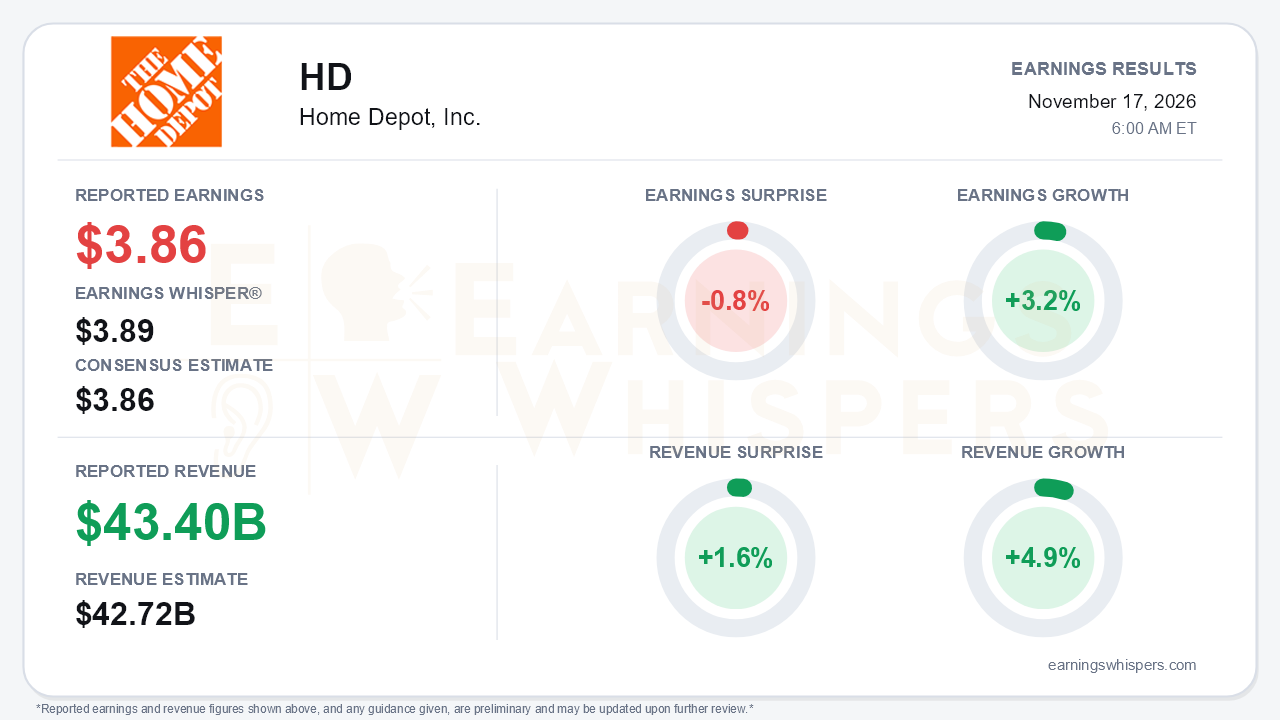
Home Depot delivered its strongest top-line quarter in four years, but none of that extra growth reached the full-year earnings outlook. Adjusted EPS of $3.86 matched the $3.86 consensus estimate and fell short of the $3.89 Earnings Whisper number, a 0.8% miss against the whisper. Revenue of $43.40 billion beat the $42.72 billion consensus by 1.6%. Earnings grew 3.2% year over year and revenue rose 4.9%. Management raised its sales and comparable-sales guidance to the high end of the prior ranges. It also pushed margin guidance to the low end and cut its outlook for SRS organic growth. As a result, adjusted EPS guidance of roughly 2% growth sits only at the midpoint of the prior flat-to-4% range. That is the central tension: demand is improving, but the company is not converting it into operating leverage.
The quality of the quarter deserves scrutiny. Comparable sales rose 2.2%, the fourth straight sequential improvement after +0.4%, +0.6% and +1.7%. Customer transactions also improved to -0.5% from -1.6% a year earlier. However, the 3.0% gain in average ticket was not entirely volume-driven, because management said roughly half of it came from same-SKU inflation. Total sales growth well ahead of the comp reflects acquisitions and new stores. Profitability went the other way:
- Gross margin slipped to about 32.8% from about 33.4%.
- Adjusted operating margin fell to 13.0% from 13.3%.
- GAAP diluted EPS rose 2.8% to $3.72.
Q3 adjusted EPS growth of 3.2% did outpace the 1.9% year-to-date pace, which is a modest improvement in earnings growth. Cash generation was a bright spot. Nine-month operating cash flow rose to $15.5 billion from $13.0 billion, helped by a much smaller working-capital drag. That cash supported nearly $4.9 billion of long-term debt repayment, and net interest expense guidance fell to about $2.2 billion.
The call offered genuine evidence of share gains:
- Big-ticket transactions rose 4.5%, up from 2.4% in Q2 and 0.8% in Q1.
- 13 of 16 departments comped positive.
- Online sales grew about 13%, the fastest in five years.
- Every Pro cohort comped positive, the ninth straight positive Pro quarter.
- Express delivery now runs in virtually all stores with a two-hour promise.
- Next-day appliance coverage expanded from about 60% to about 85% of the U.S. population.
- Enterprise cross-sell is on track for $400 million this year, and management is targeting double that in 2027.
Management's tone was more assertive and framed growth as share gain rather than market lift. The incoming CEO, Richard McPhail, was presented as a continuity choice, with Ann-Marie Campbell as president and COO and Jordan Broggi as CFO.
Bears still have legitimate ammunition:
- **Intra-quarter slowdown:** Comps cooled from +3.8% in September to +1.8% in October as mortgage rates spiked.
- **Softer market:** Management conceded the market is much softer than it expected at the start of the year.
- **SRS cut:** SRS organic growth guidance dropped to low-single digits from mid-single digits. Management cited almost unprecedented roofing pressure and sharp roofing pricing after two weak storm seasons.
- **Fourth-quarter gross margin:** Q4 gross margin is now expected to come in below last year, versus roughly flat on the Q2 call. Management blamed product mix and acquisition mix, including HVAC tuck-ins.
- **Cost pressure:** Fuel, energy, resin and metals costs are still inflating. Management identified a 3% comp as the threshold for expense leverage, which is above the current run rate.
- **Returns and tax:** ROIC slid again to 24.5% from 25.4% in Q1, and a higher 24.6% tax rate trims EPS further.
Investor sentiment improved but remains slightly negative, moving from -0.137 to -0.050. That is better positioning, but not enthusiasm. The price action has been more dramatic than the sentiment shift. Shares hit a 52-week low of $277.15 on October 1 and then rallied 25.4% to $347.51, peaking at $362.44 on November 5. The stock entered the report about 4.1% below that high and 4.4% above its 200-day moving average of $332.77. It is up 3.2% since the open following the August report. With AVWAP positive while price and momentum readings sit neutral, the stock arrived with a sharp recovery already priced in and little cushion for an in-line EPS print.
The bottom line is that Home Depot showed real demand traction, including accelerating comps, stronger big-ticket activity and broadening Pro strength. However, the economics of that growth worsened: margins compressed, SRS weakened, and comps slowed late in the quarter as rates rose. A 25% rally off the October low appears to have anticipated the improving top line. To push the stock higher from here, Home Depot likely needs to show that growth can return to margin leverage, which management's own 3% comp threshold suggests is not yet in sight.
Read our earnings preview for Home Depot, Inc.: https://www.earningswhispers.com/article/HD/23098
This earnings review was originally published on Earnings Whispers.
This article is for informational purposes only and is not investment advice. Earnings Whispers and its staff may hold positions in the securities mentioned. It is AI-assisted, based on proprietary Earnings Whispers data and company reports, and edited by Earnings Whispers staff.
Mentioned In This Article
Latest News
| 24 min | |
| 33 min | |
| 1 hour | |
| 1 hour | |
| 2 hours |
Home Depot Names New CEO After Ted Decker Steps Down. Quarterly Sales Hit $43.4 Billion.
HD
International Business Times
|
| 2 hours | |
| 2 hours | |
| 2 hours | |
| 3 hours | |
| 3 hours | |
| 3 hours | |
| 3 hours | |
| 3 hours | |
| 4 hours | |
| 4 hours |
