PagSeguro Hits The Whisper On Cost Discipline, But A Gross Profit Guidance Cut And Rising Credit Losses Cloud The Quarter
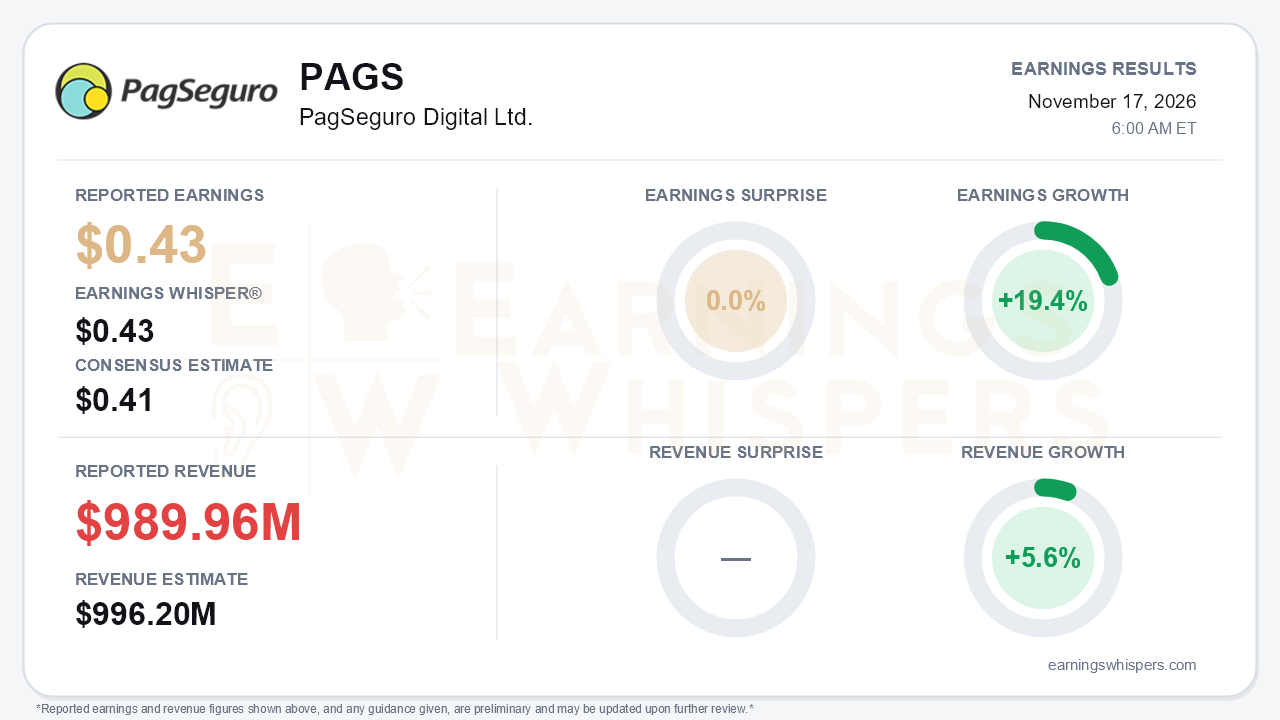
PagSeguro Digital (NYSE: PAGS) reported third-quarter earnings of $0.43 per share, matching the $0.43 Earnings Whisper and topping the $0.41 consensus. Earnings grew 19.4% year over year. Revenue of $989.96 million rose 5.6% but missed the $996.2 million consensus by 0.6%. The headline looks orderly. But the most important development was not the EPS print. Management cut its 2026 gross profit growth guidance to 3-5% from 6-9%, a range it had set at the end of last year and reaffirmed in each of the first two quarters. That is the central tension: the bottom line is being carried by efficiency and share count, while the top line and the credit engine underneath it are losing momentum.
On the profit line, the quarter did show acceleration. Non-GAAP net income of R$611 million rose 7%, up from 2% growth in the second quarter and 4% in the first. Diluted non-GAAP EPS of R$2.19 grew 13%, versus 10% in the prior quarter. Return on equity improved to 16.2% from 15.6%. Operating expenses fell to 23.7% of net revenue from 25.9% in the second quarter, and financial costs were down 7.2% year over year. Banking continues to gain weight in the mix. Banking net revenue rose 20% to R$891 million and now represents 26% of net revenue and 32% of gross profit. The quality of the beat still deserves scrutiny, however. Gross profit grew only 3.8% in the quarter and 2.5% through nine months. The EPS outcome owes more to cost control and buybacks than to revenue expansion, which is why EPS guidance of 9-13% survived even as the gross profit outlook was cut.
The call revealed deceleration across most growth metrics. Total loan growth slowed from 36% in the first quarter to 31% in the second and 25% in the third, which is now the floor of the unchanged 25-35% guide. Deposit growth slowed more sharply, from 22-23% to 15% to 8%, and checking balances fell about 5% sequentially. Total banking cash-in of roughly R$92 billion was up about 11% year over year, down from roughly R$100 billion and 23% growth in the second quarter. The press release instead highlighted 15.6% growth in cash-in per active customer. That figure is a per-client measure, and it obscures the slowdown in aggregate flows. The expanded credit portfolio also shrank to about R$50 billion from R$52.4 billion. Prepayment volumes fell faster than TPV, which management tied to tighter consumer credit and rising delinquency across Brazil. Management attributed the guidance cut to a Selic rate that stayed higher, with cuts coming slower and smaller than it had assumed. Notably, the company had already guided to the bottom of the old range in the second quarter, betting on easier second-half comparisons that did not arrive.
Asset quality is where bears have the most legitimate ammunition. Total losses rose about 47% year over year and 22% sequentially to R$130 million, and NPL90 climbed to 3.8% from 3.4%. One analyst flagged Stage 3 loans near 56%, and management declined to guide cost of risk. It did set a cap on risk charges of up to 50% of interest income on high-yield products. Working capital lending, the growth engine, is still expanding quickly. The book reached R$0.8 billion, up 171% year over year and 34% sequentially, and third-quarter origination of about R$299 million doubled. Management also presented data showing credit clients generate 2.6-2.7x more revenue and have about 10 points lower first-year churn. The open question is whether that growth is being bought with deteriorating credit.
Capital return is the clearest catalyst. The company authorized a new buyback of up to US$150 million, reversing its stated second-quarter preference for dividends. It also committed to at least R$2 billion in combined 2027-28 dividends plus a R$400 million December tranche, which management framed as roughly a 27% cumulative forward shareholder yield. An October issuance of R$2.0 billion in securitized debentures diversifies funding as deposit growth fades.
The market was not giving PAGS the benefit of the doubt going in. Shares stood at $7.99 on the report date, 10.3% below the $8.91 open following the August report and 17.1% below the 200-day moving average of $9.64. Earnings Whispers price and AVWAP trend readings are both negative. Investor sentiment was already deeply negative and slipped modestly further, to -0.69 from -0.66. Expectations were therefore low, but not low enough to make a guidance cut irrelevant.
The bottom line is that PagSeguro delivered the earnings investors expected, with improving profitability, but the quarter's real news cuts the other way. Gross profit guidance was lowered, loan and deposit growth are decelerating, and credit losses are rising. The aggressive capital return program offers a tangible floor for shareholder returns. Until top-line growth and asset quality stabilize, though, the EPS story rests more on efficiency and buybacks than on business momentum.
Read our earnings preview for PagSeguro Digital Ltd.: https://www.earningswhispers.com/article/PAGS/23070
This earnings review was originally published on Earnings Whispers.
This article is for informational purposes only and is not investment advice. Earnings Whispers and its staff may hold positions in the securities mentioned. It is AI-assisted, based on proprietary Earnings Whispers data and company reports, and edited by Earnings Whispers staff.
Mentioned In This Article
Latest News
| Nov-17 | |
| Nov-17 | |
| Nov-09 | |
| Sep-16 | |
| Aug-12 | |
| May-13 | |
| Apr-30 | |
| Apr-07 | |
| Apr-01 | |
| Mar-20 | |
| Mar-20 | |
| Mar-19 | |
| Mar-11 | |
| Mar-05 | |
| Mar-04 |
