Oaktree Specialty Lending Matches On NII, But A Fourth Straight Earnings Decline Overshadows Credit Cleanup And A New Rate Tailwind
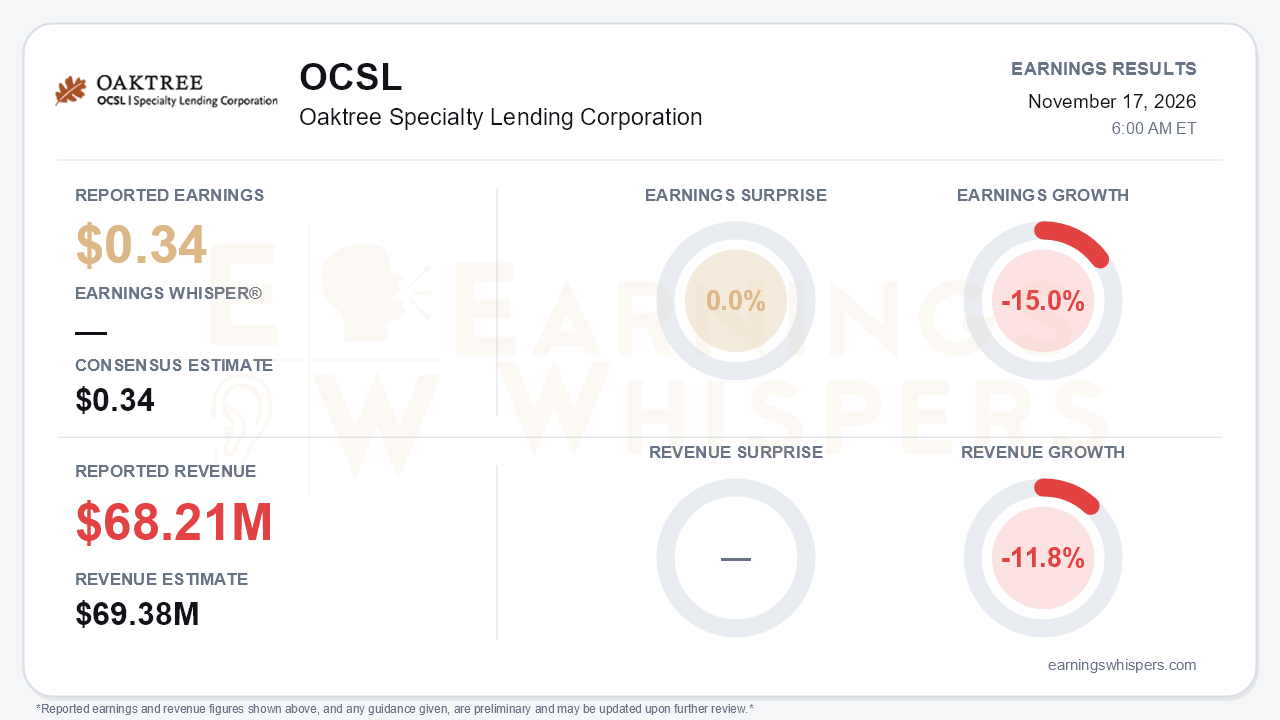
Oaktree Specialty Lending delivered exactly what the Street expected on the bottom line, and that was itself the problem. Adjusted net investment income of $0.34 per share matched consensus, while total investment income of $68.21 million missed by 1.7%. Earnings fell 15.0% from a year ago and revenue dropped 11.8%. Adjusted NII has now declined for four consecutive quarters, sliding from $0.41 in the December quarter to $0.38, $0.37 and now $0.34. Full-year adjusted NII fell to $1.49 per share from $1.76. The central tension is that credit and the balance sheet are visibly healing while the earnings engine keeps shrinking.
The quality of the quarter deserves scrutiny on both the income and expense lines. Adjusted total investment income slipped $1.1 million sequentially to $68.0 million because the average portfolio was smaller. Net new investments were negative for a second straight quarter: funded activity of $162.4 million trailed $197.8 million of repayments and exits. The larger hit came from expenses. The Part I incentive fee roughly doubled to $4.8 million from $2.4 million as hurdle relief faded, and that alone explains much of the $0.03 sequential NII decline. GAAP results also included $7.2 million of net realized and unrealized losses, and NAV per share edged down to $15.63 from $15.70. That compares with $16.64 a year earlier. The one reassurance is the payout: the $0.30 regular plus $0.02 supplemental distribution, trimmed from $0.33 last quarter, remains covered by $0.34 of NII.
The credit cleanup that management has emphasized is real. Non-accruals held at 1.8% of debt investments at fair value, down from 3.0% a year ago and from levels near 3% earlier in fiscal 2026. Non-accrual dollars at fair value fell to $45 million from $81 million, and the number of names dropped to six from ten. Resolutions are advancing:
- BioXcel is being sold to Teva, and a triggered $67.5 million milestone is expected to yield a recovery well above its 83 carrying mark.
- Thrasio was repaid at par.
- RumbleOn was repaid at 101.
The ledger is not one-directional, however. Pluralsight's first-out term loan joined the already non-accrual second-out tranche, BioXcel itself entered non-accrual through Chapter 11, and portfolio interest coverage drifted to 2.3x from 2.4x.
Portfolio composition is also shifting in ways bears can use. First lien exposure fell to 79.1% from 81.5% last quarter and 83.5% a year ago. Equity rose to 5.5% from 3.9% through three structured equity deals, and subordinated debt climbed to 6.1%. Origination momentum softened, with commitments of $178.5 million versus $206.4 million in the June quarter and new-deal yields of 9.6% versus 10.0%. Management acknowledged that direct lending deal flow is running below last year, though October originations of roughly $80 million suggest the pipeline began rebuilding in late September.
The genuinely new element is rates. With 91% of assets floating, management framed the Fed's 25-basis-point hike as an NII tailwind starting in the December quarter. The benefit is roughly $0.005 per share per quarter, or about $0.02 annualized, for each 25-basis-point move once fully reset. That is helpful but modest against a $0.07 decline in quarterly NII over the past year. Funding costs partially offset it. The weighted average cost of debt rose to 6.2% at quarter-end from 5.9%, and management cited a 6.4% pro forma rate after the new $300 million 7% notes due 2031. Those notes were more than three times oversubscribed. Together with Moody's revision of its outlook to stable, they push the next maturity after January 2027 out to February 2029, a meaningful de-risking of the capital structure.
Investors were not leaning bullish going in, and they have grown somewhat more cautious. Earnings Whispers sentiment remained negative and weakened modestly, moving from -0.21 to -0.27. Shares at $12.03 are essentially flat since the open after the August report, down 0.8%, and sit almost exactly on the 200-day moving average of $12.06. The stock has traced a full round trip in between. It peaked at $13.33 on August 31, fell to $11.19 on October 21, and has since recovered about 7.5% off that low while remaining nearly 10% below the high. Trading well below NAV, the shares reflect skepticism about the earnings trajectory rather than solvency. The Earnings Whispers trend signals remain mostly negative, with price, sequential growth and AVWAP readings all pointing lower.
The bottom line is that Oaktree Specialty Lending's quarter was cleaner beneath the surface but weaker where income investors look first. Non-accruals are down sharply from a year ago, the debt ladder is extended, and rising rates now work in the company's favor. Even so, NII and the distribution are still drifting lower, the portfolio is shrinking, and the asset mix is tilting away from first lien. Until originations return to net growth and the rate tailwind visibly offsets higher incentive fees and funding costs, the in-line print is unlikely to dislodge the market's cautious stance.
Read our earnings preview for Oaktree Specialty Lending Corporation: https://www.earningswhispers.com/article/OCSL/23104
This earnings review was originally published on Earnings Whispers.
This article is for informational purposes only and is not investment advice. Earnings Whispers and its staff may hold positions in the securities mentioned. It is AI-assisted, based on proprietary Earnings Whispers data and company reports, and edited by Earnings Whispers staff.
Mentioned In This Article
Latest News
| Nov-17 | |
| Nov-17 | |
| Nov-17 | |
| Nov-10 | |
| Oct-19 | |
| Sep-09 | |
| Aug-12 | |
| Aug-05 | |
| Aug-05 | |
| Aug-05 | |
| Jul-09 | |
| May-06 | |
| May-06 | |
| May-05 | |
| May-05 |
