Burlington Clears Consensus But Misses The Whisper As Comps Fade, Guidance Is Cut And A Modest 2027 Plan Takes Shape
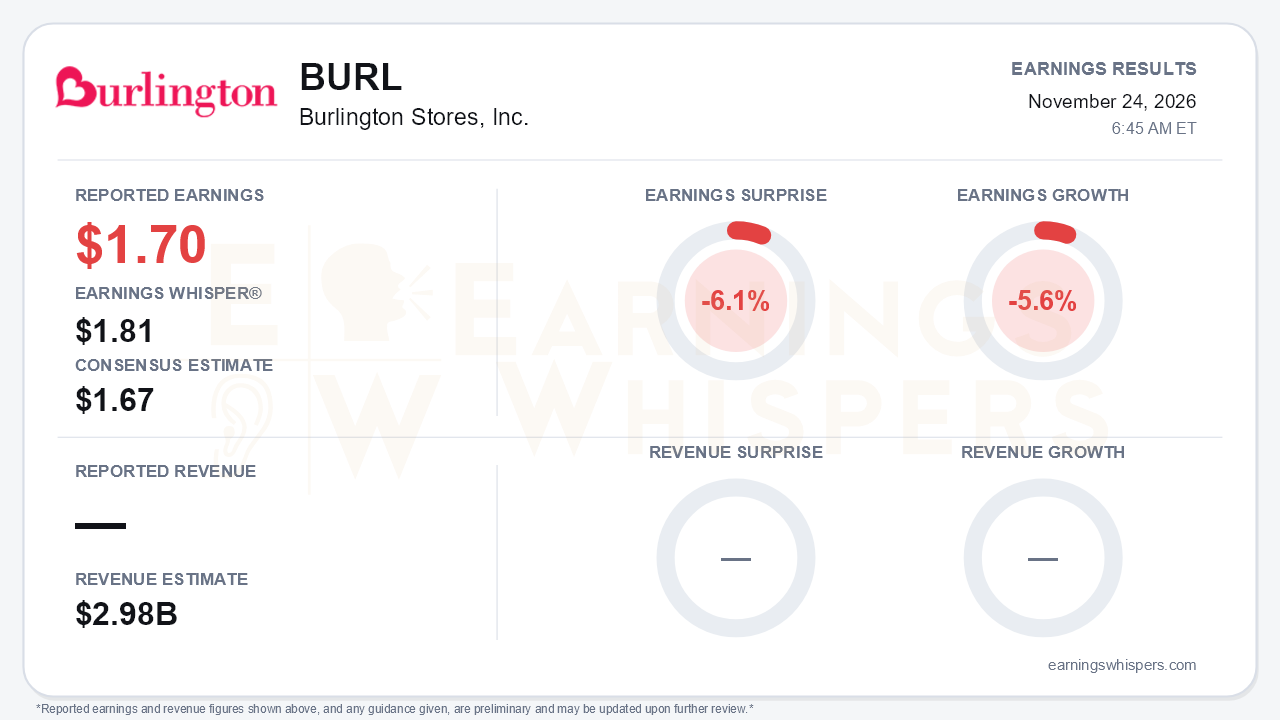
Burlington Stores (NYSE: BURL) reported fiscal third-quarter adjusted earnings of $1.70 per share. That was three cents above the $1.67 consensus but well short of the $1.81 Earnings Whisper number, a 6.1% miss against the expectations that mattered. Earnings fell 5.6% from a year ago. Net sales of $2.93 billion rose 8% but came in below the $2.98 billion consensus and under the company's own 9%–11% growth guide. Comparable store sales rose just 1%, at the low end of guidance.
The central tension is that management can point to an earnings beat against its own guidance while the growth engine is visibly slowing. The figures also need care. The release's narrative headlines adjusted EPS of $1.73, above the high end of the $1.60–$1.70 guide, versus $1.80 a year ago. Its reconciliation table, however, shows $1.70 versus $1.68, and GAAP EPS was $1.67 versus $1.63. That internal inconsistency is worth flagging. Either way, the profit line was protected by cost control rather than demand:
- Gross margin slipped 50 basis points to 43.7%, entirely from higher freight. Merchandise margin was flat even after reinvesting tariff refunds.
- Adjusted SG&A leveraged 40 basis points.
- Adjusted EBIT margin fell 60 basis points, landing at the better end of management's guided range.
- Management said margin would have been up about 10 basis points excluding the tariff-refund reinvestment.
The call made the deceleration hard to dismiss. Comps have stepped down from +6% in the first quarter to +2% in the second and +1% now. Management attributed roughly 300 basis points of October comp pressure to unseasonably warm weather, and softness has carried into November. The weakness was traffic-driven: conversion and basket size held up. That is more encouraging than a broken merchandise proposition, but it still points to a core low- and moderate-income customer buying closer to need. The tone shift was notable. Language that was "bullish" and "set up for success" in earlier calls became "candidly disappointed," with an admission that more aggressive planning "didn't help us." Management also acknowledged that some tariff-refund markdowns failed to generate the desired return.
The guidance cuts were broad:
- Fiscal 2026 comp guidance fell to 2%–3% from 3%–4%.
- Full-year sales growth narrowed to about 10% from 10%–11%.
- Full-year adjusted EPS guidance moved to $11.70–$11.80 from $11.77–$11.97.
- Fourth-quarter EPS guidance dropped to $4.85–$4.95 from $5.05–$5.15. That range sits below last year's $4.99 and reflects a $0.20 fuel and freight headwind.
- The fourth-quarter EBIT margin outlook worsened to a decline of 80–100 basis points.
The fourth-quarter comp guide of 1%–3% was maintained. Management flagged it as vulnerable to a potential super El Niño winter, noting that a similar 2015 event cost about 400 basis points of fourth-quarter comp. More consequential for the multi-year story is the initial 2027 framework: a 0%–2% comp, 5%–7% sales growth and a flattish EBIT margin. That is roughly half this year's top-line pace, with freight contracts resetting in spring 2027.
Bears have legitimate ammunition beyond the outlook. Comparable-store inventory is up 10%, and total inventory is up 16%, entering the holiday season after weak traffic. Cash has fallen to $395 million from $584 million a year ago. Capex has climbed to about $1.1 billion, including the cash purchase of a new Philadelphia headquarters. The offsets are real but secondary:
- The board authorized a new $750 million buyback.
- Nine-month operating cash flow nearly doubled to $538 million.
- The home category is recovering.
- Marketing and localization initiatives are showing early results.
- The holiday gifting assortment is stronger than last year's tariff-constrained lineup.
- Even after the cuts, full-year EPS guidance remains above the original $10.95–$11.45 range set in March.
The market had already priced in much of the disappointment. Shares entered the report at $235.16, down 23.2% since the open following the August report. They traded 22.5% below the 200-day moving average and only 3.7% above the 52-week low of $226.85 set in mid-September. Investor sentiment was negative heading into the print and edged slightly lower, from -0.22 to -0.25. That reflects persistent skepticism rather than capitulation. The Earnings Whispers trend signals are mixed: momentum is positive, while price and AVWAP trends remain negative.
The bottom line is that Burlington's quarter was a narrow consensus beat wrapped around a clear downshift. Comps are fading, fourth-quarter profit guidance is now below last year, and the first look at 2027 resets growth expectations meaningfully lower. A depressed share price and a large new buyback limit how much incremental damage the report must do. Still, the story has moved from beat-and-raise to execution under pressure, and holiday traffic, weather and inventory clearance now carry the burden of proof.
Read our earnings preview for Burlington Stores, Inc.: https://www.earningswhispers.com/article/BURL/23221
This earnings review was originally published on Earnings Whispers.
This article is for informational purposes only and is not investment advice. Earnings Whispers and its staff may hold positions in the securities mentioned. It is AI-assisted, based on proprietary Earnings Whispers data and company reports, and edited by Earnings Whispers staff.
Mentioned In This Article
Latest News
| 20 min | |
| 43 min | |
| 2 hours | |
| 2 hours | |
| 3 hours | |
| 3 hours | |
| 4 hours | |
| 4 hours | |
| Nov-16 | |
| Nov-13 | |
| Nov-10 | |
| Oct-29 | |
| Oct-28 | |
| Oct-26 | |
| Oct-22 |
