How Is Duke Energy Using Energy Storage to Build a More Reliable Grid?
Duke Energy DUK is increasingly leveraging energy storage technologies as a core part of its grid modernization strategy. By storing power during low-demand periods and deploying it during peak times, the company can optimize its generation mix for fuel savings and reduced emissions.
Battery storage helps integrate renewables by storing excess energy during low-demand periods and supplying it when demand is high. Its versatility allows the companies to improve grid performance, boost operational efficiency and reduce customer costs.
In addition to battery storage, Duke Energy operates pumped-storage hydro plants, which function as large-scale, long-duration energy reservoirs. These facilities store energy by pumping water to higher elevations when demand is low, then release it through turbines to produce electricity during peak periods. This capability provides substantial flexibility and is among the most efficient and reliable forms of bulk energy storage.
The company is consistently monitoring resource adequacy as it braces for significant demand growth, an uptick in extreme-weather events, and upcoming plant retirements. It currently operates more than 300 megawatts (MW) of grid-tied battery storage, and another 300 MW is underway.
By 2035, the company intends to have more than 6,000 MW of energy storage capacity, having already installed more than 2,400 MW of pumped-storage technology. By 2050, it anticipates around 30,000 MW of energy storage.
Battery Storage: A Key Driver of Grid Stability & Clean Energy
Battery storage helps utilities better balance supply and demand, enhance grid reliability and integrate more renewable energy. Companies like NextEra Energy NEE and The Southern Company SO are using battery storage to strengthen grid stability and optimize renewable integration.
NEE is advancing its clean energy transition by pairing renewable generation with expanded battery storage. NEE’s subsidiary NextEra Energy Resources (“NEER”) has plans to invest nearly $5.5 billion in the period of 2025-2029 to add 4,265 MW of storage projects. Southern Company is applying the same approach to boost grid resilience, advance clean energy initiatives and deliver reliable, affordable electricity to its customers.
DUK’s Earnings Estimates
The Zacks Consensus Estimate for 2025 and 2026 EPS indicates an increase of 7.29% and 6.07%, respectively, year over year.

Image Source: Zacks Investment Research
DUK Stock Trading at a Premium
DUK is trading at a premium relative to the industry, with a forward 12-month price-to-earnings of 18.55X compared with the industry average of 15.76X.
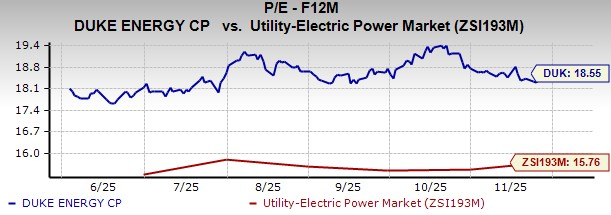
Image Source: Zacks Investment Research
DUK Stock Price Performance
In the past six months, the company’s shares have risen 3.4% compared with the industry’s 14.2% growth.
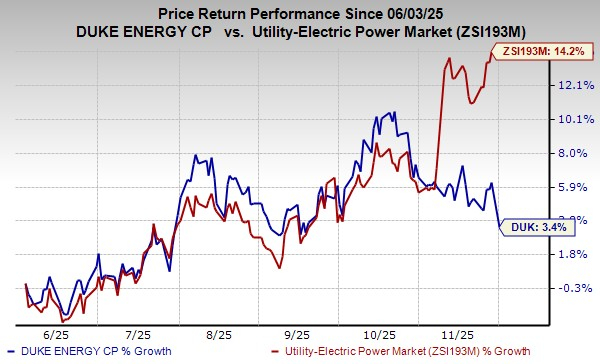
Image Source: Zacks Investment Research
DUK’s Zacks Rank
The company currently has a Zacks Rank #3 (Hold). You can see the complete list of today’s Zacks #1 Rank (Strong Buy) stocks here.
Want the latest recommendations from Zacks Investment Research? Today, you can download 7 Best Stocks for the Next 30 Days. Click to get this free report
NextEra Energy, Inc. (NEE): Free Stock Analysis Report
Southern Company (The) (SO): Free Stock Analysis Report
Duke Energy Corporation (DUK): Free Stock Analysis Report
This article originally published on Zacks Investment Research (zacks.com).
Mentioned In This Article
Latest News
| 5 hours | |
| 6 hours | |
| 7 hours | |
| 7 hours | |
| Oct-14 | |
| Oct-14 | |
| Oct-14 | |
| Oct-13 | |
| Oct-12 | |
| Oct-12 | |
| Oct-12 | |
| Oct-12 | |
| Oct-11 | |
| Oct-10 | |
| Oct-10 |
