Better Artificial Intelligence Stock: D-Wave Quantum vs. Nvidia
Key Points
D-Wave Quantum and Nvidia have introduced technologies that could enable the next phases of the AI revolution.
D-Wave's quantum computers could deliver unprecedented processing power to AI systems.
Nvidia is adapting aspects of its successful GPU strategy to the quantum computing era.
Today's artificial intelligence (AI) powerhouse, Nvidia (NASDAQ: NVDA), achieved success in its field by producing graphics processing units (GPUs), which are parallel processors that are ideally suited to the tasks involved in quickly analyzing mountains of data. The emergence of quantum computers, which can process that data far faster than today's supercomputers, could elevate AI to new heights.
Where to invest $1,000 right now? Our analyst team just revealed what they believe are the 10 best stocks to buy right now. Continue »
In fact, pure-play quantum computing company D-Wave Quantum (NYSE: QBTS) has been touting exactly that. According to its CEO, Dr. Alan Baratz, "Introducing quantum into the AI model training and inference workflow, we think will enable a generation of better models built faster and with much lower energy consumption."
Given the potential of quantum computers, could D-Wave prove to be a better long-term AI stock investment than Nvidia from here?

Image source: Getty Images.
D-Wave Quantum's approach to the AI market
Baratz explained that today's AI "faces a computational challenge due to escalating power needs and costs." He went on to explain how his company's solutions can help.
"Quantum computing's integration with AI and machine learning could offer scalable, energy-efficient solutions to address these issues and potentially offer enhanced AI capabilities," he said.
To encourage organizations to adopt its quantum computers for AI development, D-Wave released a set of software tools this year that plug into its quantum machines. Several customers are already employing D-Wave's quantum computers to boost AI. For example, researchers at the Jülich Supercomputing Centre in Germany purchased its Advantage system earlier this year to complement their AI toolset.
However, D-Wave's offerings are still nascent, and prohibitively expensive for broad adoption. Moreover, the company's hardware employs an approach called annealing quantum computing, which is more adept than rival quantum computing systems at handling specific types of problems, but which is not ideal for general computing tasks. That limits its usefulness.
In the third quarter, D-Wave booked revenue of $3.7 million, which was far too meager to cover its operating costs of $30.4 million. This resulted in a Q3 operating loss of $27.7 million, up from $20.6 million in 2024.
Given the massive gap between its sales and its operating costs, D-Wave's financial situation could be precarious, but it raised $400 million in an equity offering over the summer. Consequently, at the end of Q3, the company's cash balance stood at $836.2 million, the highest total in its history.
Nvidia's quantum computing strategy
Nvidia invented the GPU, but today, it isn't pursuing its own quantum computer chips to compete with the likes of D-Wave. Instead, its strategy to maintain its AI leadership ahead of the rise of quantum computers is based on a different part of the playbook that unlocked its current success.
The company's Compute Unified Device Architecture (CUDA) software platform was a key factor that allowed it to keep a tight grip on the market for advanced semiconductor chips, even as rivals tried to compete. CUDA allows Nvidia's customers to easily customize their GPUs for their specific business needs -- but it's only compatible with Nvidia hardware. Companies that start building systems on that foundation are thus encouraged to stick with it.
More recently, Nvidia created a version of CUDA for quantum computing: CUDA-Q. This platform facilitates the integration of GPUs and quantum computer chips into hybrid systems.
This hybrid structure is a necessity because quantum machines are far more delicate and prone to calculation errors than conventional computers. Coupling the two technologies allows the quantum hardware to execute the extremely complex calculations it's designed to handle, while the conventional computer systems manage error correction and other aspects of processing where that technology remains the superior choice.
D-Wave also accounts for hybrid workflows, but Nvidia's strategy differs in that it aims to play a supporting role in the quantum computing space. Tools such as CUDA-Q can do for hybrid systems what the original CUDA did for GPUs.
To further strengthen its offerings, Nvidia introduced its NVQLink platform in October, which physically connects GPUs to quantum processors and integrates with CUDA-Q. NVQLink has already been adopted by more than a dozen of the world's top scientific computing centers.
Nvidia's track record suggests this strategy can succeed. In its fiscal third quarter, which ended Oct. 26, sales grew by 62% year over year to a record $57 billion.
Picking between D-Wave Quantum and Nvidia stocks
Between D-Wave's strategy of developing potent quantum computers and Nvidia's strategy of enabling such machines to be used more effectively with conventional tech, a few factors make the latter company the better long-term investment.
For starters, D-Wave isn't profitable, while Nvidia delivered operating income of $36 billion in Q3, up 65% over last year. That led to a 67% year-over-year increase in diluted earnings per share to $1.30.
It's also necessary to consider their relative valuations. Because only one is generating profits, the best metric to compare them by is the price-to-sales (P/S) ratio.
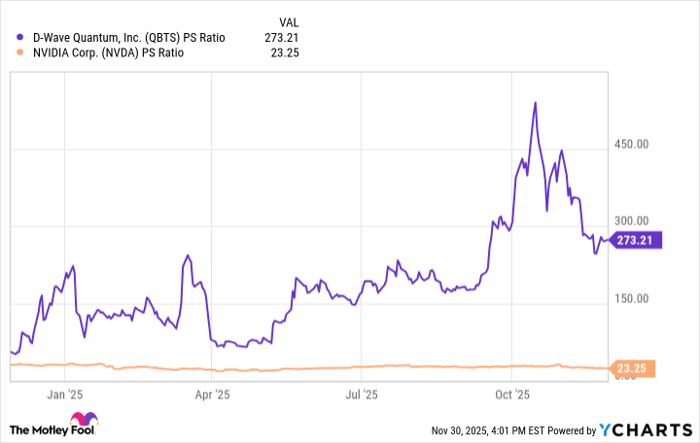
Data by YCharts.
As the chart above shows, D-Wave and Nvidia's P/S multiples weren't all that far apart a year ago, but by last week, the former had ballooned to about 10 times higher than the latter. By any standard, D-Wave shares are expensive. Moreover, considering that the company's operating costs greatly exceed its slim sales, that lofty valuation doesn't look justified.
Nvidia is already an AI juggernaut with excellent revenue growth and healthy financials, and its NVQLink solution is off to a strong start. Throw in its far more reasonable valuation compared to D-Wave, and it's the superior AI stock of these two to invest in for the long haul.
Should you invest $1,000 in D-Wave Quantum right now?
Before you buy stock in D-Wave Quantum, consider this:
The Motley Fool Stock Advisor analyst team just identified what they believe are the 10 best stocks for investors to buy now… and D-Wave Quantum wasn’t one of them. The 10 stocks that made the cut could produce monster returns in the coming years.
Consider when Netflix made this list on December 17, 2004... if you invested $1,000 at the time of our recommendation, you’d have $589,717!* Or when Nvidia made this list on April 15, 2005... if you invested $1,000 at the time of our recommendation, you’d have $1,111,405!*
Now, it’s worth noting Stock Advisor’s total average return is 1,018% — a market-crushing outperformance compared to 194% for the S&P 500. Don’t miss out on the latest top 10 list, available when you join Stock Advisor.
*Stock Advisor returns as of December 1, 2025
Robert Izquierdo has positions in Nvidia. The Motley Fool has positions in and recommends Nvidia. The Motley Fool has a disclosure policy.
Mentioned In This Article
Latest News
| 1 hour | |
| 1 hour | |
| 1 hour | |
| 1 hour | |
| 2 hours | |
| 3 hours | |
| 3 hours | |
| 3 hours | |
| 4 hours | |
| 4 hours | |
| 4 hours | |
| 4 hours | |
| 5 hours | |
| 5 hours | |
| 6 hours |
