|
|
|

|
|||||
|
|
|
Tesla effectively forced the major automakers to take electric vehicles seriously.
Tesla began with high-end vehicles, and then transitioned to the mass market.
However, this electric vehicle start-up is set to launch a mass-market truck in 2026.
The electric vehicle (EV) sector is very different today than it was when Tesla (NASDAQ: TSLA) sold its first EV. That high-end automobile effectively helped to prove that EVs could compete with internal combustion engine vehicles. Now, thanks to Tesla, just about every major auto company is making EVs.
There's still one pure-play EV maker seeking to prove that there's room for more competition in the automotive sector. Here's why, for more aggressive investors, this EV start-up could be a no-brainer buy if you have $500 to invest.
Where to invest $1,000 right now? Our analyst team just revealed what they believe are the 10 best stocks to buy right now, when you join Stock Advisor. See the stocks »
As the first company to mass-produce electric vehicles, Tesla established a business model that others could follow.
Step one is to produce a high-end model. Step two is to ramp up production of the high-end model. And step three is to fine-tune production to improve profitability. Finally, step four is to bring out a mass-market model. There are more steps, but that last one is the one that Rivian (NASDAQ: RIVN) is currently working on.
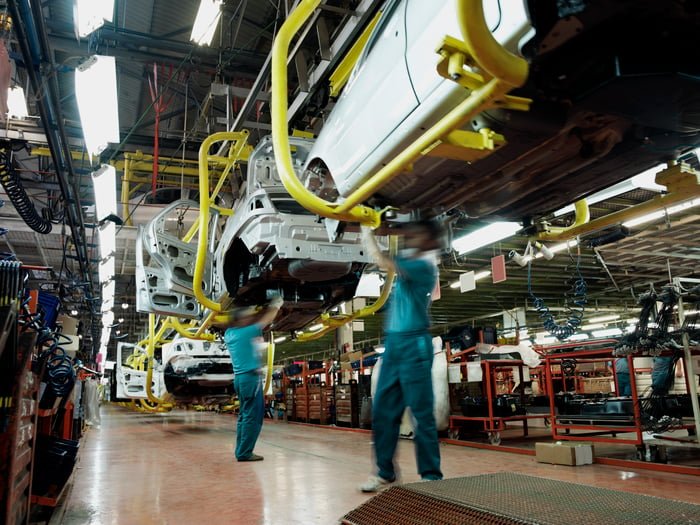
Image source: Getty Images.
Indeed, Rivian has successfully pulled off the first three steps. Its electric trucks are award-winning. Its technology is attractive enough that Amazon was an early customer, and Volkswagen is investing heavily in the company. Rivian was even able to produce a gross profit.
Achieving a gross profit requires some discussion, as it is both important and merely a step on the way toward sustainable profitability. Essentially, a gross profit means that Rivian generated more revenue from selling cars than it cost to produce those cars. There are other important costs further down the income statement that keep it in the red -- specifically, research and development and sales, general, and administrative costs. Those aren't optional expenses.
This is where step four comes into play, as Rivian continues to invest in its business to bring out the R2 in 2026. That's the mass-market version of its truck. The goal, like it was for Tesla, is to sell more EVs over which to spread the company's costs.
The auto industry is highly competitive and capital-intensive, as well as hard for a company to break into. Tesla leveraged new technology to achieve this, and that's what Rivian is also trying to do. It appears increasingly likely that Rivian will be able to follow Tesla's lead as Rivian continues to hit key milestones.
And yet, when you step back a few paces, it remains a money-losing start-up. It is only appropriate for more aggressive investors.
The company's success to date, however, bodes well for its future. The big key is that Rivian's balance sheet had $4.8 billion of cash and $2.7 billion of short-term investments on it at the midpoint of 2025. It is almost certain to get the R2 to market, allowing the company to hit yet another key goal.
The bet you are making by buying it today is that the R2 will be well-received by consumers. Given the strong reception to its high-end models, that seems like a reasonable bet to make. A $500 investment will net you around 30 shares.
The problem is that it will likely take a year or so following the R2 launch to get a real picture of how well the new model is doing. So Rivian is a long-term investment, not one that will play out over a few months. However, if you are an aggressive growth investor, Rivian's ability to follow Tesla's path suggests the business has a strong opportunity for success.
Rivian isn't the only company trying to follow Tesla into the auto sector. There are, for example, a couple of Chinese EV makers that now compete directly and effectively with Tesla. However, many upstart EV companies have fallen by the wayside. Even the ones that still remain aren't sure things, noting that Lucid (NASDAQ: LCID) is still just trying to achieve the production levels that Rivian has hit.
In other words, Rivian stands out for its success. And if it can continue to hit its goals, there could be material growth ahead for the business.
Before you buy stock in Rivian Automotive, consider this:
The Motley Fool Stock Advisor analyst team just identified what they believe are the 10 best stocks for investors to buy now… and Rivian Automotive wasn’t one of them. The 10 stocks that made the cut could produce monster returns in the coming years.
Consider when Netflix made this list on December 17, 2004... if you invested $1,000 at the time of our recommendation, you’d have $589,717!* Or when Nvidia made this list on April 15, 2005... if you invested $1,000 at the time of our recommendation, you’d have $1,111,405!*
Now, it’s worth noting Stock Advisor’s total average return is 1,018% — a market-crushing outperformance compared to 194% for the S&P 500. Don’t miss out on the latest top 10 list, available when you join Stock Advisor.
*Stock Advisor returns as of December 1, 2025
Reuben Gregg Brewer has no position in any of the stocks mentioned. The Motley Fool has positions in and recommends Amazon and Tesla. The Motley Fool recommends Volkswagen Ag. The Motley Fool has a disclosure policy.
| 45 min | |
| 2 hours | |
| 2 hours | |
| 3 hours | |
| 4 hours | |
| 4 hours | |
| 4 hours | |
| 4 hours | |
| 4 hours | |
| 6 hours | |
| 6 hours | |
| 6 hours | |
| 6 hours | |
| 7 hours | |
| 9 hours |

Join thousands of traders who make more informed decisions with our premium features. Real-time quotes, advanced visualizations, backtesting, and much more.
Learn more about FINVIZ*Elite