|
|
|

|
|||||
|
|
|
Shares of GitLab Inc. (NASDAQ: GTLB) are down nearly 13.5% the day after the company delivered its fiscal year 2026 third-quarter earnings report.
The results were solid. In fact, revenue growth of 25% kept the company’s perfect streak of reporting quarterly revenue growth of at least 25% in every quarter since its initial public offering (IPO) in 2021. The report also featured an 89% non-GAAP gross margin, 18% non-GAAP operating margin, and a 119% net retention rate, highlighting sustained strength in GitLab's core metrics.
So why is the market reacting so negatively? The answer may be due, in part, to Microsoft Corporation (NASDAQ: MSFT). News broke that Microsoft is reportedly scaling back artificial intelligence (AI) offerings after the sales staff fell short of targets in the company’s fiscal year, which ended in June. The concern is that AI features and platforms aren’t converting into meaningful revenue growth as quickly as expected.
This could be why analysts became hyper-focused on GitLab’s guidance, which wasn’t bad, but is making investors hesitant to move the stock out of the downtrend it has been in since February.
Gitlab's Q3 results should help reduce concerns that the introduction of AI tools would hurt the company’s revenue as it moves away from its developer-heavy seat model toward a hybrid approach. Its strong cRPO (current remaining performance obligation) and RPO (remaining performance obligation) growth also shows that the company is holding its own, even as it faces pressure from AI-native startups.
The issue is that GitLab, like many tech stocks, faced concerns about potentially weak AI monetization before the report. Unfortunately, the results, along with Microsoft’s announcement, gave investors a reason to question expectations and the interpretation of AI demand.
In recent quarters, GitLab has released its AI-powered DevSecOps platform. This has raised the bar on what analysts expect in terms of accelerated AI-driven upsells, rapid AI feature adoption, measurable seat expansion, and clear pricing uplift from AI integration.
Unfortunately, GitLab’s revenue guidance of between $946 million and $947 million for its fiscal year 2026 implies steady growth, but not the AI premium that analysts want.
The Microsoft announcement then makes GitLab guilty by association. It’s too early to draw firm conclusions from the report. However, it could suggest that companies are still in proof-of-concept (POC) mode. That means they’re experimenting with AI, but may not be ready for large-scale paid adoption.
This comes at a time when AI budgets are lumpy and tied to ROI metrics that are still unclear. The takeaway may be that if Microsoft can’t hit its AI sales targets, then smaller AI-platform vendors will likely face similar adoption headwinds.
Analysts have been quick to chime in on GitLab’s report, and their response isn’t encouraging.
GitLab analyst forecasts on MarketBeat show four analysts have lowered their price targets.
Only one of those is above the consensus price target of $54.75, and that was only a $55 target.
This cautious sentiment suggests investors and analysts are tempering expectations amid AI-related uncertainty.
It also reflects broader skepticism about GitLab’s ability to achieve the kind of accelerated growth typically associated with high-performing AI platforms.
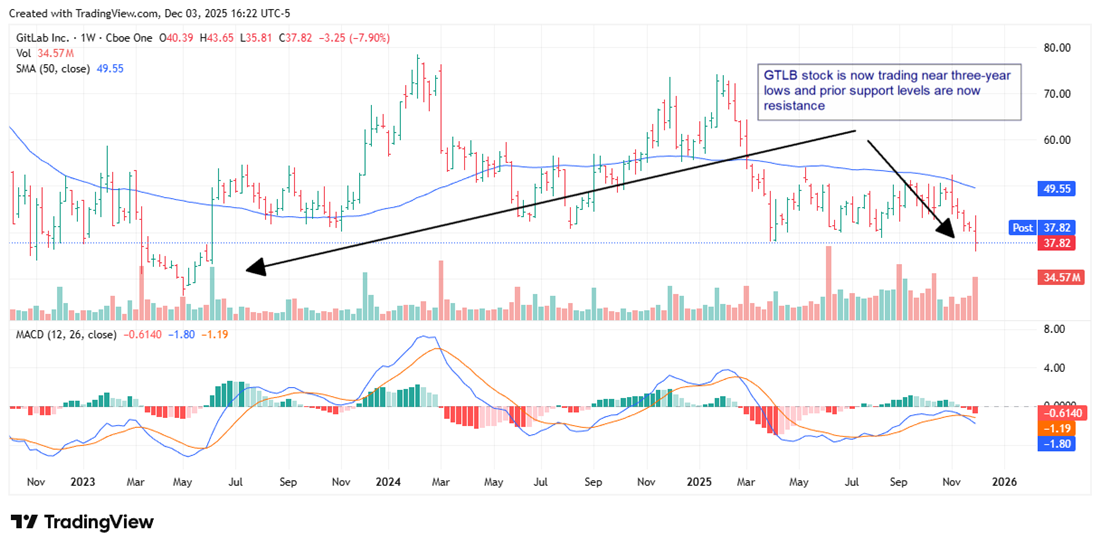
GitLab’s weekly chart has shifted decisively bearish, with the share price sliding into the high‑30s and losing its multi‑month trading range in the low‑to‑mid 40s. The stock now trades well below its declining 50‑week moving average near the upper‑40s, turning that level into firm overhead resistance rather than support.
Momentum indicators confirm the downtrend. The weekly MACD sits below the zero line and its signal, with no clear bullish crossover yet, pointing to persistent negative momentum despite brief pauses in selling. Recent downside candles have appeared on heavier‑than‑normal volume, signaling institutional distribution rather than routine profit‑taking.
Until GitLab can base in the mid‑30s and reclaim the low‑40s on strong volume with improving MACD, rallies are best viewed as counter‑trend bounces within a broader decline rather than the start of a durable uptrend.
Before you make your next trade, you'll want to hear this.
MarketBeat keeps track of Wall Street's top-rated and best performing research analysts and the stocks they recommend to their clients on a daily basis.
Our team has identified the five stocks that top analysts are quietly whispering to their clients to buy now before the broader market catches on... and none of the big name stocks were on the list.
They believe these five stocks are the five best companies for investors to buy now...
The article "Strong Quarter, Weak Reaction: Why GitLab Shares Dropped" first appeared on MarketBeat.
| 4 hours | |
| 4 hours | |
| 4 hours | |
| 5 hours | |
| 5 hours | |
| 7 hours | |
| 9 hours | |
| 9 hours | |
| 10 hours | |
| 11 hours | |
| 11 hours | |
| 11 hours | |
| 11 hours | |
| 12 hours | |
| 12 hours |

Join thousands of traders who make more informed decisions with our premium features. Real-time quotes, advanced visualizations, alerts, and much more.
Learn more about Finviz Elite