Why Netflix Still Stands Out in a Competitive Streaming Market
Key Points
Netflix was the chief pioneer of the streaming video industry.
It has succeeded in content development and built a global presence.
The company's strategy was expensive, but it eventually led to positive free cash flows.
On the surface, the continued success of Netflix (NASDAQ: NFLX) might seem surprising.
Although it pioneered the streaming industry, its success spawned numerous competitors. It now must contend against content giants like Google-parent Alphabet, Disney, and Amazon, among an array of legacy media companies and others with extensive content libraries.
Where to invest $1,000 right now? Our analyst team just revealed what they believe are the 10 best stocks to buy right now, when you join Stock Advisor. See the stocks »
Despite this fact, it has not lost its edge, and three reasons explain why.
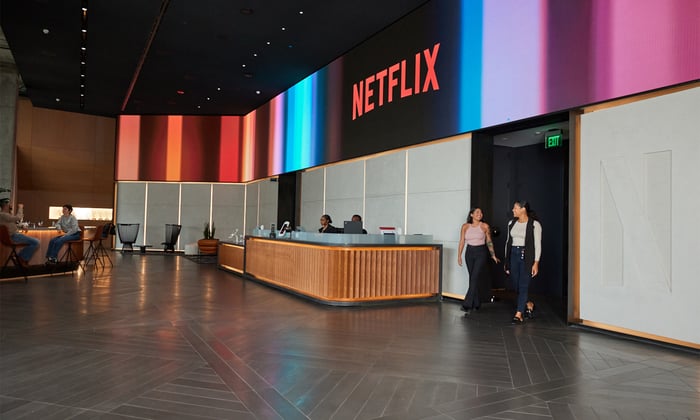
Image source: Netflix.
1. Its first-mover advantage
Netflix was not the first company to offer video streaming. In fact, it built its brand renting DVDs by mail.
Through that enterprise, it developed a significant following and brand recognition, which facilitated the transition to streaming that began in 2007. By that time, improved technology addressed the content-delivery issues that had stymied prior attempts to build streaming platforms. Consequently, Netflix's streaming efforts proved successful, so much so that they eventually made its DVD rental businesses obsolete and inspired millions to discontinue their cable TV subscriptions.
Its huge subscriber base gave it another key advantage: a massive treasure trove of viewer data. Today, this helps it produce more appealing content, and now that it has waded into the ad business, it can use that data to more effectively get marketers' ads in front of their desired audiences.
2. Its content development and global reach
As competing streaming services emerged, one way Netflix worked to differentiate itself was by developing proprietary content. Instead of relying on acquiring the streaming rights to media owned by companies like Disney, Paramount Skydance, or Comcast's Universal, it kept subscribers on the site with its own movies and television shows.
Admittedly, this demanded significant recurring capital expenditures. Nonetheless, the decision was a success, and shows like House of Cards, Stranger Things, and Cobra Kai cemented the service's popularity.
This also made Netflix a Hollywood studio in its own right. That allowed it to keep competing effectively with the likes of Disney and Paramount as those companies launched their own streaming services.
Netflix also began expanding outside of the U.S. in 2010, eventually reaching over 190 countries. Over time, its studio also began developing an array of content specifically for the audiences in those international markets -- such as Spanish thriller The Crystal Cuckoo and the South Korean dystopian drama Squid Game.
3. Financial success
All of this growth did not come without some challenges. Netflix's free cash flows were negative throughout the 2010s due to its massive content development expenses, and the free cash flow bump it experienced in 2020 amid the early stages of the pandemic proved temporary. But it responded to that adversity by making a move its leadership had long resisted -- adding an advertising-supported tier.
This move into selling commercials has proved successful. Free cash flow has been consistently positive and growing since 2023. Over the past four reported quarters, its free cash flow was nearly $9.0 billion, well above the $7.1 billion reported in the previous 12-month period.
Moreover, since the stock hit a cyclical bottom during the tech sector slump of 2022, it has risen by more than 530%. That increase led management to engage in a 10-for-1 stock split last month. Although such financial maneuvers have no direct impact on a company's value, splits do bode well for their future success and can help attract even more investor interest.
Can the boom continue?
Ultimately, Netflix appears on track to maintain its competitive advantages.
While dozens of streaming services offer programming today, Netflix now owns a studio through which it can create large volumes of new content to keep viewers engaged. Also, the massive amounts of data it owns have helped make it a major video ad platform.
Additionally, it operates in nearly every market in the world, including many where it has less streaming competition, and its ability to develop content in multiple languages should keep it popular in many local markets.
With those successes, challenges remain. Revenue growth is slowing: Analysts forecast 16% revenue growth this year and 13% in 2026.
Also, investors are now paying 43 times forward earnings for Netflix, which might amount to a modest premium. However, as long as its free cash flows continue to grow at a rapid pace, Netflix stock should stay on a long-term uptrend.
Should you invest $1,000 in Netflix right now?
Before you buy stock in Netflix, consider this:
The Motley Fool Stock Advisor analyst team just identified what they believe are the 10 best stocks for investors to buy now… and Netflix wasn’t one of them. The 10 stocks that made the cut could produce monster returns in the coming years.
Consider when Netflix made this list on December 17, 2004... if you invested $1,000 at the time of our recommendation, you’d have $560,649!* Or when Nvidia made this list on April 15, 2005... if you invested $1,000 at the time of our recommendation, you’d have $1,100,862!*
Now, it’s worth noting Stock Advisor’s total average return is 998% — a market-crushing outperformance compared to 194% for the S&P 500. Don’t miss out on the latest top 10 list, available when you join Stock Advisor.
*Stock Advisor returns as of December 1, 2025
Will Healy has no position in any of the stocks mentioned. The Motley Fool has positions in and recommends Alphabet, Netflix, and Walt Disney. The Motley Fool recommends Comcast. The Motley Fool has a disclosure policy.
Mentioned In This Article
Latest News
| Oct-25 | |
| Oct-23 | |
| Oct-23 | |
| Oct-22 | |
| Oct-22 | |
| Oct-22 | |
| Oct-22 | |
| Oct-21 |
He Self-Funded a $45-Million Nicolas Cage Movie. Then It Was Stolen.
NFLX -5.31%
The Wall Street Journal
|
| Oct-21 | |
| Oct-21 | |
| Oct-21 | |
| Oct-21 | |
| Oct-21 | |
| Oct-21 | |
| Oct-21 |
