|
|
|

|
|||||
|
|
|

Pfizer has followed the market’s trajectory closely, rising in tandem with the S&P 500 over the past six months. The stock has climbed by 11% to $25.67 per share while the index has gained 15.3%.
Is there a buying opportunity in Pfizer, or does it present a risk to your portfolio? See what our analysts have to say in our full research report, it’s free for active Edge members.
We're sitting this one out for now. Here are three reasons there are better opportunities than PFE and a stock we'd rather own.
In addition to reported revenue, organic revenue is a useful data point for analyzing Branded Pharmaceuticals companies. This metric gives visibility into Pfizer’s core business because it excludes one-time events such as mergers, acquisitions, and divestitures along with foreign currency fluctuations - non-fundamental factors that can manipulate the income statement.
Over the last two years, Pfizer failed to grow its organic revenue. This performance was underwhelming and implies it may need to improve its products, pricing, or go-to-market strategy. It also suggests Pfizer might have to lean into acquisitions to accelerate growth, which isn’t ideal because M&A can be expensive and risky (integrations often disrupt focus).

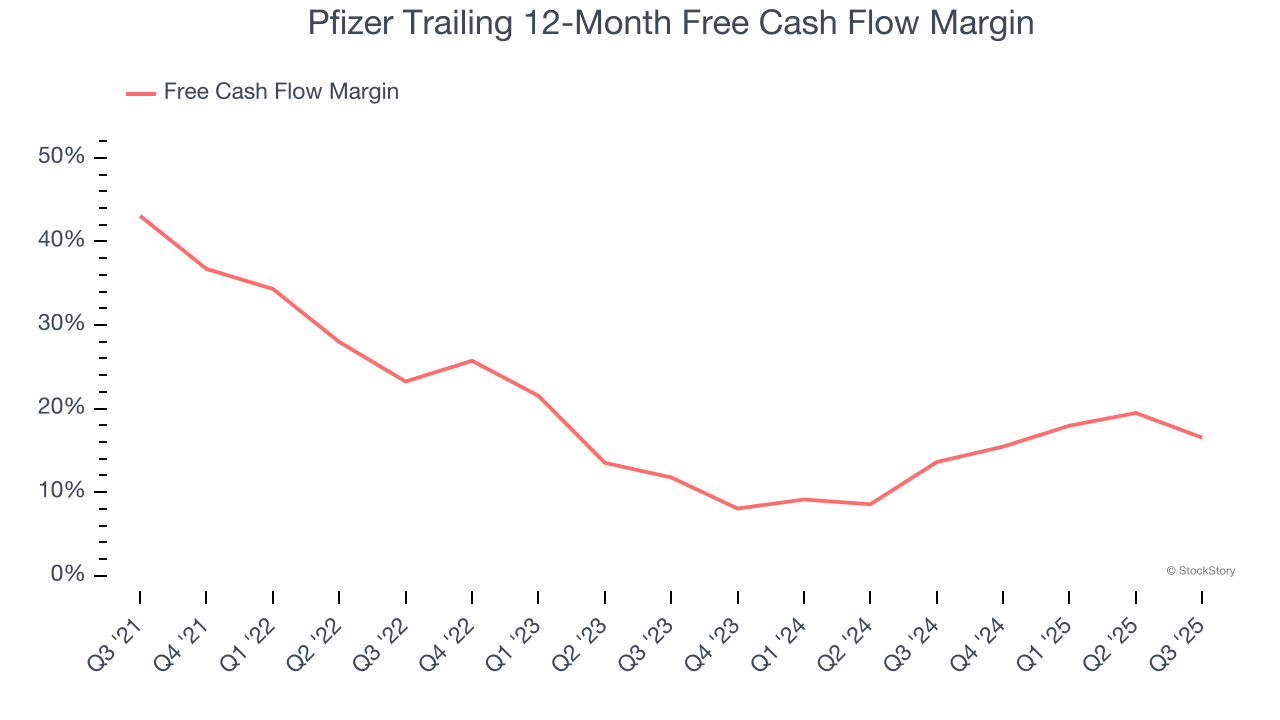
If you’ve followed StockStory for a while, you know we emphasize free cash flow. Why, you ask? We believe that in the end, cash is king, and you can’t use accounting profits to pay the bills.
As you can see below, Pfizer’s margin dropped by 26.5 percentage points over the last five years. It may have ticked higher more recently, but shareholders are likely hoping for its margin to at least revert to its historical level. If the longer-term trend returns, it could signal increasing investment needs and capital intensity. Pfizer’s free cash flow margin for the trailing 12 months was 16.5%.
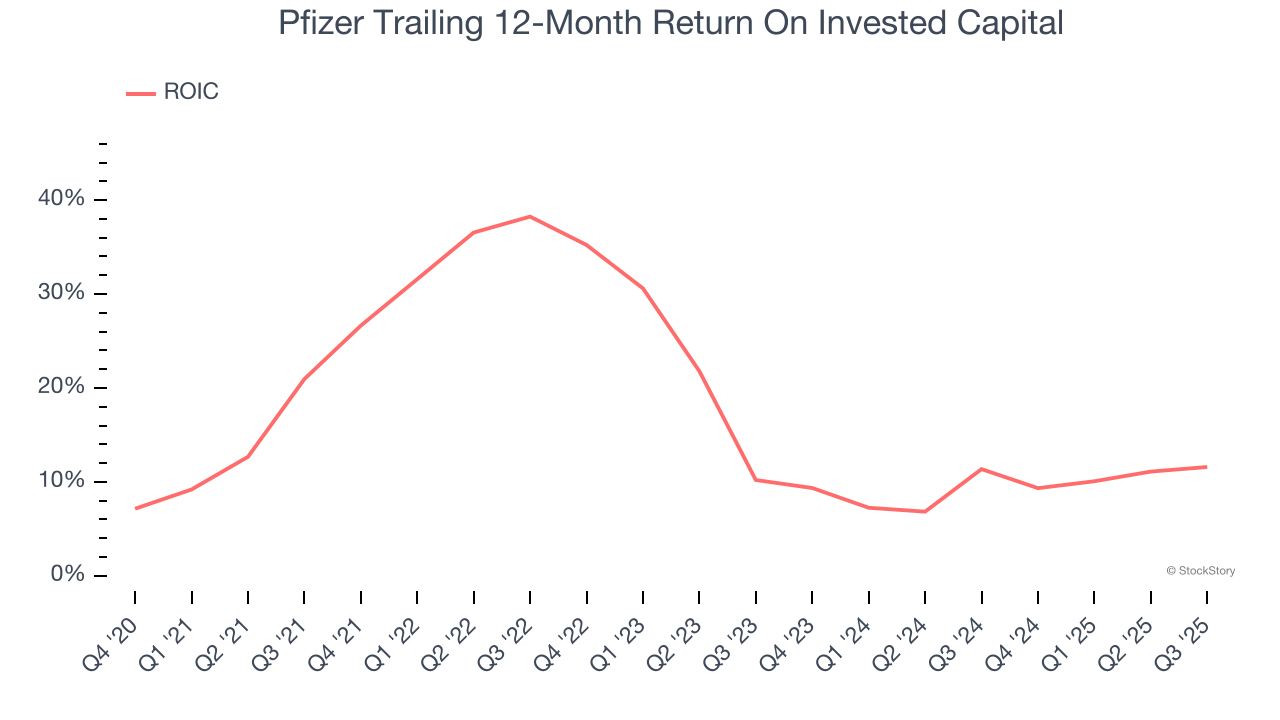
ROIC, or return on invested capital, is a metric showing how much operating profit a company generates relative to the money it has raised (debt and equity).
We like to invest in businesses with high returns, but the trend in a company’s ROIC is what often surprises the market and moves the stock price. Over the last few years, Pfizer’s ROIC has unfortunately decreased significantly. We like what management has done in the past, but its declining returns are perhaps a symptom of fewer profitable growth opportunities.
Pfizer’s business quality ultimately falls short of our standards. That said, the stock currently trades at 8.6× forward P/E (or $25.67 per share). This valuation multiple is fair, but we don’t have much faith in the company. We're pretty confident there are more exciting stocks to buy at the moment. We’d recommend looking at one of our top digital advertising picks.
The market’s up big this year - but there’s a catch. Just 4 stocks account for half the S&P 500’s entire gain. That kind of concentration makes investors nervous, and for good reason. While everyone piles into the same crowded names, smart investors are hunting quality where no one’s looking - and paying a fraction of the price. Check out the high-quality names we’ve flagged in our Top 9 Market-Beating Stocks. This is a curated list of our High Quality stocks that have generated a market-beating return of 244% over the last five years (as of June 30, 2025).
Stocks that have made our list include now familiar names such as Nvidia (+1,326% between June 2020 and June 2025) as well as under-the-radar businesses like the once-micro-cap company Kadant (+351% five-year return). Find your next big winner with StockStory today.
StockStory is growing and hiring equity analyst and marketing roles. Are you a 0 to 1 builder passionate about the markets and AI? See the open roles here.
| 8 hours | |
| Apr-22 | |
| Apr-22 | |
| Apr-21 | |
| Apr-21 | |
| Apr-21 |
Pfizer and Astellas secure FDA priority review for Padcev MIBC combo therapy
PFE
Pharmaceutical Business Review
|
| Apr-20 | |
| Apr-20 | |
| Apr-17 | |
| Apr-13 | |
| Apr-11 | |
| Apr-10 | |
| Apr-09 | |
| Apr-08 | |
| Apr-07 |

Join thousands of traders who make more informed decisions with our premium features. Real-time quotes, advanced visualizations, alerts, and much more.
Learn more about Finviz Elite