Meet the Supercharged Growth Stock That Could Join Apple, Nvidia, Microsoft, and Alphabet in the $2 Trillion Club by 2028
Key Points
Lilly's market cap recently touched $1 trillion.
Forecasts for the GLP-1 market are evolving.
New applications for GLP-1 drugs are emerging.
Apple was the first company in history to reach $1 trillion in market value, a milestone that it hit in August 2018. Just seven years later the maker of iPhones, iPads, and Macs is valued at a stunning $4.2 trillion, while five other technology companies now have market caps that exceed $2 trillion.
This growth shows just how fast companies that are first to embrace a world-changing new technology -- in this case artificial intelligence -- can scale. I predict, however, that another, quite different technology will push the market cap of a company outside the tech sector above the $2 trillion level by 2028.
Where to invest $1,000 right now? Our analyst team just revealed what they believe are the 10 best stocks to buy right now. Continue »
The company I'm referring to is pharmaceutical giant Eli Lilly (NYSE: LLY) and the technology is one that everyone is familiar with by now -- the class of medications called GLP-1 agonists, which have proven extremely effective in lowering blood sugar levels and promoting weight loss.
Eli Lilly now has the world's best-selling drug
In the third quarter, Eli Lilly's GLP-1 medication -- called tirzepatide, which treats both type 2 diabetes and obesity -- became the best-selling drug on the planet. In doing so, it knocked Keytruda, the cancer immunotherapy drug made by Merck, off the throne. Tirzepatide is sold as Mounjaro for treating type 2 diabetes and as Zepbound for weight loss.
Sales of tirzepatide have pushed Eli Lilly's stock 633% higher over the past five years -- the bulk of that rapid rise has come since May 2022 when the company first started selling the drug for treatment of diabetes -- and 38% higher this year. For comparison, the S&P 500 index is up 87% over the past five years and 16% this year.
That growth pushed Eli Lilly's market cap briefly above $1 trillion in November. The stock has settled back a bit since then, to around $953 billion. But I would argue that Eli Lilly's fortunes -- and those of its shareholders -- are very closely tied to the GLP-1 market. In the third quarter, sales of Mounjaro and Zepbound accounted for about $10.1 billion in revenue, or about 57% of the company's total revenue. In its third-quarter filing, Lilly said the two products were largely responsible for its 54% revenue growth.
Forecasts for the GLP-1 market are changing
Forecasts for the GLP-1 market are all over the map at the moment. But one research firm expects it to grow from about $49 billion this year to more than $157 billion by 2035, which represents a compound annual growth rate of 11.1%.
Yet several factors are causing some analysts to rethink those numbers, and even lower them. Chief among those are what analysts call "price erosion." That is, declining prices per unit of medication.
And we've seen some of that up close in recent weeks, as both Lilly and GLP-1 competitor Novo Nordisk in November struck a deal with the Trump administration to dramatically lower the prices they charge Medicare patients for their obesity drugs.
Other markets and ailments are emerging for GLP-1 drugs
But I would argue that kind of thinking is myopic. First, consider that obesity has long been an epidemic of developed countries. Now, however, obesity is proliferating in other nations, including large emerging-market countries like China. Goldman Sachs, which recently dialed back its forecast for the GLP-1 market's growth due to expected price erosion, also increased its forecast for markets outside the U.S. As of 2020, half of all Chinese adults were overweight or obese. The Chinese government projects that will rise to 65% by 2030.
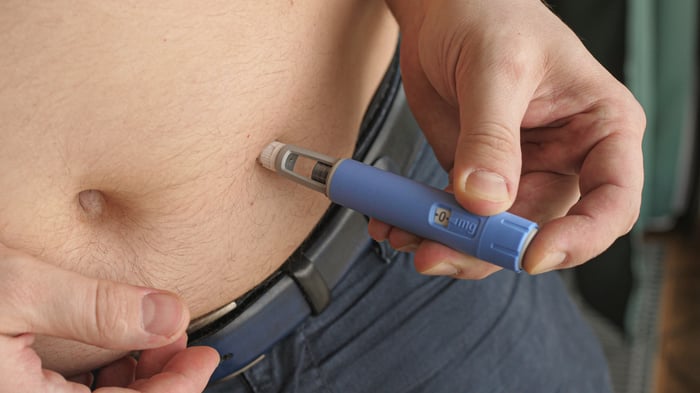
Image source: Getty Images.
In addition, the potential uses for GLP-1 drugs are rapidly increasing in number. The drugs are now being explored as treatments for addiction -- reducing cravings for everything from alcohol to gambling -- as well as osteoarthritis and Alzheimer's disease, among many other ailments. They're even being studied as a potential treatment for obesity in cats and other pets.
If GLP-1 drugs can help with so many diseases and chronic conditions, the market for them is poised to explode much more dramatically than current forecasts allow. Eli Lilly is currently the leader in the GLP-1 drug market, and I see its share price and market cap benefiting from that growth in a big way.
Should you invest $1,000 in Eli Lilly right now?
Before you buy stock in Eli Lilly, consider this:
The Motley Fool Stock Advisor analyst team just identified what they believe are the 10 best stocks for investors to buy now… and Eli Lilly wasn’t one of them. The 10 stocks that made the cut could produce monster returns in the coming years.
Consider when Netflix made this list on December 17, 2004... if you invested $1,000 at the time of our recommendation, you’d have $556,658!* Or when Nvidia made this list on April 15, 2005... if you invested $1,000 at the time of our recommendation, you’d have $1,124,157!*
Now, it’s worth noting Stock Advisor’s total average return is 1,001% — a market-crushing outperformance compared to 194% for the S&P 500. Don’t miss out on the latest top 10 list, available when you join Stock Advisor.
*Stock Advisor returns as of December 1, 2025
Matthew Benjamin has positions in Novo Nordisk. The Motley Fool has positions in and recommends Apple, Goldman Sachs Group, and Merck. The Motley Fool recommends Novo Nordisk. The Motley Fool has a disclosure policy.
Mentioned In This Article
Latest News
| Oct-09 | |
| Oct-09 | |
| Oct-09 | |
| Oct-09 | |
| Oct-08 | |
| Oct-08 | |
| Oct-08 | |
| Oct-08 | |
| Oct-08 | |
| Oct-07 | |
| Oct-07 | |
| Oct-07 | |
| Oct-07 | |
| Oct-06 | |
| Oct-06 |
