2 Top Growth Stocks to Buy in 2026 That Should Be Immune to an AI Stocks Bubble Bursting: Netflix and Casey's General Stores
Some investors are concerned that artificial intelligence (AI) stocks are overvalued and in a bubble similar to the dot-com bubble of the late 1990s, which burst in early 2000. I don't share the belief that all AI stocks are overvalued or in a bubble. That said, it's a good idea for all investors not to have too many of their eggs in one basket -- in this case, the "AI basket."
For investors seeking stocks that are likely to perform well even if AI stocks pull back significantly and cause a market decline, I have two recommendations: streaming giant Netflix (NASDAQ: NFLX) and convenience store owner and operator Casey's General Stores (NASDAQ: CASY).
Where to invest $1,000 right now? Our analyst team just revealed what they believe are the 10 best stocks to buy right now, when you join Stock Advisor. See the stocks »
Casey's seems to fly under the radar of many investors. So hopefully, I'm introducing some investors to a stock that's new to them. Both Netflix and Casey's stocks have performed extremely well over the long term.
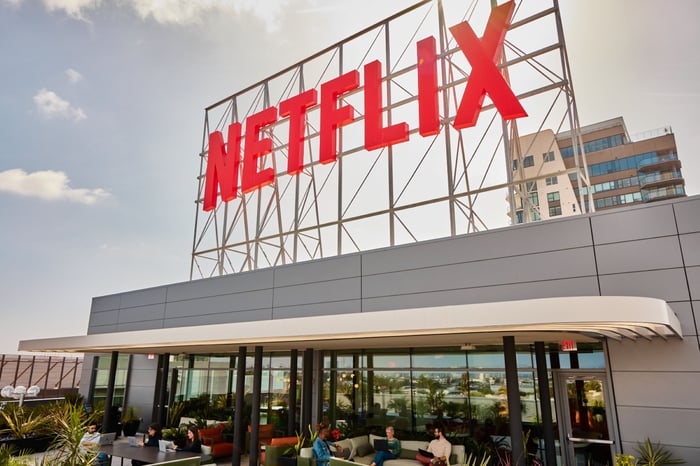
Image source: Netflix.
2 Top non-AI growth stocks to buy
| Company | Market Cap | Forward P/E Ratio | Wall Street's 5-Year Annualized EPS Growth Estimate | Year-to-Date 2025 Stock Return | 10-Year Stock Return |
|---|---|---|---|---|---|
| Netflix | $426 billion | 32.7 | 25.6% | 12.5% | 666% |
| Casey's General Stores | $21.1 billion | 34.8 | 12.6% | 43.7% | 409% |
| S&P 500 index | N/A | N/A | N/A | 18.2% | 291% |
Data sources: Yahoo! Finance and YCharts. Forward P/E = forward price to earnings. EPS = earnings per share. Data as of Friday, Dec. 5, 2025.
Netflix: The video streaming leader
Netflix is the world's largest video streaming service, boasting over 300 million paid memberships worldwide. Its offerings include TV series, films, and games. Moreover, it plans a major expansion in the video podcast space in early 2026 in the United States, following a partnership deal with Spotify announced in October.
On Friday, Netflix announced a $72 billion deal to acquire Warner Bros. Discovery's Warner Bros. TV and film studios, as well as the cable channel HBO and its streaming service, HBO Max. Among other benefits, this deal will bring Warner Bros.' extensive TV and film library, as well as two of the most popular film franchises, Harry Potter and Superman, into Netflix's fold. The deal is expected to close in 12 to 18 months, subject to shareholder and regulatory approvals.
In both good and challenging economic times, people tend to seek entertainment. Many consumers consider a Netflix subscription to be a relatively inexpensive necessity rather than a "want" that they will forgo in tough economic climates.
Indeed, Netflix stock gained a whopping 70.7% during the Great Recession, a deep economic downturn that lasted from December 2007 through May 2009. The S&P 500 index plunged 35.6% during this one-and-a-half-year period.
Netflix has been using AI to enhance its service. However, if demand for AI capabilities were to slow down significantly (which I don't think will happen), Netflix's business should remain unscathed. So, while the company uses AI, as many companies do, it's not a so-called "AI stock," in my opinion.
In the third quarter, Netflix's revenue increased 17% to $11.51 billion, and its earnings per share (EPS) rose 8.7% year over year. Earnings were hurt by an "expense related to an ongoing dispute with Brazilian tax authorities." Free cash flow (FCF) growth remains robust. FCF surged 21% year over year to $2.66 billion.
Consumer engagement remains strong. Netflix achieved its highest quarterly "view share" ever in the U.S. and U.K., which bodes well for its continued robust performance.
For the fourth quarter, Netflix guided for revenue growth of 17% and even better EPS growth of 28% year over year.
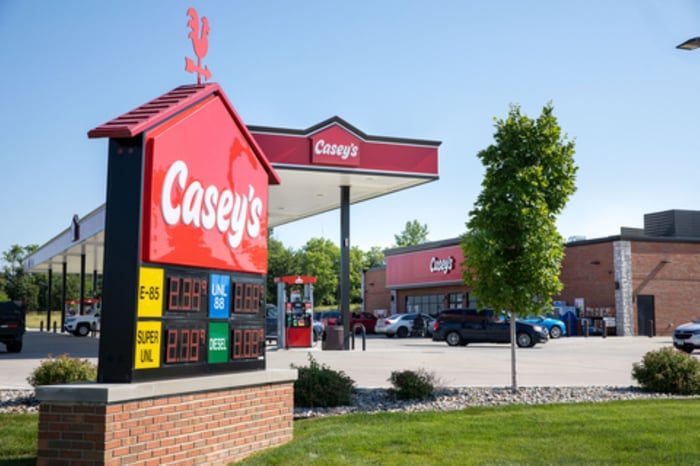
Image source: Casey's General Stores.
Casey's General Stores: A hybrid convenience store/gas station/pizzeria
In my area, the convenience store chain that dominates is Wawa. And numerous times over the years, I have heard many people say about its stores, "Those places are gold mines."
I've never been inside a Casey's General Stores location, but the company's growth and financial statistics suggest that its stores are also relatively lucrative. And the great thing for investors is that they can own a piece of the Casey's "gold mine." That's not the case with Wawa, which is privately held.
Based on store count, Casey's is the third-largest convenience store chain in the U.S., behind 7-Eleven, which is wholly owned by Japanese retailing company Seven & i Holdings, and Circle K, owned by Canada's Alimentation Couche-Tard.
Casey's, based in Iowa, owns and operates 2,895 stores in 19 states across the Midwest and the Southeastern U.S. It was founded in 1968 and has seemingly perfected its recipe for successfully locating its stores -- about two-thirds of which are located in areas with populations of 20,000 or fewer -- and its offerings of products and services.
Casey's offers gasoline, and some locations feature charging stations for electric vehicles (EVs). While it offers freshly prepared food and beverages commonly found in convenience stores (such as coffee, donuts, and sandwiches), it also has a rather unique and popular offering: pizza made from scratch on the premises. Indeed, the company ranks as the fifth-largest pizza chain in the U.S.
This winning recipe also includes the company actively fostering a sense of community in various ways, such as by offering a loyalty program that customers clearly love.
Casey's stock is probably as far removed from an AI company as is possible. A slowdown in AI demand, which would likely spark a decline in AI stocks and the overall market, should have no impact on the company's business and little to no effect on its share price.
Casey's stock pays a dividend, currently yielding 0.4%. While this is a modest dividend, it can make a significant difference over the long term.
In its fiscal Q1 of 2026 (ended July 31, 2025), Casey's revenue increased 11% to $4.57 billion. Gross profit was a slim 13.7% on gas, but a hefty 58% on prepared foods and dispensed beverages. It was a solid 35.9% on grocery and general store merchandise. Net income surged 20% year over year, translating to EPS growth of 20%.
Lastly, Casey's stock held up well during the Great Recession, which lasted from December 2007 through May 2009. It declined just 11.5%, while the S&P 500 plummeted 35.6% during this period.
Should you invest $1,000 in Netflix right now?
Before you buy stock in Netflix, consider this:
The Motley Fool Stock Advisor analyst team just identified what they believe are the 10 best stocks for investors to buy now… and Netflix wasn’t one of them. The 10 stocks that made the cut could produce monster returns in the coming years.
Consider when Netflix made this list on December 17, 2004... if you invested $1,000 at the time of our recommendation, you’d have $540,587!* Or when Nvidia made this list on April 15, 2005... if you invested $1,000 at the time of our recommendation, you’d have $1,118,210!*
Now, it’s worth noting Stock Advisor’s total average return is 991% — a market-crushing outperformance compared to 195% for the S&P 500. Don’t miss out on the latest top 10 list, available when you join Stock Advisor.
*Stock Advisor returns as of December 1, 2025
Beth McKenna has no position in any of the stocks mentioned. The Motley Fool has positions in and recommends Alimentation Couche-Tard, Netflix, Spotify Technology, and Warner Bros. Discovery. The Motley Fool recommends Casey's General Stores. The Motley Fool has a disclosure policy.
Mentioned In This Article
Latest News
| 18 hours | |
| Oct-09 | |
| Oct-09 | |
| Oct-09 | |
| Oct-09 | |
| Oct-09 | |
| Oct-09 | |
| Oct-09 | |
| Oct-09 | |
| Oct-09 | |
| Oct-08 | |
| Oct-08 | |
| Oct-08 | |
| Oct-07 | |
| Oct-06 |
