2 Seemingly Unstoppable Artificial Intelligence (AI) Stocks That Can Plunge Up to 96% in 2026, According to Select Wall Street Analysts
Key Points
Artificial intelligence (AI) represents a leap forward for corporate America that's on par with what the proliferation of the internet did for businesses.
A unique AI-data mining specialist, which has rallied almost 2,700% since the beginning of 2023, is expected to plummet 72% in the new year.
Meanwhile, a North American industrial goliath that's embraced AI in its product line could see 96% of its value wiped away if the prognostication of one analyst proves accurate.
Over the last three years, no trend has captivated the attention and capital of investors quite like the evolution of artificial intelligence (AI). Empowering software and systems with the capabilities to make split-second decisions and to potentially learn new tasks is a game changer for most industries. It's why analysts believe this technology can make waves comparable to what the proliferation of the internet did for businesses worldwide.
This optimism is widely reflected in the ratings and price targets issued by Wall Street analysts and their firms. However, bullishness isn't universal when discussing the stock market's most prominent and widely owned AI stocks.
Where to invest $1,000 right now? Our analyst team just revealed what they believe are the 10 best stocks to buy right now. Continue »
According to select Wall Street analysts, two of the hottest and seemingly unstoppable AI stocks can plunge by up to 96% in 2026.

Image source: Getty Images.
Palantir Technologies: Implied downside of 72%
The first top-performing AI stock that could be clobbered in the new year, based on the projections of one Wall Street analyst, is data mining specialist Palantir Technologies (NASDAQ: PLTR).
Shares of Palantir have soared by close to 2,700% since the beginning of 2023, which makes it one of Wall Street's highest-flying AI stocks. This supercharged return has been fueled by its sustainable moat. Neither of the company's two core AI- and machine learning-driven operating platforms, Gotham and Foundry, has competitors (at scale) that can siphon away its customers.
Gotham has been Palantir's bread and butter for years. This segment supports the U.S. federal government and its allies in planning and overseeing military missions. Palantir often secures multiyear contracts with the U.S. government, leading to highly predictable profits and operating cash flow.
In spite of this sustainable moat, RBC Capital analyst and longtime Palantir bear Rishi Jaluria believes shares of the company can plummet to $50 in 2026. Based on its closing price of nearly $178 per share on Dec. 4, this would imply downside potential of up to 72% in the new year. For what it's worth, Jaluria has raised his price target for Palantir on several occasions in 2025.
In previous research notes, Jaluria has suggested that the required personalization of its Foundry platform, which helps businesses make sense of their data and streamline operations, will make scaling the segment difficult. But above all other potential headwinds, RBC's analyst has homed in on Palantir's otherworldly valuation.
While there are many ways to value stocks, the one that tends to be the most consistent and revealing for next-big-thing trends is the price-to-sales (P/S) ratio. Before the bursting of the dot-com bubble, numerous companies leading the internet revolution peaked at P/S ratios in the neighborhood of 30 to 40. This has served as a common threshold for identifying stock market bubbles.
As of Dec. 4, Palantir stock was valued at a trailing-12-month P/S ratio of 117! Even with the company modestly increasing its full-year sales guidance on several occasions in 2025, no earnings beat would have been enough to justify such an aggressive valuation multiple. Palantir stock could plunge 50% and would still be well above the line in the sand denoting a bubble.
Palantir is also contending with historical precedent. Every game-changing technology over the last 30 years has navigated its way through a bubble-bursting event. These bubbles are triggered by investors overestimating the adoption rates, utility, and optimization of new technologies. If an AI bubble does form and burst in 2026, Palantir's lofty valuation would undoubtedly make it a target.
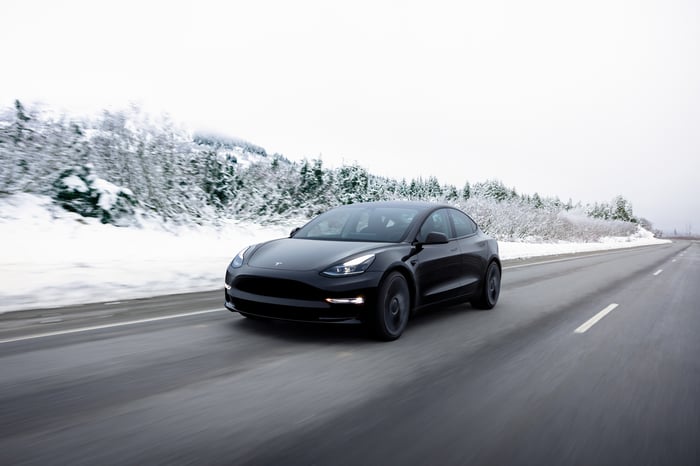
Image source: Tesla.
Tesla: Implied downside of 96%
However, Palantir's expected decline in the new year pales in comparison to what another analyst believes could happen to electric-vehicle (EV) maker Tesla (NASDAQ: TSLA).
Most investors are familiar with Tesla due to its first-mover advantage in the automotive arena. It's North America's leading EV manufacturer, having delivered close to 1.8 million EVs in back-to-back years. CEO Elon Musk's company has also been profitable, based on generally accepted accounting principles (GAAP), in each of the last five years. No other pure-play EV companies can say the same.
Furthermore, under the leadership of Musk, Tesla is expanding its scope well beyond EVs. It has a rapidly growing energy generation and storage segment, along with ambitions of producing humanoid robots (known as Optimus) that can be used for repetitive tasks. The full self-driving (FSD) software used in Tesla's EVs is also being used for perception and decision-making with Optimus.
But none of these factors apparently matter to Gordon Johnson, founder and analyst of GLJ Research, who believes shares of Tesla will plunge 96% to just $19.05.
In a research note released this summer, Johnson outlined several reasons he believes Tesla stock is grossly overvalued. In particular, he pointed to Tesla's "structural disadvantages." By this, Johnson meant that Tesla primarily sells lower-margin hardware and not the high-margin software that's driven gains for other members of the "Magnificent Seven."
GLJ Research's founder also points to the lack of existing and expected contributions from FSD and Optimus. The latter doesn't appear to be particularly close to mass production, while the former has been stuck at Level 2 capabilities for more than a decade.
Lastly, Johnson believes Tesla's valuation is unjustifiable in light of its various disadvantages. Whereas most auto stocks trade at a high-single-digit forward price-to-earnings (P/E) multiple, Tesla stock is commanding a forward P/E ratio of 200, despite its full-year sales likely declining in 2025.
Although Gordon Johnson didn't mention it, perhaps the biggest issue with Tesla, from an investment standpoint, is that a majority of Elon Musk's promises go unfulfilled. He's been claiming that Level 5 FSD is "one year away" for the last 11 years, and touted that 1 million robotaxis would be on public roadways by the end of 2020. Neither of these visions has come to fruition.
If tangible results were separated from unsubstantiated hype, Tesla shares would deflate in a big way. While a 96% drop likely isn't in the cards, Tesla could easily lose 60% of its value and still sport an unreasonable valuation.
Should you invest $1,000 in Palantir Technologies right now?
Before you buy stock in Palantir Technologies, consider this:
The Motley Fool Stock Advisor analyst team just identified what they believe are the 10 best stocks for investors to buy now… and Palantir Technologies wasn’t one of them. The 10 stocks that made the cut could produce monster returns in the coming years.
Consider when Netflix made this list on December 17, 2004... if you invested $1,000 at the time of our recommendation, you’d have $540,587!* Or when Nvidia made this list on April 15, 2005... if you invested $1,000 at the time of our recommendation, you’d have $1,118,210!*
Now, it’s worth noting Stock Advisor’s total average return is 991% — a market-crushing outperformance compared to 195% for the S&P 500. Don’t miss out on the latest top 10 list, available when you join Stock Advisor.
*Stock Advisor returns as of December 1, 2025
Sean Williams has no position in any of the stocks mentioned. The Motley Fool has positions in and recommends Palantir Technologies and Tesla. The Motley Fool has a disclosure policy.
Mentioned In This Article
Latest News
| 7 hours | |
| Oct-10 | |
| Oct-10 | |
| Oct-10 | |
| Oct-09 | |
| Oct-09 | |
| Oct-09 | |
| Oct-09 | |
| Oct-09 | |
| Oct-09 | |
| Oct-09 |
Tesla's China Retail Sales Fall 9% Even as Shanghai Exports Surge 58%
TSLA
Benzinga Prediction Markets
|
| Oct-09 | |
| Oct-09 | |
| Oct-09 | |
| Oct-09 |
