Buy, Hold or Sell UUUU Stock After Its Massive 176% Six-Month Run?
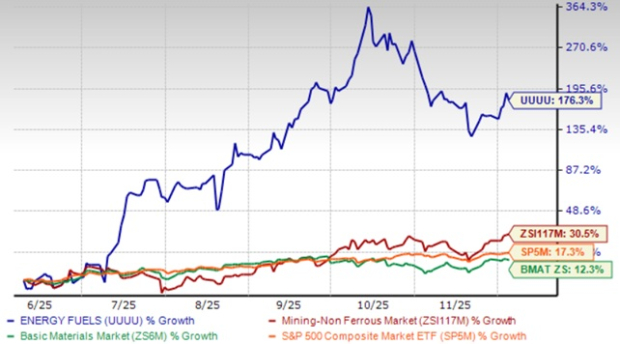
Energy Fuels UUUU has surged 176% in the past six months, outperforming the non-ferrous mining industry’s 30.5% growth, the Zacks Basic Materials sector’s 12.3% gain and the S&P 500’s 17.3% climb.
UUUU Stock’s Performance vs. Industry, Sector & S&P 500
The stock has also beaten peers like Centrus Energy LEU, Uranium Energy UEC and Cameco CCJ, as shown in the chart below.
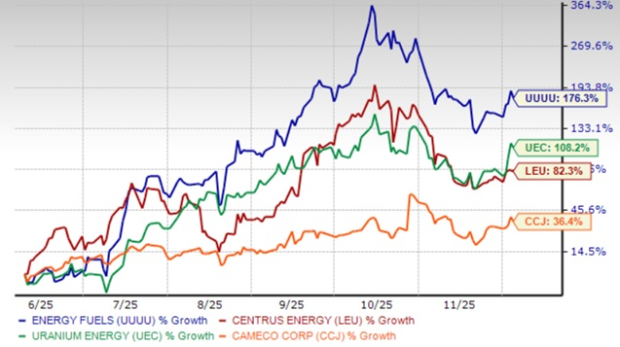
Before investors chase this steep rally, it’s important to examine what is driving the momentum, the sustainability of UUUU’s growth and the associated risks.
Energy Fuels’ Q3 Revenues Jump, Losses Persist
Third-quarter 2025 total revenues came in at $17.7 million, soaring 337.6% year over year, driven by higher uranium sales volumes, which offset the decline in prices. The company sold 240,000 pounds of uranium (including a spot sale of 100,000 pounds) at an average $72.38 per pound, generating uranium revenues of $17.37 million. The company had sold 50,000 pounds of uranium in the previous year quarter, generating $4 million in uranium revenues.
Costs applicable to revenues surged 592% to $12.78 million due to higher uranium sold at elevated per-pound costs. Exploration, development and processing expenses also climbed, along with standby, selling and administrative costs. Despite the revenue jump, these increased expenditures resulted in Energy Fuels reporting a loss of seven cents per share, unchanged from last year’s quarter.
UUUU Posts Solid Uranium Output, Pinyon Plain Stands Out
During the quarter, Energy Fuels mined ore containing approximately 465,000 pounds of uranium from its Pinyon Plain, La Sal and Pandora mines. Pinyon Plain stood out once again, delivering an impressive 1.27% average grade.
The mine’s is set to be the highest-grade uranium deposit mined in U.S. history. With Energy Fuels currently extracting ore from only about 25% of the vertical extent of the target zone, the mine holds considerable exploration upside.
Energy Fuels Issues Optimistic Outlook for 2025 & 2026
UUUU expects to mine 55,000-80,000 tons of ore containing approximately 875,000-1,435,000 pounds of uranium in 2025. It aims to process up to 1 million pounds of uranium this year.
The company expects to sell 160,000 pounds of uranium in the fourth quarter of 2025, 350,000 pounds in 2025 and 620,000-880,000 pounds in 2026, under its current portfolio of long-term uranium sales contracts. These ranges, however, exclude any spot sales the company may make if prices go up.
Energy Fuels expects lower uranium costs starting in the fourth quarter of 2025 as it begins processing low-cost Pinyon Plain ores. Total weighted average cost of goods sold will go down to $23–$30 per pound of uranium, ranking among the lowest costs for mined uranium production in the world.
The company expects to lower the cost of goods sold to approximately $50-$55 per uranium sales for the remaining 2025 sales. The weighted average cost of goods sold is projected to drop to $30-$40 per pound in the first quarter of 2026. These trends are expected to boost gross margins.
UUUU Continues to Advance Rare Earths Ambitions
In August, Energy Fuels produced its first kilogram of dysprosium (Dy) oxide at 99.9% purity, surpassing commercial benchmarks. It expects to deliver the first samples of high-purity terbium (Tb) oxide by the end of this year. UUUU has plans to construct and commission commercial-scale Dy, Tb and potentially samarium (Sm) separation capacity at the White Mesa Mill, which could be operational by the fourth quarter of 2026.
A key milestone came in September, with its high-purity neodymium-praseodymium (NdPr) oxide produced being converted into commercial-scale rare earth permanent magnets (REPMs) by South Korea’s POSCO International Corp. These magnets have met the stringent quality requirements for use in high-temperature drive unit motors that are installed in EVs and hybrid vehicles.
Energy Fuels also received final government approvals for the development of the Donald Project rare earth and critical mineral joint venture in Australia, along with receipt of a conditional Letter of Support from Export Finance Australia.
Energy Fuels’ Balance Sheet Remains Debt-Free
Energy Fuels ended the third quarter with $298.5 million of working capital, including $94 million of cash and cash equivalents, $141.3 million of marketable securities, $12.1 million of trade and other receivables, $74.4 million of inventory, and no debt.
The company, like it’s peer Uranium Energy, has no debt on its balance sheet. Meanwhile Cameco’s debt-to-capital ratio is at 0.13 and Centrus Energy’s at 0.77.
UUUU’s Revenue Volatility Mirrors Uranium Price Swings
Uranium prices have currently dipped to the lowest in two months at around $77 per pound due to an improved supply outlook. Kazatomprom reporting 33% growth rate in exports in the third quarter and a 10% increase in total output seems to have quelled the previous supply fears. Cameco indicating that it might be able to recoup some of the previously projected production shortfall from the McArthur River Mine (due to the development delays) also allayed supply fears.
Energy Fuels’ revenues tend to fluctuate as it typically avoids selling uranium or makes lower sales during price downturns, adding uncertainty to quarterly performance.
UUUU Face Losses, Sees Downward Earnings Estimate Activity
The Zacks Consensus Estimate for Energy Fuels’ 2025 earnings is currently pegged at a loss of 35 cents per share, wider than the loss of 28 cents reported in 2024. The bottom-line estimate for 2026 is also pegged at a loss of six cents per share.
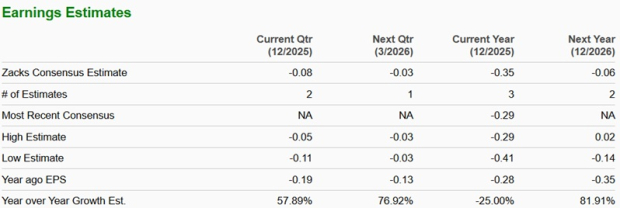
Image Source: Zacks Investment Research
Both the estimates have undergone negative revisions as shown in the chart below.
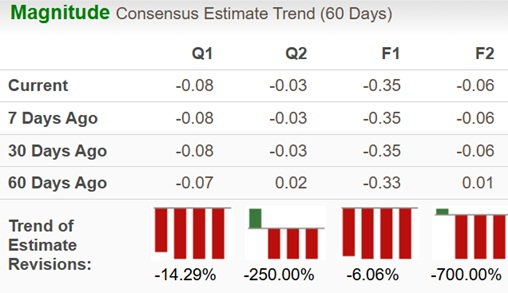
Image Source: Zacks Investment Research
Energy Fuels’ Valuation Looks Stretched
Energy Fuels is trading at a forward price/sales (P/S) of 42.60X, well above the industry average of 3.87X. The company’s Value Score of F suggests that the stock is not so cheap and has a stretched valuation at this moment.
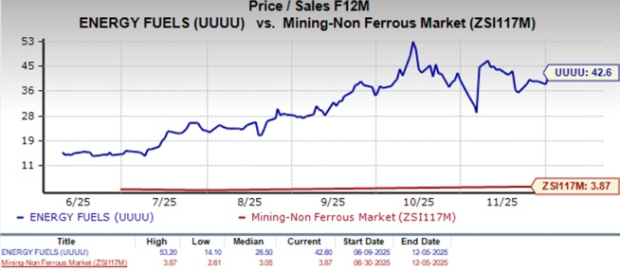
Image Source: Zacks Investment Research
Meanwhile, Centrus Energy and Cameco are cheaper alternatives than UUUU, with P/S of 9.86X and 15.88X, respectively. Uranium Energy is trading at a loftier P/S of 70.98.
UUUU’s Long-Term Case Intact
Demand for uranium and REEs in clean energy applications, along with U.S. efforts to reduce dependence on China, present major tailwinds. The White Mesa Mill in Utah, being the only U.S. facility able to process monazite and produce separated REE materials, gives the company an edge. Also, the U.S. Geological Survey’s addition of uranium to its 2025 Critical Minerals List further highlights its strategic importance for national security and domestic supply chains.
Backed by its debt-free balance sheet, Energy Fuels is ramping up uranium production while developing significant REE capabilities. With expansion plans and a target capacity of 4–6 million pounds of uranium per year, UUUU is well-positioned for growth.
Our Final Take on UUUU Stock
Energy Fuels offers compelling long-term potential, supported by a robust balance sheet, strategic REE advancements and strengthening uranium output. However, considering the premium valuation, expected losses through 2026 and the downward estimate revisions, new investors can consider waiting for a better entry point.
UUUU currently carries a Zacks Rank #3 (Hold). You can see the complete list of today’s Zacks #1 Rank (Strong Buy) stocks here.
Want the latest recommendations from Zacks Investment Research? Today, you can download 7 Best Stocks for the Next 30 Days. Click to get this free report
Cameco Corporation (CCJ): Free Stock Analysis Report
Energy Fuels Inc (UUUU): Free Stock Analysis Report
Uranium Energy Corp. (UEC): Free Stock Analysis Report
Centrus Energy Corp. (LEU): Free Stock Analysis Report
This article originally published on Zacks Investment Research (zacks.com).
Mentioned In This Article
Latest News
| Oct-05 | |
| Oct-03 | |
| Oct-01 | |
| Sep-30 | |
| Sep-30 | |
| Sep-30 | |
| Sep-29 | |
| Sep-29 | |
| Sep-29 | |
| Sep-29 | |
| Sep-29 | |
| Sep-28 | |
| Sep-28 | |
| Sep-26 | |
| Sep-22 |
