Which Bank's AI Bet Will Drive Greater Productivity: JPM or WFC?
JPMorgan JPM and Wells Fargo WFC, the major U.S. banks, are aggressively deploying artificial intelligence (AI) across their operations, from internal workflow automation and customer service tools to analytics and risk management. The initiative will enhance efficiency and productivity in a rapidly evolving financial services landscape.
Let us delve deeper and assess AI’s role in JPM and WFC’s businesses and how they are leveraging AI to stay ahead in today’s fast-paced world.
JPMorgan: Growth-Oriented
JPMorgan’s leadership emphasizes an aggressive but disciplined approach to AI and technology as key drivers of growth and efficiency. AI is being deployed “everywhere” across the bank as an enabler for both large-scale efficiency projects and smaller tools that boost individual employee productivity.
The bank views these technology investments as having “very predictable and strong returns” and remains confident they will pay off. JPMorgan is willing to invest heavily in areas like AI-powered customer features and digital innovation, so long as those investments are responsible and profitable.
Concrete results are already emerging from JPMorgan’s AI strategy. In operations, the company expects more than a 40% productivity increase in the coming years. After one year of implementation, it has doubled annual efficiency gains (to almost 6%) by leveraging AI-driven solutions. This boost in productivity allows JPMorgan to handle greater business volume with fewer incremental costs, supporting higher profitability. Management believes that as a “growth business,” it will absorb many efficiency gains into expansion rather than pure headcount cuts.
Looking ahead, JPMorgan is exploring advanced AI (large language models and “agentic” AI systems) for complex tasks like fraud investigations and account openings, aiming for further efficiency and service enhancements. The company sees AI as a core strategic asset to improve customer experience, drive productivity and reinforce its competitive edge.
Wells Fargo: Efficiency-Focused
Wells Fargo’s CEO Charles Scharf has an efficiency-focused vision for AI and technology, aligning with his broader strategy of cost discipline and improved returns. Under his leadership, the company has already streamlined its workforce significantly and still sees room to become more efficient even before fully leveraging AI.
Wells Fargo plans to fund new technology investments and other growth initiatives through ongoing cost savings, rather than expanding the expense base. Management stresses that tech spending will be governed by ROI, and projects must “generate higher returns and faster growth” or be delayed.
Management believes that AI offers an “extremely significant” opportunity to boost productivity and likely reduce future staffing needs. Applying generative AI to software development has already made Wells Fargo’s coders approximately 30–35% more productive, a “real efficiency” gain yielding far more output with the same resources. Similar AI-driven improvements are being explored across many functions, from compliance and customer service to lending and investment banking, wherever AI can streamline work once done by people.
Overall, Wells Fargo’s tone is pragmatic yet optimistic. The company views technology (especially AI) as a powerful lever to cut costs and boost productivity, directly supporting higher profitability. AI will be adopted with strategic discipline, balancing innovation with strict cost control to enhance returns.
JPMorgan & Wells Fargo’s Prospects
The Zacks Consensus Estimate for JPM’s 2025 and 2026 revenues suggests growth of 2.8% and 4.2%, respectively. Likewise, the consensus estimate for earnings implies a 2.5% increase for this year and 4.7% for 2026.
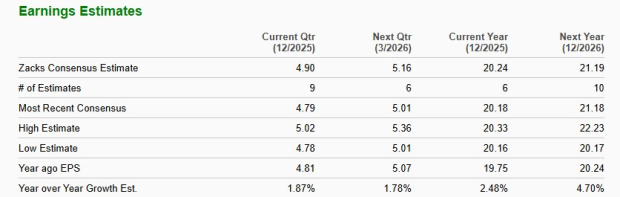
Image Source: Zacks Investment Research
The Zacks Consensus Estimate for WFC’s 2025 and 2026 revenue implies year-over-year growth of 2.2% and 5.4%, respectively. Further, the consensus estimate for earnings indicates a 17% and 10.8% rise for 2025 and 2026, respectively.
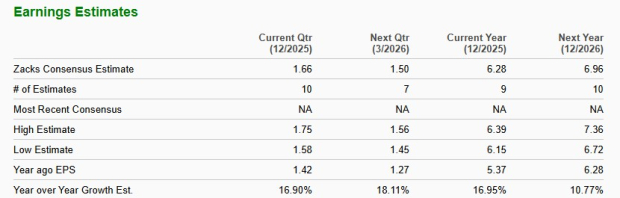
Image Source: Zacks Investment Research
JPM & WFC: Price Performance, Valuation & Other Comparisons
While 2025 started on a positive note, Trump’s tariff plans and geopolitical tension resulted in massive volatility, upending bullish investor sentiments. Nonetheless, they are now optimistic about banks’ performance as the operating backdrop has turned favorable. This year, shares of JPMorgan and Wells Fargo have gained 29.4% and 29.1%, respectively.
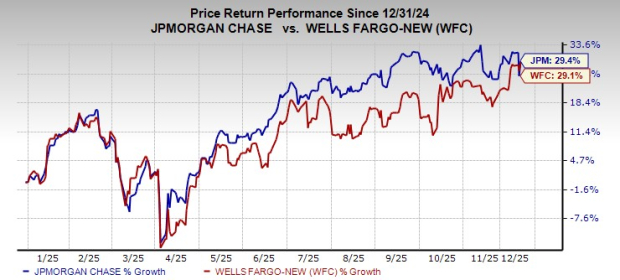
Image Source: Zacks Investment Research
Further, both have outpaced the S&P 500 Index. In terms of investor sentiment, JPMorgan has a marginal edge.
In terms of valuation, JPM is currently trading at a 12-month forward price-to-earnings (P/E) of 14.68X, while WFC stock is currently trading at a 12-month forward P/E of 13.12X.
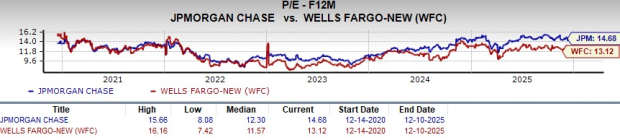
Image Source: Zacks Investment Research
Meanwhile, the industry has a 12-month forward P/E of 14.73X. So, Wells Fargo is trading at a discount compared with the industry and JPMorgan.
JPMorgan’s return on equity (ROE) of 17.18% is above WFC’s 12.51%. Further, the industry’s ROE is 12.53%. This reflects that JPM is more efficiently using shareholder funds to generate profits.
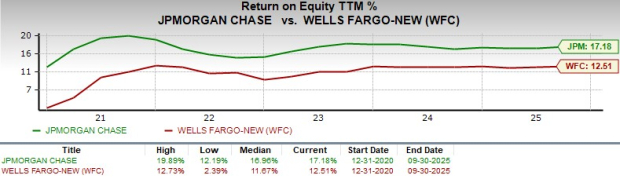
Image Source: Zacks Investment Research
JPMorgan or Wells Fargo: Which is a Better Bet on AI-Usage?
Wells Fargo appears to be the more compelling AI-driven opportunity relative to JPMorgan, given its sharper efficiency focus and stronger earnings trajectory. While JPM is leveraging AI to fuel long-term growth, WFC’s disciplined, ROI-centered deployment is expected to translate more directly into bottom-line improvements. Its tech strategy is tightly aligned with cost reduction, and early gains, such as 30-35% coder productivity, signal material margin upside.
WFC’s cheap valuation further strengthens its case, with superior earnings growth expectations for 2025-2026. With AI accelerating its efficiency overhaul, Wells Fargo offers a more attractive blend of profitability momentum and relative value.
Currently, JPM carries a Zacks Rank #3 (Hold), while WFC has a Zacks Rank #2 (Buy). You can see the complete list of today’s Zacks #1 Rank (Strong Buy) stocks here.
Want the latest recommendations from Zacks Investment Research? Today, you can download 7 Best Stocks for the Next 30 Days. Click to get this free report
Wells Fargo & Company (WFC): Free Stock Analysis Report
JPMorgan Chase & Co. (JPM): Free Stock Analysis Report
This article originally published on Zacks Investment Research (zacks.com).
Mentioned In This Article
Latest News
| 1 hour | |
| 1 hour | |
| 2 hours | |
| 2 hours | |
| 3 hours | |
| 4 hours | |
| 4 hours | |
| 5 hours | |
| 6 hours | |
| 8 hours | |
| 8 hours | |
| 8 hours | |
| 8 hours | |
| 9 hours | |
| 10 hours |
Debanking Probe Finds JPMorgan, Banks Cut Off MAGA Sellers and Democrat Groups
JPM
The Wall Street Journal
|
