|
|
|

|
|||||
|
|
|
SpaceX currently operates the only crew-capable spacecraft capable of reaching the International Space Station.
Boeing has a similar spacecraft, but NASA is afraid to put people on it.
Russia's only space base for launching astronauts just got destroyed.
In June 2025, the bromance between President Donald Trump and Elon Musk turned into a public feud. Upset by rising government debt, the SpaceX CEO called the president's new "Big Beautiful" budget bill "disgusting," and an "abomination" -- to which the president responded with threats to save money by canceling government contracts with SpaceX and its Starlink subsidiary.
The argument threatened to spiral out of control until Musk played his trump card (pun intended): If the U.S. government no longer required SpaceX's services, then it shouldn't mind SpaceX decommissioning its Dragon space capsules, used to shuttle astronauts to and from the International Space Station (ISS).
Where to invest $1,000 right now? Our analyst team just revealed what they believe are the 10 best stocks to buy right now, when you join Stock Advisor. See the stocks »
Musk withdrew the threat within hours, but the point had been made. Shortly thereafter, the feud simmered down. And why?
I'm assuming it's because someone pointed out that without the Dragon capsules, America is almost entirely incapable of human spaceflight.
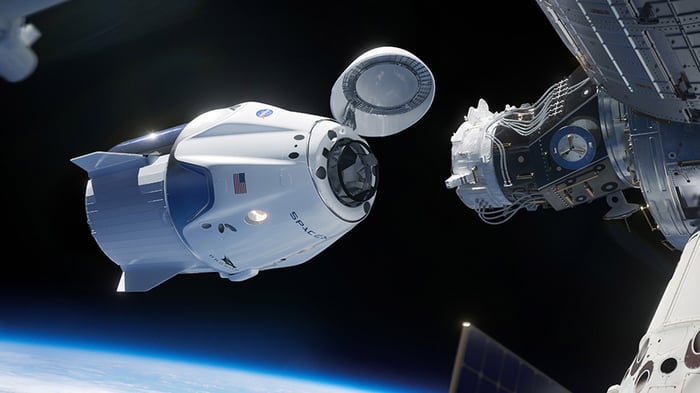
Image source: SpaceX.
To many taxpayers (and investors), this probably comes as a surprise. After all, more than a decade ago, when NASA first proposed shifting astronaut missions to commercial contractors, it sought to avoid a situation in which the government would be dependent on just one space provider by awarding twin Commercial Crew contracts to both SpaceX and Boeing (NYSE: BA).
Problem was, while SpaceX performed on its contract, and has indeed already conducted nearly a dozen Commercial Crew missions with its Dragon capsules, Boeing has only done (half of) one. A test flight in 2024 went awry, forcing NASA to bring Boeing's Starliner space capsule back to Earth empty, and stranding the two astronauts it was carrying aboard ISS until SpaceX was able to rescue them earlier this year.
Boeing had hoped to fix the problems with its spacecraft and continue trying to get Starliner certified for human spaceflight. But late last month, NASA announced that the next Starliner mission will carry cargo only, as it's still not certain the spacecraft is safe for astronauts. The space agency ratcheted down the number of crewed missions Boeing might eventually perform, too, from six previously, to four -- and set no dates for when those flights might (or might not) happen.
Long story short, NASA cannot simply substitute Boeing's Starliner if the Dragon capsules are retired, at least not yet.
The next shoe dropped just days after this Boeing news broke. Over at Baikonur Cosmodrome in Kazakhstan, at the Roscosmos launch site 31/6 used for crewed missions known, a Soyuz rocket blasted off with two Russian cosmonauts and one American astronaut on board on Nov. 27. The launch itself went fine, and the crew members all arrived safely aboard ISS a day later.
Site 31/6 itself wasn't so lucky.
Do to a mechanical defect that the Russians aren't eager to discuss publicly, it seems the "launch service platform," which supports the Soyuz rocket before liftoff and is retracted just before launch (to not get toasted), broke free from its restraints and fell into the launch pad's flame trench, either during or shortly after launch. It's essential for future launches, but apparently broken beyond repair, and replacing it "could take up to two years," according to Russian media.
Historically, Russia and America have taken turns giving each other's spacefarers lifts to ISS. But for the next two years, Russia can't launch cosmonauts to ISS.
And they can't launch American astronauts, either.
Are there any alternatives to using SpaceX to reach the International Space Station? Short answer: no. Longer answer: Maybe, but they're far-fetched.
Theoretically, Chinese rockets based on the Soyuz design might carry astronauts (or cosmonauts, or Chinese taikonauts) to ISS. But current U.S. law forbids Chinese participation in the ISS project, so that's probably a no-go.
Lockheed Martin has a crew-capable spacecraft, the Orion, that it plans to use to send astronauts to the moon. However, that vessel is intended to be launched only atop Space Launch System rockets, which cost $2 billion apiece, making this solution cost-prohibitive.
And that's it. While other space companies exist, such as Rocket Lab, for example, Northrop Grumman, and many others, none of them currently fly spacecraft that are rated safe for humans.
As a result, SpaceX, with its Falcon 9 rockets and Dragon capsules, are now the only way to get astronauts to and from ISS. In a situation like this one, SpaceX can (theoretically) now name its price for this service, as it has literally no competition for the service it provides.
Entirely coincidentally, I'm sure, earlier this week, Elon Musk announced that he will finally proceed with the long-awaited SpaceX IPO in 2026. I suspect it will be very successful.
Before you buy stock in Boeing, consider this:
The Motley Fool Stock Advisor analyst team just identified what they believe are the 10 best stocks for investors to buy now… and Boeing wasn’t one of them. The 10 stocks that made the cut could produce monster returns in the coming years.
Consider when Netflix made this list on December 17, 2004... if you invested $1,000 at the time of our recommendation, you’d have $513,353!* Or when Nvidia made this list on April 15, 2005... if you invested $1,000 at the time of our recommendation, you’d have $1,072,908!*
Now, it’s worth noting Stock Advisor’s total average return is 965% — a market-crushing outperformance compared to 195% for the S&P 500. Don’t miss out on the latest top 10 list, available when you join Stock Advisor.
*Stock Advisor returns as of December 8, 2025
Rich Smith has positions in Rocket Lab. The Motley Fool has positions in and recommends Boeing and Rocket Lab. The Motley Fool recommends Lockheed Martin. The Motley Fool has a disclosure policy.
| 4 hours | |
| 5 hours | |
| 9 hours | |
| 11 hours | |
| 12 hours |
Stock Market Today: Dow Drops On U.S.-Iran Attacks; Defense Stocks Rise; Tesla Falls (Live Coverage)
BA
Investor's Business Daily
|
| 13 hours | |
| 14 hours | |
| 14 hours | |
| 18 hours | |
| Mar-01 | |
| Feb-28 | |
| Feb-27 | |
| Feb-27 | |
| Feb-27 | |
| Feb-27 |

Join thousands of traders who make more informed decisions with our premium features. Real-time quotes, advanced visualizations, backtesting, and much more.
Learn more about FINVIZ*Elite