PANW vs. CRWD: Which Cybersecurity Stock Has an Edge Right Now?
Palo Alto Networks PANW and CrowdStrike CRWD are both at the forefront of the cybersecurity space, playing key roles in guarding organizations from extensive cyberattacks. While Palo Alto Networks focuses broadly on next-generation firewalls, cloud security and AI-driven threat detection, CrowdStrike specializes in endpoint protection and extended detection and response, offering AI-native cloud security through its Falcon platform. Both players are taking active roles in enabling enterprises against cloud and endpoint security.
Palo Alto Networks and CrowdStrike are riding the key industry trends, driven by the mounting incidents of credential theft, remote desktop protocol breaches and social engineering-based strikes by malicious actors. Per a Mordor Intelligence report, the cybersecurity space is expected to witness a CAGR of 12.45% from 2025 to 2030.
With this strong growth forecast for the cybersecurity market, the question remains: Which stock has more upside potential? Let’s break down their fundamentals, growth prospects, market challenges and valuation to determine which offers a more compelling investment case.
The Case for Palo Alto Networks Stock
Palo Alto Networks remains a cybersecurity leader, offering solutions for network security, cloud security and endpoint solutions for customers who need full enterprise security support. Its next-generation firewalls and advanced threat detection technologies are widely recognized and adopted globally.
Palo Alto Networks’ wide range of innovative products, strong customer base and growing opportunities in areas like Zero Trust, Secure Access Service Edge (SASE) and private 5G security continue to support its long-term growth potential. Palo Alto Networks’ ongoing technology advancements make it a compelling long-term investment.
For example, in the first quarter of fiscal 2026, SASE was Palo Alto Networks’ fastest-growing segment, with SASE Annual recurring revenues (ARR) increasing 34% year over year. Growth is mainly coming from customers who want to reduce the number of security tools they use. Many organizations are moving away from older SASE products that do not provide a full view of their networks, cloud workloads, and remote users. A notable example during the first quarter is where a large U.S. cabinet agency signed a $33 million SASE deal covering 60,000 seats after replacing its existing provider.
However, Palo Alto Networks is encountering some near-term challenges. The company is experiencing shortened contract durations and a slowdown in the transition to Palo Alto Networks’ cloud-based AI-powered platforms from its legacy platforms. Moreover, PANW’s $1 million-plus deals are shifting from multi-year payments to annual payments, resulting in a shorter sales cycle and affecting top-line stability.
This can cause a deceleration in Palo Alto Networks’ top-line growth. Notably, the company’s revenue growth rate has been decelerating over the past two fiscal years. Over the past year, the revenue growth rate has slowed down to a mid-teen percentage range, a sharp contrast from the mid-20s percentage in fiscal 2023. In the first quarter of fiscal 2026, its sales and non-GAAP earnings per share (EPS) grew 15.4% and 19.2%, respectively, year over year. The Zacks Consensus Estimate for fiscal 2026 and 2027 revenues indicates a year-over-year increase of approximately 14.1% and 13.3%, respectively.
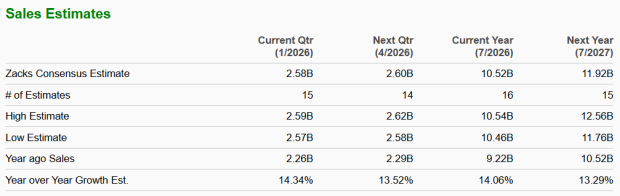
Image Source: Zacks Investment Research
The Case for CrowdStrike Stock
CrowdStrike provides its cybersecurity services mainly through its Falcon platform. CrowdStrike’s Falcon platform is renowned for being the industry’s first multi-tenant, cloud native, intelligent security solution. The Falcon platform helps secure workloads across on-premise, cloud-based and virtualized environments running on several endpoints, such as desktops, laptops, servers, virtual machines and IoT devices.
CrowdStrike’s cloud-based Falcon platform currently provides 29 cloud modules via a software-as-a-service (SaaS) subscription model that is categorized under three categories: Endpoint Security, Security & IT Operations and Threat Intelligence. The share of subscription-based sales to CrowdStrike’s total revenues grew from 72% in fiscal 2017 to 95% in fiscal 2025.
A key driver of CrowdStrike’s customer growth is its Falcon Flex subscription model, which streamlines security adoption with modular and scalable solutions. This flexibility fosters long-term customer commitments, fueling steady revenue growth and deeper platform integration. CrowdStrike’s subscription customers, who adopted six or more cloud modules, represented 49% of the total subscription customers at the end of the third quarter. Those with seven or more cloud modules accounted for 34%, and those with eight or more cloud modules represented 24% as of Oct. 31, 2025.
In the third quarter of fiscal 2026, Annual Recurring Revenues (ARR) from Falcon Flex customers reached $1.35 billion, more than triple last year’s level. Management said Falcon Flex is now one of the most common ways customers choose to buy and expand on the Falcon platform. Falcon Flex helps customers adopt new modules without long contract steps, which leads to faster platform usage. This is also driving strong re-Flex activity. More than 200 customers expanded their Flex contracts in the third quarter, and some more than doubled their original spending. According to the company, this shows that customers see value quickly and are willing to increase their usage once they start with Flex.
These factors are likely to continue driving growth while supporting CrowdStrike’s top-line growth. In the third quarter, CrowdStrike’s sales and non-GAAP EPS grew 22% and 26.3%, respectively, year over year. The Zacks Consensus Estimate for fiscal 2026 and 2027 revenues is pegged at $4.80 billion and $5.83 billion, respectively, both indicating a year-over-year increase of around 21%.
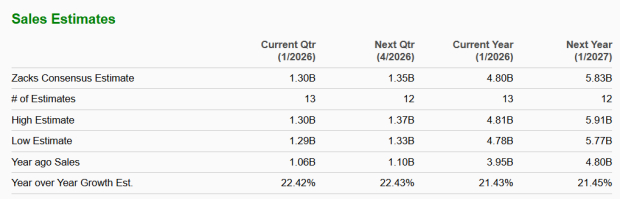
Image Source: Zacks Investment Research
Price Performance and Valuation of PANW and CRWD
Year to date, CrowdStrike shares have appreciated 47.6%, while Palo Alto Networks shares have gained 5.4%.
PANW vs. CRWD: YTD Price Return Performance
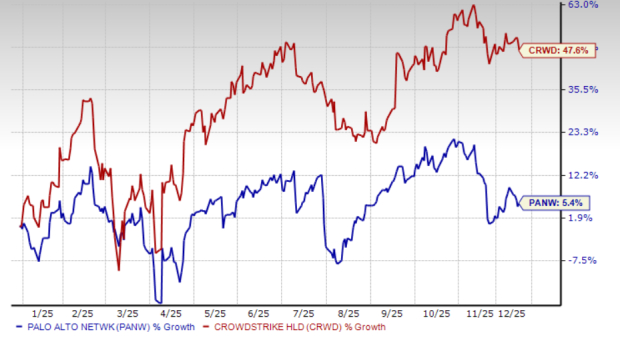
Image Source: Zacks Investment Research
Currently, Palo Alto Networks is trading at a forward sales multiple of 12.1X, lower than CrowdStrike’s forward sales multiple of 22.34X. CrowdStrike does seem pricey compared with Palo Alto Networks. However, CrowdStrike’s valuations also reflect higher growth expectations for the company.
PANW vs. CRWD: Forward 12-Month P/S Ratio
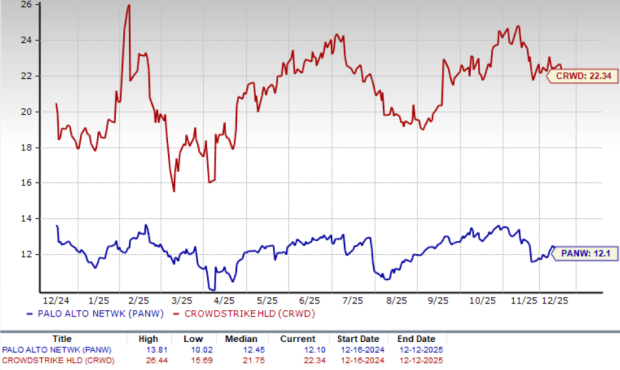
Image Source: Zacks Investment Research
Conclusion: CRWD Has an Edge Over PANW
Both CrowdStrike and Palo Alto Networks are key players in the cybersecurity space, but Palo Alto Networks is facing near-term challenges, including shortened contract durations and slowing sales growth. Moreover, as businesses continue to prioritize AI-driven cybersecurity solutions, CrowdStrike’s leadership in threat prevention, response and recovery will only strengthen. With stronger growth momentum and a sharper focus on emerging threats, CrowdStrike appears better positioned and more attractive for investors at present.
Currently, CrowdStrike carries a Zacks Rank #3 (Hold), giving the stock a clear edge compared to Palo Alto Networks, which has a Zacks Rank #4 (Sell).
You can see the complete list of today’s Zacks #1 (Strong Buy) Rank stocks here.
Want the latest recommendations from Zacks Investment Research? Today, you can download 7 Best Stocks for the Next 30 Days. Click to get this free report
Palo Alto Networks, Inc. (PANW): Free Stock Analysis Report
CrowdStrike (CRWD): Free Stock Analysis Report
This article originally published on Zacks Investment Research (zacks.com).
Mentioned In This Article
Latest News
| 2 hours | |
| Oct-08 | |
| Oct-08 | |
| Oct-08 | |
| Oct-08 | |
| Oct-08 | |
| Oct-07 | |
| Oct-07 | |
| Oct-07 | |
| Oct-07 | |
| Oct-07 | |
| Oct-07 | |
| Oct-07 | |
| Oct-07 | |
| Oct-07 |
