Prediction: Nvidia Will Become a $15 Trillion Company in 2030
Key Points
Nvidia remains the dominant AI accelerator company, and its growth rate far surpasses industry averages.
A natural slowing process and rising competition could temper growth expectations.
Nvidia (NASDAQ: NVDA) has continually surpassed market expectations. Over the last three years, the stock has come out of nowhere to become the world's largest company as measured by market cap.
Even though it pulled back after reaching the $5 trillion market cap milestone, the recent $4.4 trillion market cap is massive by any measure.
Where to invest $1,000 right now? Our analyst team just revealed what they believe are the 10 best stocks to buy right now. Continue »
Despite that retreat, Nvidia stock is likely on track to reach $15 trillion, and that may be a conservative estimate. Here's why Nvidia achieving such a market cap makes sense.
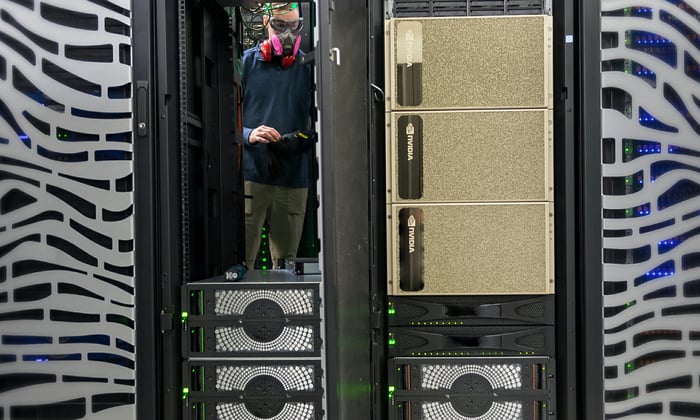
Image source: Nvidia.
The path to $15 trillion
Indeed, predicting an increase of more than threefold in five years is aggressive for any stock, though it has risen more than 1,400% since its low in October 2022. At that 2022 low, Nvidia's market cap was about $290 billion, a considerable size but a small fraction of Apple's and Microsoft's, companies it has since surpassed. In terms of market cap, Nvidia was not in uncharted territory until becoming the first $4 trillion company.
Today, that same amount of growth would take it to around $67 trillion, an unlikely goal even for Nvidia. Still, the path to $15 trillion is more realistic, and here's why.
According to Grand View Research, the AI chip market is expected to grow at a compound annual growth rate (CAGR) of 29% through 2030. From $4.4 trillion, a 29% growth rate over five years would take the company to around $15.7 trillion.
That estimate may seem conservative because, at least for now, Nvidia is far surpassing that growth rate. In the first nine months of fiscal 2026 (ended Oct. 26), the company's $148 billion in revenue grew by 62%.
Why the relatively "conservative" prediction makes sense
Assuming Nvidia stock can maintain that level of growth, it would theoretically reach $15 trillion in approximately 2.5 years. Nonetheless, investors have many reasons to temper growth expectations.
For one, such revenue growth rates tend not to be sustainable and slow over time. This is affecting Nvidia, as one year ago, it grew its revenue by 94%, well above the current 62% growth rate. That slowing will probably continue, meaning investors should expect growth rates to more closely resemble the predicted CAGR over time.
The same trend is true for its valuation. This may have already happened to some degree, as its P/E ratio of 45 is arguably low for such a fast-growing company. Still, over time, valuations tend to reflect market averages more closely. If the valuation gets compressed to the current S&P 500 average P/E ratio of 31, that would significantly slow the stock's growth.
Finally, competition is increasing. For now, Nvidia controls an estimated 80% of the AI chip market, according to estimates by Susquehanna. However, its competitors have ramped up investments to claim some of this market share.
Right now, the competitor most likely to succeed is AMD. Companies like Microsoft, Meta Platforms, and Oracle already use AMD's accelerators.
Additionally, AMD has boasted that its MI450 will surpass the performance of Nvidia's upcoming Vera Rubin processors. If that claim proves true, Nvidia's growth could dramatically slow to the point that a $15 trillion market cap prediction becomes more realistic.
Investors will likely know over the next year how well the MI450 competes with Vera Rubin. Furthermore, five years is a long time, so investors also have to take into account what cannot be predicted, a fact that should temper investor expectations.
Nvidia in five years
Considering today's perspective, a $15 trillion market cap for Nvidia in five years is realistic and could be considered conservative.
Indeed, if Nvidia could maintain its current growth rate for five years, its market cap would reach far more than $15 trillion. Nonetheless, investors have many reasons to expect growth that more closely resembles the industry CAGR.
Over time, Nvidia's revenue growth rate is almost certain to slow. Moreover, its P/E ratio is likely to fall, and competition from AMD and others could cut into its growth rate and market share.
Nvidia remains the market leader in AI accelerators, and that is unlikely to change. While a $15 trillion market cap in five years represents a significant slowdown, it would probably still leave shareholders with market-beating returns.
Should you buy stock in Nvidia right now?
Before you buy stock in Nvidia, consider this:
The Motley Fool Stock Advisor analyst team just identified what they believe are the 10 best stocks for investors to buy now… and Nvidia wasn’t one of them. The 10 stocks that made the cut could produce monster returns in the coming years.
Consider when Netflix made this list on December 17, 2004... if you invested $1,000 at the time of our recommendation, you’d have $505,695!* Or when Nvidia made this list on April 15, 2005... if you invested $1,000 at the time of our recommendation, you’d have $1,080,694!*
Now, it’s worth noting Stock Advisor’s total average return is 962% — a market-crushing outperformance compared to 193% for the S&P 500. Don't miss the latest top 10 list, available with Stock Advisor, and join an investing community built by individual investors for individual investors.
*Stock Advisor returns as of December 16, 2025.
Will Healy has positions in Advanced Micro Devices. The Motley Fool has positions in and recommends Advanced Micro Devices, Apple, Meta Platforms, Microsoft, Nvidia, and Oracle. The Motley Fool recommends the following options: long January 2026 $395 calls on Microsoft and short January 2026 $405 calls on Microsoft. The Motley Fool has a disclosure policy.
Mentioned In This Article
Latest News
| 23 min | |
| 27 min | |
| 59 min | |
| 1 hour | |
| 1 hour | |
| 1 hour | |
| 3 hours | |
| 5 hours | |
| 5 hours | |
| 6 hours | |
| Oct-25 | |
| Oct-25 | |
| Oct-25 | |
| Oct-25 | |
| Oct-25 |
