INTEGRA DELIVERS ROBUST FEASIBILITY STUDY FOR DELAMAR GOLD-SILVER HEAP LEACH PROJECT HIGHLIGHTING IMPROVED ECONOMICS AND REDUCED DEVELOPMENT RISK
TSXV: ITR; NYSE American: ITRG
VANCOUVER, BC, Dec. 17, 2025 /PRNewswire/ - Integra Resources Corp. ("Integra" or the "Company") (TSXV: ITR) (NYSE American: ITRG) is pleased to announce the results of its Feasibility Study (the "FS") for the development of its wholly-owned DeLamar Gold and Silver Heap Leach Project ("DeLamar" or the "Project"), comprised of the DeLamar and Florida Mountain deposits, located in southwestern Idaho.
(All amounts in United States ("U.S.") dollars unless otherwise stated)
2025 DeLamar Feasibility Study Highlights:
- Robust and resilient project returns: After-tax net present value 5% ("NPV") of $774 million ("M") and 46% after-tax internal rate of return ("IRR") using base case metal prices of $3,000 per ounce ("/oz") gold ("Au") and $35/oz silver ("Ag"); After-tax NPV of $1.7 billion ("B") and 89% after-tax IRR using spot metal prices of $4,250/oz Au and $60/oz Ag.
- Increased ounces and mine-life: Addition of stockpile material enhances mine life to 10 years and total life-of-mine ("LOM") production to 1.1 million ounces ("Moz") of gold equivalent ("AuEq").
- Consistent and profitable production profile1,2,3: Average production of 119 thousand ounces ("koz") AuEq from year 1 to 5 with average LOM production of 106 koz AuEq at site level cash costs of $1,179/oz AuEq (co-product) and below industry average all-in sustaining costs ("AISC") of $1,480/oz AuEq (co-product); efficient mining supports low life-of mine strip ratio of 0.54:1.
- Realistic and financeable Project: Total initial capital cost of $389 M (includes $38 M of owners' cost) and sustaining capital of $305 M over the LOM; strong project financing pathway created by ongoing cash flow generation from the Company's operating Florida Canyon Mine ("Florida Canyon") and strong cash balance of ~$81 million as at the third quarter 2025.
- Competitive Project metrics4: Base case NPV-to-capex ratio of 2.0 and payback of 1.8 years; spot NPV-to-capex ratio and payback improve to 4.4 and 1.1 years, respectively.
- Strong free cash-flow profile in early years2: Excellent profitability at beginning of mine life; Year 1-5 average after-tax free cash flow of $165 M; smooth transitioning from Florida Mountain to DeLamar deposits with no grade or tonnage "cliffs".
- Simplified Project layout and processing: Two oxide heap leach facilities ("HLF") (vs. single large HLF design in the 2022 Pre-Feasibility Study ("PFS")), and two-stage crushing (vs. three-stage in PFS); reduced mine-site footprint and enhanced water usage strategy brings potential permitting advantages.
- Meaningful benefits to local communities: Excellent local support for Project development built upon years of engagement and early inclusion of local interests in Project design; an average of 300 direct permanent jobs are expected to be created at DeLamar.
- Strong Tribal partnerships: Relationship Agreement with the Shoshone-Paiute Tribes of the Duck Valley Indian Reservation (the "Shoshone-Paiute") establishes a transformative and long-term partnership for the development of DeLamar; engagement underway with additional Tribal Nations near the Project area.
- Significant scarcity value: DeLamar remains one of the few large-scale precious metals projects in the U.S. at the Feasibility Study level that is actively being advanced toward National Environmental Protection Act ("NEPA") federal mine permitting.
- Visibility on short and long-term growth: Large Measured and Indicated sulphide resource material excluded from mine plan with multiple-near mine expansion targets open along strike and at depth; DeLamar is one of the largest undeveloped silver resources in the U.S. with a largely underexplored district scale land package.
- Opportune timing: With the FS now complete and federal permitting expected to commence in the near term, the Project is well positioned to advance in one of the strongest gold–silver price environments in history, supported by favorable U.S. permitting tailwinds.
(1) Gold equivalent calculated using base case metal prices: $3,000/oz Au and $35/oz Ag |
(2) See Cautionary Note Regarding Non-GAAP Measures |
(3) World Gold Council reported average all-in sustaining cost for gold mining industry of $1,578/oz Au in Q2 2025 |
(4) NPV-to-capex ratio calculated as after-tax Project NPV5% divided by total initial capital cost |
George Salamis, President, CEO and Director of Integra commented: "The Feasibility Study confirms what we have long believed: DeLamar is one of the most compelling, resilient, and capital-efficient heap leach gold-silver projects in the U.S. preparing to enter federal permitting. The FS outlines a simplified, phased, and materially de-risked development plan with outstanding economics, including a rapid 1.8-year payback, strong early free cash flow profile, and one of the highest NPV-to-capex ratios among projects of this scale. Importantly, the FS is being delivered as federal permitting is expected to commence in early 2026, positioning Integra to advance DeLamar at an opportune time. While the FS reflects a conservative, oxide-only development case, it represents only the beginning for DeLamar. The Project also hosts a large sulphide mineral resource that is not included in the mine plan, multiple near-mine expansion opportunities that remain open, and largely underexplored district-style upside.
The updated two heap leach configuration materially improves constructability, operating flexibility, and capital efficiency, while providing meaningful leverage to higher metal prices and maintaining resilience in lower-metal price environments. Updated feasibility-level engineering, metallurgy, and costing significantly enhance Project confidence, reduce execution risk, and support future permitting through a more advanced and robust water management strategy. The delivery of the FS is a major milestone for Integra and underscores our confidence in DeLamar's ability to generate long-term value for our shareholders, Tribal Nation partners, and the communities of Idaho. DeLamar is expected to support an average workforce of approximately 300 high-quality, long-term jobs over the life-of-mine. We look forward to providing further permitting guidance as the Project enters a new phase in 2026."
Integra will host a conference call and webcast to discuss the FS on Thursday, December 18, 2025 at 11:00 AM Eastern Time / 8:00 AM Pacific Time, featuring a presentation from the senior management team and a live Q&A session. A recording will be available on Integra's corporate website. To register for the webcast, please use the following link (call details are listed below):
https://events.q4inc.com/attendee/518660974
Feasibility Study Summary
The FS confirms robust economics for a low-cost, large-scale, conventional open pit oxide heap leach operation, with competitive operating costs and high rate of return. The FS outlines total production of 1.1 Moz AuEq over a 10-year operating mine life (plus two years of residual leaching), resulting in an average annual production profile of 106 koz AuEq per annum at a co-product mine-site AISC of $1,480/oz. The Project generates an after-tax NPV5% of $774 M with an after-tax IRR of 46% at base case gold and silver prices of $3,000/oz and $35/oz, respectively.
The Company retained Forte Dynamics, Inc. (now SLR Consulting Limited) ("Forte") as lead consultants, along with other engineering consultants, to complete the FS and prepare a technical report in accordance with National Instrument 43-101 Standards of Disclosure for Mineral Projects ("NI 43-101"). The FS is derived from updated mineral reserve estimate effective December 8, 2025. The effective date of the FS is December 8, 2025, and a technical report prepared in accordance with NI 43-101 will be filed on the Corporation's website and under its SEDAR+ profile within 45 days of this news release.
Table 1: DeLamar Feasibility Study Highlights1
Mining | |
Total Tonnage Mined (k tonnes) | 185,178 |
Total Ore Mined (k tonnes) | 119,972 |
Strip Ratio (Waste: Ore) | 0.54 |
Operating Mine Life (years) | 10 |
Contained | |
Contained Gold (koz Au) | 1,259 |
Contained Silver (koz Ag) | 52,310 |
Contained Gold Equivalent (koz AuEq) | 1,869 |
Production | |
Heap Leach Recovery | |
LOM Average Gold Recovery (%) | 72.3 % |
LOM Average Silver Recovery (%) | 33.2 % |
Payable Metals | |
LOM Gold Payable (koz Au) | 910 |
LOM Silver Payable (koz Ag) | 17,392 |
LOM Gold Equivalent Payable (koz AuEq) | 1,113 |
Avg. Annual Gold Payable (koz Au) - Yr 1 to Yr 10 | 88 |
Avg. Annual Silver Payable (koz Ag) - Yr 1 to Yr 10 | 1,602 |
Avg. Annual Gold Equivalent Payable (koz AuEq) - Yr 1 to Yr 10 | 106 |
Avg. Annual Gold Payable (koz Au) - Yr 1 to Yr 5 | 102 |
Avg. Annual Silver Payable (koz Ag) - Yr 1 to Yr 5 | 1,450 |
Avg. Annual Gold Equivalent Payable (koz AuEq) - Yr 1 to Yr 5 | 119 |
Costs per Tonne | |
Mining Costs ($/t mined) | $2.51 |
Mining Costs ($/t processed) | $3.87 |
Processing Costs ($/t processed) | $4.91 |
G&A Costs ($/t processed) | $1.51 |
Total Site Operating Cost ($/t processed) | $10.29 |
Cash Costs | |
LOM Cash Cost, net-of-silver by-product ($/oz Au)2 | $772 |
LOM Cash Cost, co-product ($/oz AuEq)2 | $1,179 |
LOM AISC, net-of-silver by-product ($/oz Au)2 | $1,142 |
LOM AISC, co-product ($/oz AuEq)2 | $1,480 |
Capital Expenditure (incl. Contingency) | |
Pre-production Capital – incl. Contingency ($M)3 | $347.0 |
Bonding Cash Collateral ($M) | $3.9 |
Owners' Cost ($M) | $38.2 |
Total Initial Capital ($M) | $389.1 |
Sustaining Capital / Equipment Financing – incl. Contingency ($M) | $304.9 |
Reclamation Cost ($M)4 | $65.5 |
Salvage Value ($M) | ($8.1) |
Bonding Cash Collateral Return ($M) | ($3.9) |
Total Capital ($M) | $747.5 |
Base Case Metal Price Assumptions | |
Gold Price ($/oz) | $3,000 |
Silver Price ($/oz) | $35 |
Base Case Project Economics | |
After-Tax IRR (%) | 46.0 % |
After-Tax NPV5% ($M) | $773.7 |
Payback Period (years) | 1.8 |
Average Annual Net Free Cash Flow ($M)2 – Yr 1 to Yr 10 | $142.8 |
Total Net Free Cash Flow ($M) | $1,066.3 |
(1) Gold equivalent calculated using base case metal prices: $3,000/oz Au and $35/oz Ag |
(2) See Cautionary Note Regarding Non-GAAP Financial Measures |
(3) Assumes mobile equipment financing |
(4) Closure costs include $26.4 M ongoing water treatment reclamation liability |
Figure 1: DeLamar Project Production and Operating Cost Profile1,2
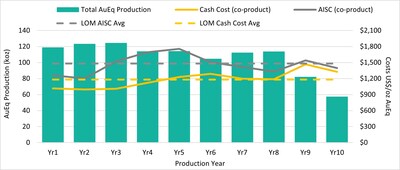
(1) Gold equivalent calculated using base case metal prices: $3,000/oz Au and $35/oz Ag | |
(2) See Cautionary Note Regarding Non-GAAP Financial Measures |
Figure 2: DeLamar Project After-tax Cash Flow Profile (base case)1,2
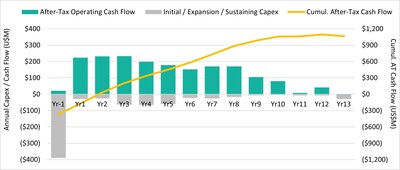
(1) Cash flow profile shown using base case metal prices: $3,000/oz Au and $35/oz Ag |
(2) See Cautionary Note Regarding Non-GAAP Financial Measures |
Table 2: DeLamar Project After-Tax NPV, IRR and Payback Sensitivity Table
$/oz Au | $/oz Ag | NPV5% ($M) | IRR (%) | Payback (years) |
$2,250 | $20 | $178.3 | 16 % | 4.5 |
$2,500 | $25 | $391.1 | 27 % | 2.8 |
$2,750 | $30 | $584.6 | 37 % | 2.2 |
$3,000 | $35 | $773.7 | 46 % | 1.8 |
$3,250 | $40 | $961.6 | 55 % | 1.6 |
$3,500 | $45 | $1,149.0 | 63 % | 1.4 |
$3,750 | $50 | $1,336.2 | 72 % | 1.3 |
$4,000 | $55 | $1,523.5 | 80 % | 1.2 |
$4,250 | $60 | $1,710.3 | 89 % | 1.1 |
$4,500 | $65 | $1,897.1 | 97 % | 1.0 |
Property Description, Location and Access
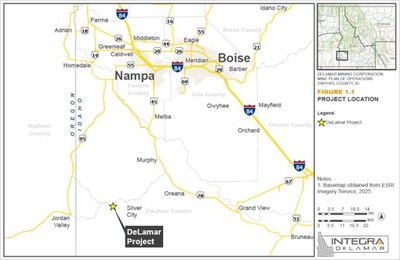
The historic mine site and Delamar Project are located within southwestern Idaho in Owyhee County approximately 80 air kilometers southwest of Idaho's state capital of Boise. The nearest town is Jordan Valley, Oregon which is situated near U.S. highway 95, a 1.5 hour drive from Boise. The Project is within the historical Carson mining district and includes the formerly producing DeLamar silver-gold mine, which was last operated by Kinross Gold Corporation. The Project is accessed via 28 kilometers of existing road east from Jordan Valley, Oregon.
Figure 3: DeLamar Project Location Map
Updated Mineral Resource Estimate
Mineral resources were re-estimated from the resource model released in 2023 which includes the Florida Mountain deposit, the DeLamar deposit, and historical stockpiles and backfill. The mineral resource estimate is based on 3,348 drillholes totaling ~383,000 meters ("m"). Gold and silver mineralization was modeled following industry-standard and Canadian Institute of Mining, Metallurgy & Petroleum ("CIM")-compliant protocols.
Key steps included:
- Statistical evaluation of assay data and determination of natural grade populations.
- Construction of mineral-domain wireframes using 30-meter spaced sectional control.
- Projection and slicing of domain polygons across each deposit to ensure geological continuity.
- Coding of block models with gold and silver using level-plan geometries.
- Geostatistical analysis of mineralization trends to support estimation and classification.
- Grade interpolation using inverse-distance methods into 6 × 6 × 6 m blocks at the DeLamar deposit and 6 × 8 × 8 m blocks at the Florida Mountain deposit, with domain-specific coding to constrain estimates.
The mineral resource estimate for the FS includes updated price assumptions and metallurgical recovery inputs for the pit optimization used to constrain them. Sulphide material continues to be reported in this resource mineral update, consistent with prior studies, as it continues to show potential economic extraction. Importantly, the fundamental resource methodology has not changed from the 2023 mineral resource update.
Table 3: DeLamar Project Mineral Resources
Measured | Indicated | Measured & Indicated | ||||||||
Mineral Resources | Tonnes | Grade | Ounces | Tonnes | Grade | Ounces | Tonnes | Grade | Ounces | |
GOLD (Au) | (kt) | (g/t) | (koz) | (kt) | (g/t) | (koz) | (kt) | (g/t) | (koz) | |
DeLamar Project | Oxide | 15,548 | 0.41 | 204 | 139,953 | 0.31 | 1,400 | 155,501 | 0.32 | 1,604 |
Sulphide | 21,643 | 0.51 | 357 | 68,629 | 0.45 | 984 | 90,272 | 0.46 | 1,341 | |
TOTAL | Mixed | 37,189 | 0.47 | 561 | 208,582 | 0.36 | 2,384 | 245,772 | 0.37 | 2,945 |
Measured | Indicated | Measured & Indicated | ||||||||
Mineral Resources | Tonnes | Grade | Ounces | Tonnes | Grade | Ounces | Tonnes | Grade | Ounces | |
SILVER (Ag) | (kt) | (g/t) | (koz) | (kt) | (g/t) | (koz) | (kt) | (g/t) | (koz) | |
DeLamar Project | Oxide | 15,548 | 20.46 | 10,230 | 139,953 | 13.72 | 61,750 | 155,501 | 14.40 | 71,979 |
Sulphide | 21,643 | 32.90 | 22,922 | 68,629 | 22.30 | 49,254 | 90,272 | 24.90 | 72,176 | |
TOTAL | Mixed | 37,189 | 27.70 | 33,152 | 208,582 | 16.60 | 111,004 | 245,772 | 18.20 | 144,155 |
Inferred | Inferred | |||||||||
Mineral Resources | Tonnes | Grade | Ounces | Mineral Resources | Tonnes | Grade | Ounces | |||
GOLD (Au) | (kt) | (g/t) | (koz) | SILVER (Ag) | (kt) | (g/t) | (koz) | |||
DeLamar Project | Oxide | 19,813 | 0.26 | 163 | DeLamar Project | Oxide | 19,813 | 20.94 | 13,336 | |
Sulphide | 19,789 | 0.37 | 235 | Sulphide | 19,789 | 10.10 | 1,529 | |||
TOTAL | Mixed | 39,603 | 0.31 | 398 | TOTAL | Mixed | 39,603 | 11.70 | 14,865 | |
(1) | All Mineral Resource estimates have been prepared in accordance with NI 43-101 standards. |
(2) | Mineral Resources that are not Mineral Reserves do not have demonstrated economic viability. |
(3) | Jeffrey Bickel, of RESPEC Company LLC of Reno, Nevada, is a Qualified Person as defined in NI 43-101, and is responsible for reporting Mineral Resources for the DeLamar Project. Mr. Bickel is independent of the Company. |
(4) | "Oxide", as listed above, is an aggregate category inclusive of all material types amenable to heap-leaching, including In-Situ Oxide, Stockpiles, and In-Situ Mixed material. |
(5) | In-Situ Oxide/Mixed and Stockpile Mineral Resources are reported at a 0.17 and 0.1 g/t AuEq cut-off, respectively, in consideration of potential open-pit mining and heap leach processing. |
(6) | Sulphide Mineral Resources are reported at a 0.3 g/t AuEq cut-off at DeLamar and 0.2 g/t AuEq at Florida Mountain in consideration of potential open pit mining and grinding, flotation, ultra-fine regrind of concentrates, and either Albion or agitated cyanide-leaching of the reground concentrates. |
(7) | AuEq was calculated using a price of $2,650/oz Au and a price of $30/oz Ag, as well as metallurgical recoveries which were variable based on spatial area and each respective oxidation zone of the deposit. |
(8) | The Mineral Resources are constrained by pit optimizations using a price of $2,650/oz Au, a price of $30/oz Ag, mining cost of $2.50/tonne, variable processing costs ranging from $3.26-$5.30/tonne, and metallurgical recoveries ranging from 45%-95% for Au and 15%-92% for Ag. Variable metallurgical recoveries and processing costs correspond to various material types including Oxide, Transition, Sulphide, and Stockpile materials, as well as spatial zones of the deposit with defined metallurgical characteristics. The pit optimizations also used a G&A cost of $0.65/tonne, pad replacement cost of $1.00/tonne for heap leach material, and refining costs of $0.00/oz and $0.50/oz for Au and Ag, respectively. |
(9) | Rounding as required by reporting guidelines may result in apparent discrepancies between tonnes, grades, and contained metal content. |
(10) | The estimate of Mineral Resources may be materially affected by geology, environment, permitting, legal, title, taxation, sociopolitical, marketing, or other relevant issues. |
(11) | Mineral Resources reported are inclusive of Mineral Reserves. |
(12) | The Effective Date of the Mineral Resource Estimate is December 8, 2025 |
Updated Mineral Reserve Estimate
Proven and Probable Mineral Reserves for the Project utilized the updated resource model released in 2023, which was constrained by engineered pit designs based on Lerchs–Grossmann optimization shells, with appropriate cut-off grades that reflect updated metal prices, metallurgical recoveries, geotechnical criteria, and operating cost assumptions. No changes were made to the underlying reserve methodology since the PFS released in 2022. Variations in reserves from the previous PFS study are from the updated 2023 resources (which includes the addition of historical stockpile resources), revised cost assumptions, and metallurgical recoveries. Reserves have been updated for heap leach only material to streamline permitting, simplify processing and reduce capital. This removes sulphide material from the reserve. Additionally, drill-tested historic low grade ore stockpiles included in the resource have been included in the reserve.
Table 4: DeLamar Project Mineral Reserves
Proven | Probable | Proven & Probable | ||||||||
Mineral Reserves | Tonnes | Grade | Ounces | Tonnes | Grade | Ounces | Tonnes | Grade | Ounces | |
GOLD (Au) | (kt) | (g/t) | (koz) | (kt) | (g/t) | (koz) | (kt) | (g/t) | (koz) | |
DeLamar Project | Oxide | 11,675 | 0.40 | 149 | 108,297 | 0.32 | 1,110 | 119,972 | 0.33 | 1,259 |
Sulphide | - | - | - | - | - | - | - | - | - | |
TOTAL | Mixed | 11,675 | 0.40 | 149 | 108,297 | 0.32 | 1,110 | 119,972 | 0.33 | 1,259 |
Proven | Probable | Proven & Probable | ||||||||
Mineral Reserves | Tonnes | Grade | Ounces | Tonnes | Grade | Ounces | Tonnes | Grade | Ounces | |
SILVER (Ag) | (kt) | (g/t) | (koz) | (kt) | (g/t) | (koz) | (kt) | (g/t) | (koz) | |
DeLamar Project | Oxide | 11,675 | 16.34 | 6,132 | 108,297 | 13.26 | 46,173 | 119,972 | 13.56 | 52,305 |
Sulphide | - | - | - | - | - | - | - | - | - | |
TOTAL | Mixed | 11,675 | 16.34 | 6,132 | 108,297 | 13.26 | 46,173 | 119,972 | 13.56 | 52,305 |
(1) | All estimates of Mineral Reserves have been prepared in accordance with NI 43-101 standards and are included within the current Measured and Indicated Mineral Resources. |
(2) | Sterling K, Watson, P.Eng., of RESPEC Company LLC of Reno, Nevada, is a Qualified Person as defined in NI 43-101, and is responsible for reporting Mineral Reserves for the DeLamar Project. Mr. Watson is independent of the Company. |
(3) | Mineral Reserves are based on prices of $2,000/oz Au and $25/oz Ag. The Mineral Reserves were defined based on pit designs that were created to follow optimized pit shells created in Whittle. Pit designs followed pit slope recommendations provided by RESPEC. |
(4) | Mineral Reserves are reported using block value cutoff grades representing the cost of processing. |
(5) | The Mineral Reserves are constrained by pit optimizations using a price of $2,000/oz Au, a price of $25/oz Ag, mining cost of $2.50/tonne, variable processing costs ranging from $3.26-$5.30/tonne, and metallurgical recoveries ranging from 45%-95% for Au and 15%-92% for Ag. The pit optimizations also used a G&A cost of $0.65/tonne, pad replacement cost of $1.00/tonne for heap-leach material, and refining costs of $0.00/oz and $0.50 for Au and Ag, respectively. |
(6) | Energy prices of US$3.50 per gallon of diesel. |
(7) | Pit optimizations were run on a range of prices from $500/oz Au to $3,000/oz Au. |
(8) | The cut-off grade for Mineral Reserves is based on economics at a "Break-Even Internal" cut-off grade for the deposits. |
(9) | The Mineral Reserves purposes of reference is the point where material is fed into the crusher. |
(10) | All ounces reported herein represent troy ounces, "g/t Au" represents grams per tonne gold and "g/t Ag" represents grams per tonne silver. |
(11) | Mineral Resources reported are inclusive of Mineral Reserves |
(12) | Rounding as required by reporting guidelines may result in apparent discrepancies between tonnes, grades, and contained metal content. |
(13) | The estimate of Mineral Reserves may be materially affected by geology, environment, permitting, legal, title, taxation, sociopolitical, marketing, or other relevant issues. |
(14) | The Effective Date of the Mineral Reserves Estimate is December 8, 2025. |
Production Profile
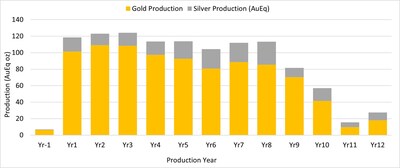
The contemplated operation in the FS spans 13 years, comprising one year of construction (Year -1), 10 years of active mining and gold-silver processing operations, and two years of residual leaching and nominal production. The Project is expected to produce a total of approximately 1.1 Moz AuEq.
The first six months of the construction period focuses on establishing the Florida Mountain deposit heap leach pad, utilizing readily available historical low-grade gold-silver ore stockpile as overliner material. This material will be screened and crushed and will provide a flow channel for leachate.
This allows the stacking of fresh, higher-grade gold-silver ore from the Florida Mountain deposit and the application of leach solution to start in month seven of the construction year, unlocking the ability to produce ~7 koz AuEq in Year -1. As solution inventory builds and leach flows increase through month 20, production ramps accordingly, resulting in 119 koz AuEq produced during the first full year after construction (Year 1). The DeLamar deposit heap leach pad construction begins in Year 3 and begins to receive DeLamar deposit historic stockpile and pit ore in Year 4. Active mining operations will continue until Year 10 followed by two years of residual gold-silver leaching.
Figure 4: DeLamar Project Production Breakdown by Area
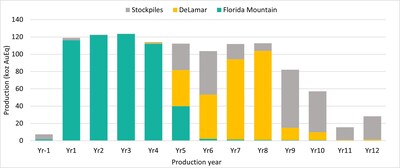
Figure 5: DeLamar Project Production Breakdown by Metal
Mining
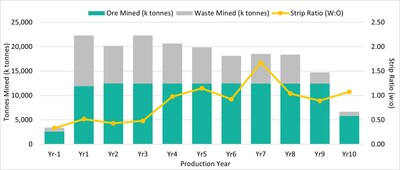
Mining is designed as a conventional open-pit operation using truck-and-shovel methods, focused on delivering high grade gold-equivalent production from the Florida Mountain deposit early in the Project, before transitioning to sustained mid-life production at the DeLamar deposit. The mine plan schedules 185 million tonnes ("Mt") of total material movement over the 10-year active mine life, including 120 Mt of ore with an average grade of 0.33 g/t Au and 13.6 g/t Ag, for a combined 1.3 Moz of contained gold and 52.3 Moz of contained silver. Strip ratios remain low and consistent at 0.54:1 over the life-of-mine, supporting efficient mining and strong early cash flows. Mining rates of ore are planned for 35,000 tonnes per day ("tpd") with no more than 12 benches extracted per year.
Material movement is sequenced to prioritize higher-grade Florida Mountain deposit ore in the first four years, enabling average production of ~119 koz AuEq per year during the payback window. Mid-life mining transitions to the DeLamar deposit pit, which provides consistent tonnage, stable grades, and reduced haulage requirements as backfill is incorporated into the sequencing.
Mining assumptions are built from first principles, including drill penetration rates, powder factors, cycle times, equipment availabilities, and original equipment manufacturer ("OEM")-validated haulage models. The fleet includes up to 17 haul trucks, three production drills, and a matched loading fleet of excavators and shovels sized to maintain efficient dig-and-haul cycles. Waste placement and backfilling strategies minimize external dump requirements and align with closure objectives. Overall, the mining plan reflects an executable, low-risk approach that supports strong economics, operational flexibility, and a smooth transition into reclamation activities in the later years of the Project.
Figure 6: DeLamar Project Mining Profile
Processing and Recovery
Project mineralization is amenable to conventional cyanide leaching. The Project has an updated two heap leach configuration that considers environmental, heap stability, and economic impacts. This configuration balances early capital efficiency with operational flexibility, allowing staged commissioning while managing particle fines and agglomeration risk across distinct ore domains. To reduce truck haulage requirements, one heap leach pad will be located adjacent to the Florida Mountain deposit, and the other will be located adjacent to the DeLamar deposit.
Run-of-mine ore will be transferred from the pits via haul trucks to their respective heaps leach pads for two-stage crushing before stacking. The crushing circuit consists of a primary mineral sizer and secondary low-pressure roll crusher, reducing the particle size of run of mine ore to a P80 (particle size at which 80% of the sample material passes) of approximately 19 millimeters. The selection of crushing equipment was supported by abrasion and impact testing.
The crushed ore from the Florida Mountain deposit contains limited fines and does not require agglomeration, making it suitable for direct truck dump stacking following two-stage crushing.
A portion of the crushed ore from the DeLamar deposit pit contains enough fines and clay and will require agglomeration through a screening and agglomeration circuit followed by curing and conveyor stacking. Screening and selective agglomeration are applied only where required, minimizing operating complexity while protecting permeability and recovery performance.
Heaps leach pads will be stacked at a rate of 35,000 tpd. Cyanide solution will be applied and processed via a small Merrill-Crowe facility located near the DeLamar deposit heap leach pad, designed for a throughput of approximately 1,360 m3 per hour. Filter cakes will be further processed at Integra's Florida Canyon Mine refinery to produce doré bars, reducing initial capital requirements for DeLamar. Florida Canyon is expected to have sufficient permitted capacity to process DeLamar doré without modification.
Figure 7: DeLamar Project Heap Leach Stacking by Source
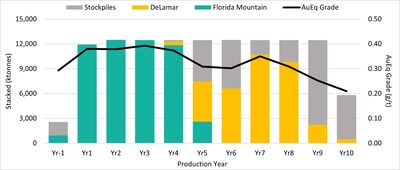
Table 5: DeLamar Project Mining & Processing Summary
Mining | DeLamar | Florida Mtn. | Stockpiles | Total |
Total Tonnage Mined (kt) | 75,905 | 76,625 | 32,648 | 185,178 |
Total Ore Mined (kt) | 35,072 | 52,253 | 32,648 | 119,972 |
Strip Ratio (Waste: Ore) | 1.16 | 0.47 | 0.00 | 0.54 |
Grade | ||||
Average Gold Grade (g/t Au) | 0.33 | 0.37 | 0.24 | 0.33 |
Average Silver Grade (g/t Ag) | 18.92 | 10.18 | 13.22 | 13.56 |
Contained Metals | ||||
Contained Gold (koz Au) | 377 | 628 | 254 | 1,259 |
Contained Silver (koz Ag) | 21,339 | 17,095 | 13,877 | 52,310 |
Contained Gold Equivalent (koz AuEq) | 626 | 827 | 416 | 1,869 |
Production | ||||
Heap Leach Recovery | ||||
LOM Average Gold Recovery (%) | 66.1 % | 74.1 % | 76.9 % | 72.3 % |
LOM Average Silver Recovery (%) | 26.9 % | 37.9 % | 37.4 % | 33.2 % |
Payable Metals | ||||
LOM Gold Payable (koz Au) | 249 | 465 | 196 | 910 |
LOM Silver Payable (koz Ag) | 5,734 | 6,472 | 5,185 | 17,392 |
LOM Gold Equivalent Payable (koz AuEq) | 316 | 540 | 256 | 1,113 |
Power and Infrastructure
The Project infrastructure strategy prioritizes refurbishment and targeted upgrades to minimize initial capital, while maintaining reliability and certainty around the construction schedule.
DeLamar historically operated as a fully serviced site until 1998 after which limited remediation and ongoing care and maintenance were completed. Several existing facilities and infrastructure elements remain in place and will be refurbished or augmented for the new Project. New infrastructure will be constructed only where required to meet capacity, safety, or operational performance requirements of the Project.
The Project will require up to 6.5 megawatts ("MW") of power which will be supplied to the site by the refurbished 69-kilovolt ("kV") transmission line and distributed throughout the site via a new substation and refurbished 4,160 power distribution network. A 2 MW backup generator is planned to be installed for back-up or emergency power.
The existing water treatment plant will be upgraded and augmented with more treatment capacity for use in the Project.
On-site facilities will be selectively upgraded to align with the planned mining fleet and operation profile. The existing five-bay mobile maintenance shop will be upgraded to six-bays, large enough to accommodate 150-tonne series haul trucks. The administration building will be repaired, and site communications infrastructure will be enhanced. Existing site roads will be refurbished and upgraded limiting the need for new roads.
A small Merrill-Crowe plant will be constructed with ditches and ponds to capture contact water for treatment and industrial use. Additional new construction includes a two-stage crushing circuit, truck wash, laboratory, and warehouse.
Operating Costs
Operating costs were estimated through first principles and supplier quotes. Where possible, first principal assumptions and costs of units were compared to those experienced at the Florida Canyon Mine, Integra's active heap leach operation in Nevada.
Mining operating cost estimates were prepared by RESPEC Company LLC ("RESPEC") using first principles. This was done using estimated hourly costs of equipment and personnel against the anticipated hours of work for each. The equipment hourly costs were estimated for fuel, oil and lubrication, tires, under-carriage, repair and maintenance costs, and special wear items. First principal assumptions and the cost of mine personnel and consumables were benchmarked against Florida Canyon.
Process operating costs were developed by Forte from first principles to determine unit consumptions of materials, supplies, power and personnel, and the estimated cost of unit for these was estimated from supplier quotes and industry benchmarks. The cost of materials, supplies, power and labor were benchmarked against Florida Canyon.
Labor general and administrative ("G&A") costs were estimated based on personnel requirements for administrative, accounting, safety and security, and environmental departments to support mining and processing activities. Costs are also included for legal, land, permit bonding and power. G&A costs were benchmarked against Florida Canyon.
Table 6: DeLamar Project Operating and Mining Cost Breakdown
Per Tonne | ||
LOM Operating Costs (US$) | Mined | Processed |
Mining | $2.51 | $3.87 |
Processing | $4.91 | |
G&A | $1.51 | |
Total Site Costs | $10.29 | |
$/oz Au | $/oz AuEq | |
LOM Cash Costs, AISC & AIC Breakdown | By-Product | Co-Product |
Mining | $510 | $417 |
Processing | $648 | $530 |
G&A | $199 | $163 |
Total Site Costs | $1,357 | $1,110 |
Transport & Refining | $10 | $8 |
Royalties1 | $75 | $61 |
Total Cash Costs | $1,441 | $1,179 |
Silver By-Product Credits | ($669) | - |
Total Cash Costs Net of Silver by-Product | $772 | $1,179 |
Sustaining Capital | $335 | $274 |
Closure Costs Net of Residual Value2 | $34 | $28 |
Site Level All-in Sustaining Costs | $1,142 | $1,480 |
(1) Royalty summary outlined below |
(2) Closure costs for AISC calculation exclude ongoing water treatment reclamation costs |
Project Royalties
The FS considers two primary royalties that apply to the Project. Triple Flag Precious Metals Corp. ("Triple Flag") holds a 2.5% net smelter returns royalty ("NSR") that applies to ~90% of the current DeLamar deposit resources and reserves, however the royalty will be reduced to 1.0% upon Triple Flag receiving total royalty payments of C$10 M. A wholly-owned subsidiary of Wheaton Precious Metals Corp. currently holds a 1.5% NSR that applies to the current DeLamar and Florida Mountain deposit resources and reserves. The production profile in the FS reflects an average royalty rate of 2.3%.
Capital Cost Estimates
Capital cost estimates emphasize constructability, vendor-supported pricing, and execution sequencing aligned with the planned development schedule.
Mining initial and sustaining capital estimates were prepared by RESPEC. Estimates assume owner-operated mining equipment and are based on the equipment and facilities required to achieve the production schedule. Capital costs are based on estimation guides, quotations from equipment vendors and recent costs for new equipment at the Company's operating Florida Canyon mine in Nevada.
The process and infrastructure capital costs were developed by Forte for initial and sustaining capital. The capital costs for each phase are comprised of direct costs and indirect costs. The direct costs were developed from labor, materials, plant equipment, sub-contracts, and construction equipment. Indirect costs were applied to the direct costs to account for items such as: construction support, engineering, procurement and construction management, vendor support during specialty construction and commissioning, spare parts, contingency, owner's costs, freight and taxes. Capital costs were estimated based on 2025 U.S. dollars and are presented with no added escalation.
Table 7: DeLamar Project Capital Cost Breakdown
Capital Cost Breakdown | Pre-Production | Sustaining | Reclamation | Combined |
Capital Costs | ||||
Mining1,2 | $27.8 | $145.1 | $172.9 | |
Processing | $276.5 | $136.1 | $412.6 | |
G&A | $5.1 | $0.0 | $5.1 | |
Capex Sub-Total | $309.4 | $281.2 | $590.6 | |
Contingency3 | $37.6 | $23.7 | $61.3 | |
Total Capital Costs | $347.0 | $304.9 | $651.9 | |
Other Capital | ||||
Owners' Costs | $38.2 | $38.2 | ||
Reclamation – Site4 | $65.5 | $65.5 | ||
Cash Collateral (bonding) | $3.9 | ($3.9) | $0.0 | |
Residual Value | ($8.1) | ($8.1) | ||
Total Other Capital | $42.1 | $0.0 | $53.5 | $95.6 |
TOTAL CAPITAL | $389.1 | $304.9 | $53.5 | $747.5 |
(1) Assumes financing of mobile equipment. Pre-production = 10% cash down and 1 year of payments |
(2) Includes $10 M in pre-stripping |
(3) Overall contingency of 12% (Mining 5%, Processing 13%, G&A 17%) |
(4) Includes $26.4 M for ongoing water treatment post mine closure |
Environmental and Permitting
The Project is supported by strong environmental and technical teams that have led major advancements in obtaining necessary approvals and permits since the 2022 PFS, including the Mine Plan of Operations completeness determination by the U.S. Bureau of Land Management ("BLM") and the completion of environmental resource baseline studies to support Project environmental effects analysis under NEPA. Integra has an established collaborative approach with regulatory agencies and our technical teams and will continue to develop the Project to meet all applicable regulatory standards. The construction and operation of the Project require further permitting which will continue to actively advance in 2026 and 2027 through parallel U.S. Federal, State of Idaho, and Owyhee County permitting processes that address mine reclamation, air and water quality, wetland impacts and cyanidation.
In accordance with the BLM's mandate to prevent undue environmental degradation on public lands, the Project design optimization has continued to focus on the reduction of environmental impacts and surface disturbance of the mine operation through a leaching-focused process, consolidation of development rock storage facilities and the design of heap leach facilities in proximity to the open pits. Through various studies conducted on the Project over the years, the proposed mine footprint has been reduced by ~25%. This optimization will continue through the evaluation of agency-proposed alternatives and mitigations during the NEPA process to deliver a robust mine operation that is protective of water resources, air quality, cultural resources, wildlife and vegetation, and post-mine land use.
Stakeholder, Community, and Tribal Nation Engagement
Since Project acquisition in the third quarter of 2017, the Company has operated with dedicated budget and personnel to engage proactively with the communities, Tribal Nations, and other stakeholders with ties to DeLamar. With increasing frequency as the Project approaches state and federal permitting, the Company has worked to build lasting relationships with a wide range of stakeholders, including nearby residents and community members, Tribal Nations, nongovernmental organizations and various levels of government representatives. This approach reflects a deep Company-wide commitment to a high standard of social performance, achieved by acting transparently and building mutual respect and shared value.
Stakeholder engagement is guided by an External Stakeholder Plan ("ESP"), a Project site-specific plan that is updated annually to guide the activities, goals, and strategies for stakeholder engagement in a tailored manner that reflects the unique requirements of each region, individual stakeholder context, and cultural settings surrounding DeLamar. The ESP management approach specifically addresses the Company's stakeholder engagement, public communication, community involvement & investment, and monitoring & reporting – including social impact risks assessments, grievance procedures, materiality, and metric tracking.
Since 2020, Integra has worked to engage proactively and respectfully with potentially affected Tribal Nations, with the intent to exceed regulatory requirements by prioritizing early, inclusive, and respectful dialogue in order to build mutual understanding and recognize Tribal interests. In 2025, Integra and the Shoshone-Paiute Tribes of the Duck Valley Indian Reservation entered into a Relationship Agreement that will guide a mutually beneficial partnership between the two parties over the course of the permitting, development, and future operation of the Project. Integra is concurrently advancing discussions with additional Tribal Nations to evaluate the interest in developing similar relationships.
Integra's approach of being present and active within the Project's stakeholder network has allowed the Company to build consensus and collaborate on issues of shared concern as the mine and operational designs have iteratively evolved. Potential social and community impacts have been and will continue to be considered and evaluated in accordance with the NEPA and other federal and state laws. There are no currently known social or community issues that would be expected to have a material impact on the Company's ability to mine at the Project.
Exploration Potential and Upside at DeLamar
Beyond the FS mine plan, DeLamar offers substantial longer-term upside and strategic optionality. The FS includes an updated mineral resource statement that includes sulphide mineral resources, which are currently excluded from the Project's mineral reserves and economic analysis, preserving future processing and development optionality as technology, costs, and market conditions evolve. In addition, DeLamar hosts one of the largest undeveloped silver mineral resources in the U.S. and sits within a largely underexplored, district-scale land package with multiple near-mine and regional exploration targets open along strike and at depth. The Project layout and infrastructure contemplated in the FS also provide flexibility for potential future throughput expansion, allowing Integra to pursue disciplined growth opportunities while maintaining a simplified, low-risk development pathway.
Next Steps and Opportunities
With the FS complete, the Company is advancing permitting and construction readiness. Near-term priorities include advancing detailed engineering and execution planning. Opportunities remain to further optimize the production plan, mine sequence and heap leach facility design to maximize early production from the Florida Mountain deposit and further smooth the transition to DeLamar deposit production. The simplified oxide-focused Project design, combined with robust early cash flow potential and strong economics, positions DeLamar well for permitting, financing, and development execution.
No Production Decision: The Company has not made a production decision for the Project. A decision to proceed with construction will only be made following the completion and review of detailed engineering, financing arrangements, and receipt of all required permits and approvals.
DeLamar Feasibility Study Conference Call & Webcast
Integra will host a conference call and webcast on Thursday, December 18, 2025, at 11:00 AM Eastern Time / 8:00 AM Pacific Time, to discuss the DeLamar FS. Details for the conference call and webcast are included below.
Dial-In Numbers / Webcast:
Conference ID: 8306105
Toll Free: (800) 715-9871
Toll: +1 (646) 307-1952
Webcast: https://events.q4inc.com/attendee/518660974
About Integra
Integra is a growing precious metals producer in the Great Basin of the Western United States. Integra is focused on demonstrating profitability and operational excellence at its principal operating asset, the Florida Canyon Mine, located in Nevada. In addition, Integra is committed to advancing its flagship development-stage heap leach projects: the past producing DeLamar Project located in southwestern Idaho and the Nevada North Project located in western Nevada. Integra creates sustainable value for shareholders, stakeholders, and local communities through successful mining operations, efficient project development, disciplined capital allocation, and strategic M&A, while upholding the highest industry standards for environmental, social, and governance practices.
ON BEHALF OF THE BOARD OF DIRECTORS
George Salamis
President, CEO and Director
CONTACT INFORMATION
Corporate Inquiries: ir@integraresources.com
Company website: www.integraresources.com
Office phone: 1 (604) 416-0576
Qualified Persons
The scientific and technical information contained in this news release has been reviewed and approved by James Frost, P.Eng., Director, Technical Services of Integra Resources Corp., who is a Qualified Person as defined by NI 43-101. In reviewing and approving this disclosure, Mr. Frost has relied upon the work of other Qualified Persons, each of whom has reviewed and approved the scientific and technical information within their respective areas of expertise.
Forte Dynamics, Inc. part of SLR Consulting Limited, has led the Feasibility Study and is managing the Report with RESPEC Company LLC contributing. The following independent Qualified Persons with associated firms have reviewed and approved this news release as defined by NI 43-101:
Barry Carlson, P.E., SME-RN, Forte Dynamics, Inc.
Deepak Malhotra, Phd., P.E., SME-RN, Forte Dynamics, Inc.
Jeffrey Bickel, C.P.G., RESPEC Company LLC
Keith Watson, P.Eng., RESPEC Company LLC
Jay Nopola, P.E., RESPEC Company LLC
Data Verification
The Qualified Persons responsible for the FS technical report have verified the data for which they are accountable, including the sampling, analytical, and test data underlying the information disclosed in this news release. Geological, mine engineering and metallurgical reviews included, among other things, reviewing drill data and core logs, review of geotechnical and hydrological studies, environmental and community factors, the development of the life of mine plan, capital and operating costs, transportation, taxation and royalties, and review of existing metallurgical test work. In the opinion of the Qualified Persons, the data, assumptions, and parameters used in the sections of the FS that they are responsible for preparing are sufficiently reliable for those purposes. The technical report in respect of the FS, when filed, will contain more detailed information concerning individual Qualified Persons responsibilities, associated quality assurance and quality control, and other data verification matters, and the key assumptions, parameters and methods used by the Company.
Sampling and QA/QC Procedure
Thorough QA/QC protocols are followed on the Project, including insertion of duplicate, blank and standard samples in the assay stream for all drill holes. The samples are submitted directly to American Assay Labs in Reno, Nevada for preparation and analysis. Analysis of gold is performed using fire assay method with atomic absorption (AA) finish on a 1 assay ton aliquot. Gold results over 5 g/t are re-run using a gravimetric finish. Silver analysis is performed using ICP for results up to 100 g/t on a 5-acid digestion, with a fire assay, gravimetric finish for results over 100 g/t silver.
Additional supporting details regarding the information in this news release, will be provided in the FS technical report which will be available on SEDAR+ under the Company's profile within 45 days of this news release, including all qualifications, assumptions and exclusions that relate to the FS. The FS technical report is intended to be read as a whole, and sections should not be read or relied upon out of context.
Forward Looking Statements
Certain information set forth in this news release contains "forward‐looking statements" and "forward‐looking information" within the meaning of applicable Canadian securities legislation and in applicable United States securities law (referred to herein as forward‐looking statements). Forward-looking statements are often identified by the use of words such as "may", "will", "could", "would", "anticipate", "believe", "expect", "intend", "potential", "estimate", "budget", "scheduled", "plans", "planned", "forecasts", "goals" and similar expressions. Except for statements of historical fact, certain information contained herein constitutes forward‐looking statements which includes, but is not limited to, statements with respect to: the future financial or operating performance of the Company, the Project and its mineral properties; results from work performed to date; the estimation of mineral resources and reserves; the realization of mineral resource and reserve estimates; the development, operational and economic results of the FS for the Project, including cash flows, revenue potential, development, expenditures, and timing thereof, extraction rates, life-of-mine projections and cost estimates; timing of completion of a technical report summarizing the results of the FS; magnitude or quality of mineral deposits; anticipated advancement of the Project mine plan; exploration expenditures, costs and timing of the development of new deposits; costs and timing of future exploration; permitting; construction and optimization planning; estimates of metallurgical recovery rates; anticipated advancement of the Project, future prospects and prospective inclusion of Mineral Resources in future mining activities; requirements for additional capital; the future price of metals; government regulation of mining operations; environmental risks; the timing and possible outcome of pending regulatory matters; the realization of the expected economics of the Project; future growth potential of the Project; and future development plans.
Forward-looking statements are based on a number of factors and assumptions made by management and considered reasonable at the time such statement was made. Assumptions and factors include: the Company's ability to complete its planned exploration and development programs; the absence of adverse conditions at the Project and the Company's mineral properties; satisfying ongoing covenants under the Company's loan facilities; no unforeseen operational delays; no material delays in obtaining necessary permits; results of independent engineer technical reviews; the possibility of cost overruns and unanticipated costs and expenses; the price of gold remaining at levels that continue to render the Project and the Company's mineral properties economic; the Company's ability to continue raising necessary capital to finance operations; and the ability to realize on the mineral resource and reserve estimates. Forward‐looking statements necessarily involve known and unknown risks and uncertainties, which may cause actual performance and financial results in future periods to differ materially from any projections of future performance or result expressed or implied by such forward‐looking statements. These risks and uncertainties include, but are not limited to: general business, economic and competitive uncertainties; the actual results of current and future exploration activities; conclusions of economic evaluations; meeting various expected cost estimates; benefits of certain technology usage; changes in project parameters and/or economic assessments as plans continue to be refined; future prices of metals; possible variations of mineral grade or recovery rates; the risk that actual costs may exceed estimated costs; geological, mining and exploration technical problems; failure of plant, equipment or processes to operate as anticipated; accidents, labor disputes and other risks of the mining industry; delays in obtaining governmental approvals or financing; risks related to local communities; the speculative nature of mineral exploration and development (including the risks of obtaining necessary licenses, permits and approvals from government authorities); title to properties; and other factors beyond the Company's control and as well as those factors included herein and elsewhere in the Company's public disclosure. Although the Company has attempted to identify important factors that could cause actual actions, events or results to differ materially from those described in the forward-looking statements, there may be other factors that cause actions, events or results not to be as anticipated, estimated or intended. Readers are advised to study and consider risk factors disclosed in Integra's Annual Information Form dated March 26, 2025 for the fiscal year ended December 31, 2024, which is available on the SEDAR+ issuer profile for the Company at www.sedarplus.ca and available as Exhibit 99.1 to Integra's Form 40-F, which is available on the EDGAR profile for the Company at www.sec.gov.
Investors are cautioned not to put undue reliance on forward-looking statements. The forward-looking statements contained herein are made as of the date of this news release and, accordingly, are subject to change after such date. The Company disclaims any intent or obligation to update publicly or otherwise revise any forward-looking statements or the foregoing list of assumptions or factors, whether as a result of new information, future events or otherwise, except in accordance with applicable securities laws. Investors are urged to read the Company's filings with Canadian securities regulatory agencies, which can be viewed online under the Company's profile on SEDAR+ at www.sedarplus.ca.
Cautionary Note Regarding Non-GAAP Financial Measures
Alternative performance measures in this news release such as "cash cost", "AISC" and "free cash flow" are furnished to provide additional information. These non-GAAP performance measures are included in this news release because these statistics are used as key performance measures that management uses to monitor and assess performance of DeLamar, and to plan and assess the overall effectiveness and efficiency of mining operations. These performance measures do not have a standardized meaning within International Financial Reporting Standards ("IFRS") and, therefore, amounts presented may not be comparable to similar data presented by other mining companies. These performance measures should not be considered in isolation as a substitute for measures of performance in accordance with IFRS.
Cash Costs
Cash costs include site operating costs (mining, processing, site G&A), refinery costs and royalties, but excludes head office G&A and exploration expenses. While there is no standardized meaning of the measure across the industry, the Company believes that this measure is useful to external users in assessing operating performance.
All-In Sustaining Cost
Site level AISC includes cash costs and sustaining and expansion capital, but excludes head office G&A and exploration expenses. The Company believes that this measure is useful to external users in assessing operating performance and the Company's ability to generate free cash flow from potential operations.
Free Cash Flow
Free cash flows are revenues net of operating costs, royalties, capital expenditures and cash taxes. The Company believes that this measure is useful to the external users in assessing the Company's ability to generate cash flows from the Project.
Cautionary Note for U.S. Investors Concerning Mineral Resources and Reserves
NI 43-101 is a rule of the Canadian Securities Administrators which establishes standards for all public disclosure an issuer makes of scientific and technical information concerning mineral projects. Technical disclosure contained in this news release has been prepared in accordance with NI 43-101 and the Canadian Institute of Mining, Metallurgy and Petroleum Classification System. These standards differ from the requirements of the U.S. Securities and Exchange Commission ("SEC") and resource and reserve information contained in this news release may not be comparable to similar information disclosed by domestic United States companies subject to the SEC's reporting and disclosure requirements.
Neither the TSX Venture Exchange nor its Regulation Services Provider (as that term is defined in the policies of the TSX Venture Exchange) accepts responsibility for the adequacy or accuracy of this release.


SOURCE Integra Resources Corp.

Mentioned In This Article
Latest News
| Sep-23 | |
| Sep-17 | |
| Sep-15 | |
| Aug-12 | |
| Aug-12 | |
| Aug-11 | |
| Jul-30 | |
| Jul-23 | |
| Jun-26 | |
| Jun-25 | |
| Jun-02 | |
| May-29 | |
| May-26 | |
| May-13 | |
| May-12 |
