Is Nvidia Stock a Buy in 2026?
Key Points
Nvidia stock has underperformed its peers in the semiconductor space this year.
The company's valuation is becoming cheaper despite its historic operating performance.
Nvidia has a number of catalysts going into 2026.
When it comes to leading semiconductor stocks, investors don't need to look much further than companies like Taiwan Semiconductor Manufacturing, Broadcom, Advanced Micro Devices, Micron Technology, and of course, Nvidia (NASDAQ: NVDA).
While Nvidia has been the headline act for much of the artificial intelligence (AI) revolution, shares have lagged its chip peers throughout 2025.
Where to invest $1,000 right now? Our analyst team just revealed what they believe are the 10 best stocks to buy right now, when you join Stock Advisor. See the stocks »

As 2026 draws closer, growth investors may be wondering if Nvidia remains a good buy, or if now is the time to rotate capital away from the world's most valuable company and seek new opportunities.
What should Nvidia investors be on the lookout for in 2026?
For the last three years, Wall Street's primary focus surrounding Nvidia is the performance of its data center business. This segment accounts for the bulk of Nvidia's revenue and profits, as it captures demand for the company's graphics processing units (GPU).
Throughout the AI revolution, investors have paid close attention to Nvidia CEO Jensen Huang's commentary around the company's Hopper and Blackwell GPU architectures. While Blackwell remains an important catalyst for Nvidia, investors should start to pay closer attention to guidance around the upcoming Rubin chips. So far, investors have already gotten a small preview of demand for Rubin.
For instance, Huang recently noted that Nvidia has a total order backlog of around $500 billion for Blackwell, Rubin, and accompanying networking products. Of note, a portion of this revenue has already been booked, with an estimated $300 billion expected to be recognized during 2026.
In addition, Anthropic recently signed a $30 billion compute capacity agreement with Microsoft. As part of the deal, Anthropic will be leveraging clusters of Blackwell and Rubin chips.
At a macro level, Goldman Sachs estimates that hyperscalers including Microsoft, Alphabet, Amazon, and Meta Platforms will spend roughly $500 billion on AI capital expenditures (capex) next year. Taking this one step further, McKinsey & Company is forecasting AI infrastructure to be a $7 trillion opportunity over the next five years.

GOOGL Capital Expenditures (TTM) data by YCharts
Against this backdrop, investors should monitor how these secular tailwinds fueling accelerated investment in infrastructure continue to impact Nvidia, being aware that rising infrastructure will impact Nvidia well beyond its core data center operation.
Throughout next year and beyond, Nvidia's opportunities in adjacent markets, including next-generation CPUs and accelerated computing operating systems, should begin to come into focus as well, thanks to some savvy partnerships with Intel and Palantir Technologies.
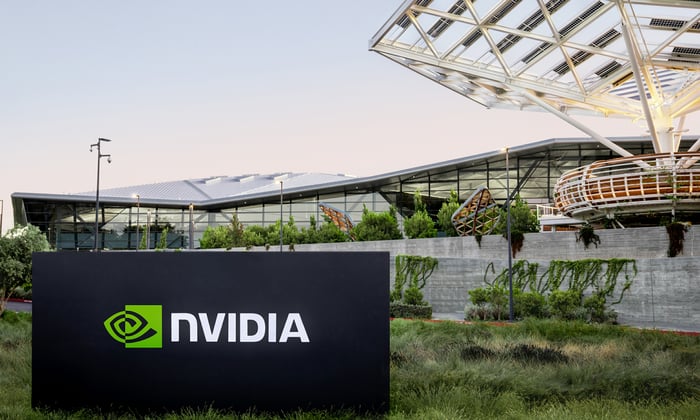
Image source: Nvidia.
Nvidia's valuation trends are getting interesting
In the table, I've summarized Nvidia's price-to-sales (P/S) and forward price-to-earnings (P/E) multiples, as of the end of each quarter over the last year.
| Metric | Current | 3Q25 | 2Q25 | 1Q25 | 4Q24 |
|---|---|---|---|---|---|
| Price-to-sales (P/S) | 23.3 | 30.2 | 29.6 | 20.7 | 26.4 |
| Forward price-to-earnings (P/E) | 23.4 | 31.5 | 57.4 | 24.8 | 28.1 |
Data source: Yahoo! Finance.
There are two anomalies that stick out from the data.
First, Nvidia's valuation multiples experienced notable compression during the company's first fiscal quarter of 2025 (ended April 30). This was driven by uncertainty surrounding President Trump's tariff policies, as well as fear that a Chinese start-up called DeepSeek could pose a threat to U.S. dominance in the AI landscape.
The second theme that's beginning to become more noticeable is that Nvidia's P/S and forward P/E ratios are hovering around the same levels as their prior lows earlier this year. Once again, I think this contraction revolves around fear more than anything else. Specifically, investors are concerned about rising competition from AMD and custom application-specific integrated circuits (ASICs) from Broadcom.
Is Nvidia stock a buy heading into the new year?
While rising competition in the chip space is a very real thing, I don't see Nvidia necessarily losing its grip anytime soon. AI infrastructure is expected to be a multitrillion-dollar market that lasts several years. Buying into the idea that the hyperscalers will migrate away from Nvidia's GPUs overnight is unrealistic.
Right now, Nvidia stock is becoming cheaper by the day despite the company operating at historic levels and signing new deals and partnerships -- effectively broadening its total addressable market (TAM) beyond data center services and simultaneously bringing new levels of business visibility as the AI infrastructure era kicks off.
I think now is a great time to buy the dip and capitalize on the chip king's ongoing sell-off. Investors with a long-term time horizon could use the recent depressed price action to add to a core buy-and-hold position. Given these dynamics, I see Nvidia as a no-brainer heading into the new year.
Should you buy stock in Nvidia right now?
Before you buy stock in Nvidia, consider this:
The Motley Fool Stock Advisor analyst team just identified what they believe are the 10 best stocks for investors to buy now… and Nvidia wasn’t one of them. The 10 stocks that made the cut could produce monster returns in the coming years.
Consider when Netflix made this list on December 17, 2004... if you invested $1,000 at the time of our recommendation, you’d have $509,039!* Or when Nvidia made this list on April 15, 2005... if you invested $1,000 at the time of our recommendation, you’d have $1,109,506!*
Now, it’s worth noting Stock Advisor’s total average return is 972% — a market-crushing outperformance compared to 193% for the S&P 500. Don't miss the latest top 10 list, available with Stock Advisor, and join an investing community built by individual investors for individual investors.
*Stock Advisor returns as of December 20, 2025.
Adam Spatacco has positions in Alphabet, Amazon, Meta Platforms, Microsoft, Nvidia, and Palantir Technologies. The Motley Fool has positions in and recommends Advanced Micro Devices, Alphabet, Amazon, Goldman Sachs Group, Intel, Meta Platforms, Microsoft, Nvidia, Palantir Technologies, and Taiwan Semiconductor Manufacturing. The Motley Fool recommends Broadcom and recommends the following options: long January 2026 $395 calls on Microsoft and short January 2026 $405 calls on Microsoft. The Motley Fool has a disclosure policy.
Mentioned In This Article
Latest News
| 11 min | |
| 25 min | |
| 25 min | |
| 40 min | |
| 1 hour | |
| 1 hour | |
| 1 hour | |
| 1 hour | |
| 1 hour | |
| 2 hours | |
| 3 hours | |
| 3 hours | |
| 3 hours | |
| 3 hours | |
| 3 hours |
