Everything Investors Need to Know About President Trump's Executive Order Reclassifying Marijuana as a Lower Class of Drug
Key Points
U.S. drug policy is dictated by the Controlled Substances Act.
The Controlled Substances Act categorizes drugs under different schedules and criteria.
Classifying marijuana as a Schedule III drug could benefit cannabis companies in several ways.
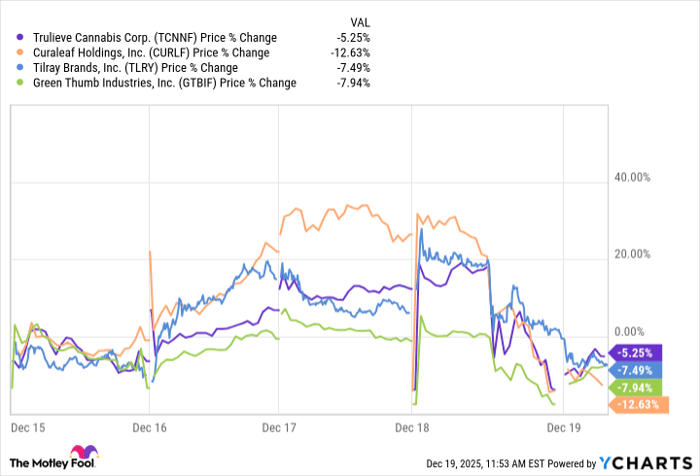
It's been quite an interesting week for cannabis stocks. Speculation that President Donald Trump was considering some policy changes around the classification of cannabis led to brief pops in shares of major players in the marijuana industry. These included Trulieve Cannabis, Curaleaf Holdings, Tilray Brands (NASDAQ: TLRY), and Green Thumb Industries.
Where to invest $1,000 right now? Our analyst team just revealed what they believe are the 10 best stocks to buy right now, when you join Stock Advisor. See the stocks »
On Dec. 18, Trump followed through and signed an executive order (EO) that paves the way for marijuana rescheduling. I'll explain why this new regulatory framework is important and how it affects marijuana businesses. From there, I'll explore why cannabis stocks sold off sharply to end the week and determine whether now might be an opportunity to buy the dip.
How Trump's marijuana rescheduling shifts U.S. drug policy
Drug policy in the U.S. is determined by the Controlled Substances Act (CSA). The legislation says substances are to be classified under one of five schedules, based on different criteria or qualifications.
Schedule I drugs are those that meet the following criteria:
- The substance has a high potential for abuse.
- It is not accepted as medical treatment in the U.S.
- It is not considered safe to use even under medical supervision.
So Schedule I narcotics fall under the strictest classification, and are perceived as presenting the highest risk for patients and consumers. Many of the substances classified under Schedule I are psychedelics.
Trump's EO reclassifies marijuana from a Schedule I narcotic to a Schedule III -- putting it in the same tier with anabolic steroids (performance-enhancing drugs), as well as ketamine.

Image source: Getty Images.
What does rescheduling change for the cannabis industry?
Rescheduling marijuana to a Schedule III narcotic potentially helps cannabis businesses in a few ways.
First, companies that sell marijuana or CBD products should face fewer roadblocks in both clinical research and financial regulation. In theory, this could help open the door for improved relationships with banks, which are restricted from serving businesses that sell products barred by federal law.
Moreover, should marijuana and CBD become more integrated into modern medicine, it wouldn't be surprising to see leading cannabis companies begin to partner with pharmaceutical giants.
Perhaps the biggest benefit to the industry from marijuana rescheduling would be lower taxes. Companies that sell Schedule I substances must abide by a federal tax provision known as 280E. Essentially, 280E prevents cannabis companies from deducting business expenses including rent, utilities, and certain wages from income.
With marijuana categorized under Schedule III, cannabis companies will be able to use these deductions to lower their taxable income. In the long run, higher profitability could help them both strengthen product development pipelines and more easily explore medical research.
Is now a good time to buy cannabis stocks?
As you can see in the chart above, cannabis stocks plummeted following the president signed the executive order. On the surface, this might seem counterintuitive. However, I think there are some legitimate reasons that influenced the reversal.
First, downgrading marijuana to a Schedule III substance should be seen as nothing more than a first step toward broader reform in the cannabis market. This reclassification doesn't legalize marijuana at the national level.
On top of that, implementation of this regulatory framework remains unknown. Rescheduling a drug may not necessarily lead to a meaningful increase in medical research, additional customers, or new products for cannabis businesses. With that in mind, it's tough to gauge how this development will move the needle financially for the marijuana industry.
Against this backdrop, I think the future of the cannabis market largely remains uncertain. That would mean that marijuana stocks are likely to continue being volatile.
While I find the president's decision interesting and potentially transformative for the broader medical sector, I don't see the ongoing volatility -- featuring sharp spells of both momentum and sell-offs -- as a prudent opportunity to invest in cannabis stocks right now.
If anything, the current state of cannabis stocks could be seen as a vehicle for day traders, as opposed to a durable opportunity for long-term investors seeking wealth creation.
Should you buy stock in Tilray Brands right now?
Before you buy stock in Tilray Brands, consider this:
The Motley Fool Stock Advisor analyst team just identified what they believe are the 10 best stocks for investors to buy now… and Tilray Brands wasn’t one of them. The 10 stocks that made the cut could produce monster returns in the coming years.
Consider when Netflix made this list on December 17, 2004... if you invested $1,000 at the time of our recommendation, you’d have $509,039!* Or when Nvidia made this list on April 15, 2005... if you invested $1,000 at the time of our recommendation, you’d have $1,109,506!*
Now, it’s worth noting Stock Advisor’s total average return is 972% — a market-crushing outperformance compared to 193% for the S&P 500. Don't miss the latest top 10 list, available with Stock Advisor, and join an investing community built by individual investors for individual investors.
*Stock Advisor returns as of December 23, 2025.
Adam Spatacco has no position in any of the stocks mentioned. The Motley Fool recommends Green Thumb Industries and Tilray Brands. The Motley Fool has a disclosure policy.
Mentioned In This Article
Latest News
| Oct-15 | |
| Oct-13 | |
| Oct-12 | |
| Oct-08 | |
| Oct-08 | |
| Oct-08 | |
| Oct-08 | |
| Oct-08 | |
| Oct-08 | |
| Oct-08 | |
| Oct-07 | |
| Oct-07 | |
| Sep-30 | |
| Sep-30 | |
| Sep-28 |
