Cintas' $5.2B UniFirst Bid Ignites the Battle for Route Dominance
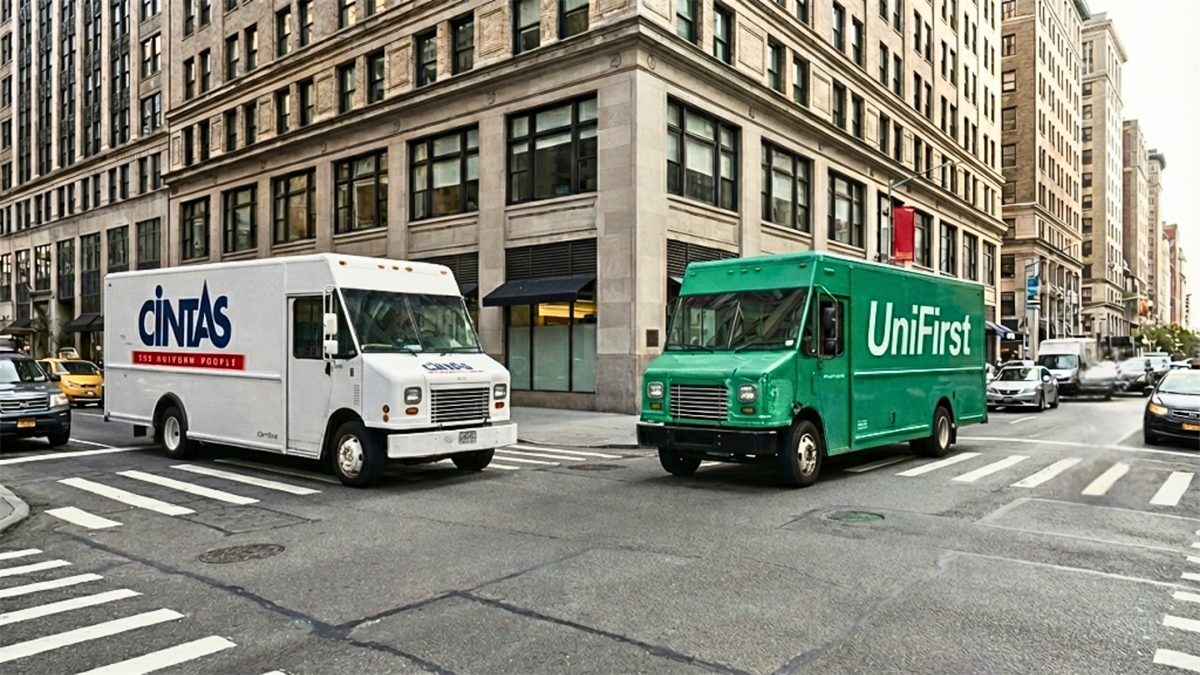
In the industrial services industry, efficiency is often measured by a single, ruthless metric: route density. The profitability of a uniform rental company depends heavily on how many stops a delivery truck can make per mile of travel.
When two competitors service the same street with two different trucks, fuel, labor, and maintenance resources are wasted. However, when one truck services every business on that street, margins expand significantly. This fundamental economic reality is the driving force behind the major announcement currently shaking up the facility services sector.
On Dec. 22, 2025, Cintas Corporation (NASDAQ: CTAS) moved to secure this density by submitting a proposal to acquire its smaller rival, UniFirst Corporation (NYSE: UNF). This aggressive bid aims to combine the first and third-largest players in the North American market, creating a dominant logistical network. For investors, the narrative has shifted from simple quarterly earnings to a high-stakes strategic play involving a substantial premium, complex governance hurdles, and the potential for massive operational savings.
The Cash Offer: Analyzing the $5.2 Billion Bid
The financial terms of the proposal are straightforward and aggressive. Cintas has offered to acquire all outstanding shares of UniFirst for $275 per share in an all-cash transaction. This valuation places a total enterprise value of approximately $5.2 billion on UniFirst. This valuation reflects a total enterprise value of about $275 per share in an all-cash deal.
For UniFirst shareholders, the offer represents an immediate and significant realization of value. The bid stands at a 64% premium over UniFirst’s 90-day volume-weighted average price prior to the announcement. In the world of mergers and acquisitions, premiums typically range between 20% and 40%. A 64% markup is a clear signal that Cintas is not testing the waters; they are intent on closing this deal.
The structure of the deal is equally important. By offering all cash, Cintas removes the risk of stock market volatility for UniFirst shareholders. Unlike a stock-for-stock merger, in which the payout value fluctuates with the acquirer’s share price, this offer provides a fixed, guaranteed exit price.
The market responded swiftly to the disclosure. UniFirst shares jumped between 16% and 38% in after-hours trading, reflecting investor excitement and the sudden closing of the valuation gap. Meanwhile, Cintas' stock price remained relatively stable. This stability from the acquirer’s stock often indicates that the market believes the purchase price, while high, is justified by the value the deal will generate over the long term.
Route Density: The $375 Million Opportunity
Why would Cintas pay such a steep premium? The answer lies in the one truck theory. Merging Cintas and UniFirst operations allows Cintas to eliminate redundant routes, effectively doubling the revenue per mile traveled without doubling costs.
Cintas projects these operational improvements will generate approximately $375 million in annual cost efficiencies. These savings are achieved by removing duplication in logistics, processing plants, and administrative overhead.
This strategy has a proven history. In 2017, Cintas successfully acquired and integrated G&K Services, migrating customers, optimizing routes, and expanding operating margins. The UniFirst proposal is a larger-scale version of that proven playbook. The $375 million in annual savings would significantly lower the effective price Cintas is paying for the company over time.
Closing the Gap: Strong Fundamentals, Stagnant Stock
This acquisition offer comes at a pivotal moment for UniFirst. The company is financially healthy, with recent strong financial results, but its stock performance has lagged behind that of its larger rival, creating friction with shareholders.
UniFirst is a strong target. In its fourth quarter of fiscal 2025, the company reported revenue of $614.45 million and earnings per share (EPS) of $2.28, both of which surpassed analyst expectations. Full fiscal year 2025 revenue reached $2.43 billion. Additionally, UniFirst has a solid balance sheet with a debt-to-equity ratio of just 0.03, making it an easier acquisition for Cintas as they are not taking on a significant liability burden.
Despite these solid fundamentals, activist investor Engine Capital has publicly pressured the UniFirst Board to sell. In letters sent to the board, Engine Capital highlighted that while Cintas' stock has appreciated nearly fivefold over the last decade, UniFirst shares have remained comparatively stagnant.
The disparity in valuation is also evident across the sector. Uniform rental companies like Cintas and UniFirst generally command higher stock multiples than general facility service providers, such as ABM Industries (NYSE: ABM), because uniform rental contracts are long-term and generate recurring revenue. By acquiring UniFirst, Cintas captures that high-quality revenue stream and applies its superior operating model to further widen margins, theoretically correcting the underperformance identified by the activists.
Regulatory Hurdles and Breakup Fees
Despite compelling economics, the deal faces a hurdle: the Croatti family. Their dual-class share structure gives them roughly 71% of the vote with only 19.6% economic interest, allowing them to block the sale, as they did in January 2025. However, the 64% premium (a $5.2 billion cash exit) creates immense pressure on the Board's fiduciary duty to all shareholders.
Combining the #1 and #3 market players poses antitrust risk and requires approval from the FTC. To mitigate this, Cintas included a $350 million reverse termination fee. This non-refundable deposit is an insurance policy for UniFirst shareholders, paid if regulators block the deal, signaling Cintas's confidence in closing the deal.
A Waiting Game: Value vs. Control
The proposed acquisition of UniFirst by Cintas is a classic example of strategic industry consolidation. For Cintas investors, it represents a bold use of capital to secure undisputed market dominance and drive long-term efficiency. The company is betting that its superior logistics network can extract hundreds of millions in value from UniFirst’s customer base.
For UniFirst investors, the offer provides an immediate, high-value exit that exceeds what the market has been willing to pay for the standalone company. The $275 cash offer is a tangible realization of the company's worth.
While negotiations regarding the family vote and regulatory approvals may take time, the industrial logic is undeniable. The potential to save $375 million annually by optimizing routes creates a powerful financial gravity pulling these two companies together. As the UniFirst Board reviews the offer with its advisors, the market waits to see if the price of uniformity is finally right.
Where Should You Invest $1,000 Right Now?
Before you make your next trade, you'll want to hear this.
MarketBeat keeps track of Wall Street's top-rated and best performing research analysts and the stocks they recommend to their clients on a daily basis.
Our team has identified the five stocks that top analysts are quietly whispering to their clients to buy now before the broader market catches on... and none of the big name stocks were on the list.
They believe these five stocks are the five best companies for investors to buy now...
The article "Cintas’ $5.2B UniFirst Bid Ignites the Battle for Route Dominance" first appeared on MarketBeat.
Mentioned In This Article
Latest News
| Oct-06 | |
| Oct-01 | |
| Sep-30 | |
| Sep-29 | |
| Sep-24 | |
| Sep-24 | |
| Sep-23 | |
| Sep-23 | |
| Sep-23 | |
| Sep-23 | |
| Sep-23 | |
| Sep-23 | |
| Sep-22 | |
| Sep-16 | |
| Sep-16 |
