|
|
|

|
|||||
|
|
|
Baidu’s BIDU AI Cloud business is gaining strategic significance as the company sharpens its focus on scaling its foundation model ecosystem and deepening enterprise use cases. The introduction of ERNIE 5.0, built with native omni-modal capabilities across multimodal understanding, creative writing and instruction following, is expected to further strengthen Baidu’s technological depth in China’s increasingly competitive AI infrastructure market. The model is positioned to enhance interoperability across BIDU’s four-layer AI architecture and is likely to support a broader push to embed generative AI more deeply into enterprise workflows over time.
Qianfan, Baidu’s Model-as-a-Service platform, has been upgraded to an agent-centric architecture that is expected to play a central role in driving future AI Cloud adoption. By integrating ERNIE 5.0 with an expanded model library, third-party tools and stronger support for complex agent workflows, Qianfan is increasingly positioned to enable enterprises to build, deploy and scale AI agents with lower friction. This infrastructure-led approach is anticipated to support continued expansion in non-marketing revenues. In the third quarter of 2025, AI Cloud Infrastructure revenue reached RMB 4.2 billion, up 33% year over year, while subscription-based AI accelerator infrastructure revenue surged 128%, suggesting a shift toward recurring, inference-heavy workloads that should improve revenue visibility going forward.
However, the transition is likely to remain margin-intensive in the near term. The Zacks Consensus Estimate for Baidu’s fourth-quarter 2025 revenues is pegged at $4.62 billion, indicating a 1.09% year-over-year decline as investments in AI Search transformation and cloud infrastructure are expected to outweigh short-term profitability considerations. AI Cloud is still in a scaling phase, but sustained uptake of ERNIE-powered agents through Qianfan is expected to be a key determinant of whether Baidu can convert its technological lead into a durable, long-term AI Cloud advantage.
Baidu’s AI Cloud expansion is unfolding amid rising competition from Alibaba BABA and Tencent TCEHY, both pursuing parallel enterprise AI strategies. Alibaba deploys its Tongyi Qianwen foundation model through Alibaba Cloud, integrating AI across e-commerce and cloud services and positioning Alibaba as a major force in China’s AI infrastructure market. Tencent leverages its Hunyuan model via Tencent Cloud, embedding AI across gaming, social and enterprise applications. Market differentiation among Alibaba, Tencent and Baidu will hinge on demonstrating measurable enterprise value and achieving AI Cloud profitability.
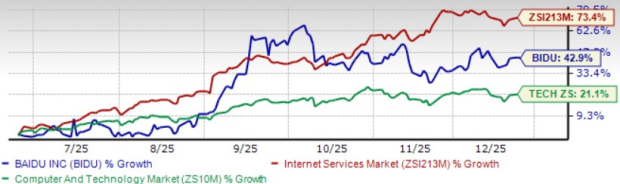
Baidu’s shares have appreciated 42.9% in the past six months, underperforming the Zacks Internet - Services industry’s jump of 73.4% but beating the Zacks Computer and Technology sector’s growth of 21.1%.
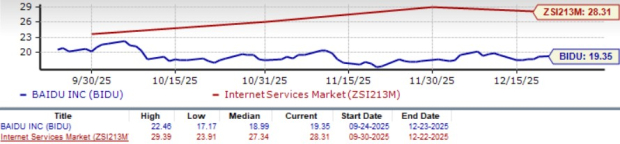
From a valuation standpoint, BIDU’s forward 12-month price/earnings ratio is 19.35X, which is below the industry average of 28.31X. BIDU has a Value Score of C.
The Zacks Consensus Estimate for BIDU’s fourth-quarter 2025 earnings is pegged at $1.5 per share, down by 5 cents over the past 60 days, indicating a 42.97% year-over-year decline.

Baidu, Inc. price-consensus-chart | Baidu, Inc. Quote
Baidu currently carries a Zacks Rank #3 (Hold). You can see the complete list of today’s Zacks #1 Rank (Strong Buy) stocks here.
Want the latest recommendations from Zacks Investment Research? Today, you can download 7 Best Stocks for the Next 30 Days. Click to get this free report
This article originally published on Zacks Investment Research (zacks.com).
| 1 hour | |
| 2 hours | |
| 2 hours | |
| 4 hours | |
| Mar-16 | |
| Mar-16 | |
| Mar-16 | |
| Mar-16 | |
| Mar-16 | |
| Mar-16 | |
| Mar-16 | |
| Mar-16 | |
| Mar-16 | |
| Mar-14 | |
| Mar-13 |

Join thousands of traders who make more informed decisions with our premium features. Real-time quotes, advanced visualizations, backtesting, and much more.
Learn more about Finviz Elite