Is CMG Sacrificing Near-Term Margins to Protect Long-Term Demand?
Chipotle Mexican Grill, Inc. CMG appears increasingly willing to absorb near-term margin pressure to safeguard traffic and brand demand amid a challenging consumer backdrop. Management made it clear on the third quarter of 2025 earnings call that pricing will no longer be used aggressively to offset inflation, even as cost pressures accelerate into the mid-single-digit range.
Restaurant-level margin declined 100 basis points year over year to 24.5% in third-quarter 2025, reflecting higher marketing spend, wage inflation, and the company’s decision not to fully pass through rising food and tariff costs. Rather than protecting margins, CMG is leaning into value perception, expanding portions, stepping up menu innovation, and increasing marketing to drive transactions, particularly among lower- and middle-income consumers who have pulled back dining frequency.
Importantly, management framed this margin compression as a temporary “dislocation,” not a structural reset. Chipotle continues to price below peers, widening its relative value gap, while betting that improved execution, loyalty engagement, and innovation will restore traffic once consumer conditions stabilize. Investments in throughput-enhancing equipment and digital accuracy further signal a focus on experience over short-term profitability.
The company’s near-term earnings leverage may remain muted in 2026, especially as pricing lags inflation. However, Chipotle’s history suggests that transaction-led recoveries can eventually restore margin flow-through. In that context, today’s margin sacrifice looks less like weakness and more like a strategic choice, prioritizing long-term demand durability over short-term financial optics.
How CMG’s Margin Trade-Off Compares With Peers
Chipotle is not alone in balancing margins against demand, but its strategy diverges from how other public fast-casual players are responding to consumer pressure.
Sweetgreen SG has leaned into menu innovation, labor optimization, and selective pricing to stabilize traffic, while still working toward margin recovery. Unlike Chipotle, Sweetgreen’s margin profile remains more fragile, making it less flexible in absorbing sustained inflation without pricing action.
Meanwhile, CAVA Group CAVA has leaned into menu innovation and throughput improvements to drive traffic, while using measured pricing to offset inflation. CAVA’s growth-stage profile allows for reinvestment, but sustained cost pressures could test margin expansion ambitions.
Compared with these peers, CMG’s strategy stands out for its willingness to accept near-term margin pressure without aggressive discounting, reinforcing brand value and positioning the company to capture demand when consumer spending stabilizes.
CMG’s Price Performance, Valuation and Estimates
Chipotle’s shares have lost 31.6% in the past six months compared with the industry’s decline of 3.7%.
Price Performance

Image Source: Zacks Investment Research
From a valuation standpoint, CMG trades at a forward price-to-sales ratio of 3.82X, down from the industry’s average.
P/S (F12M)
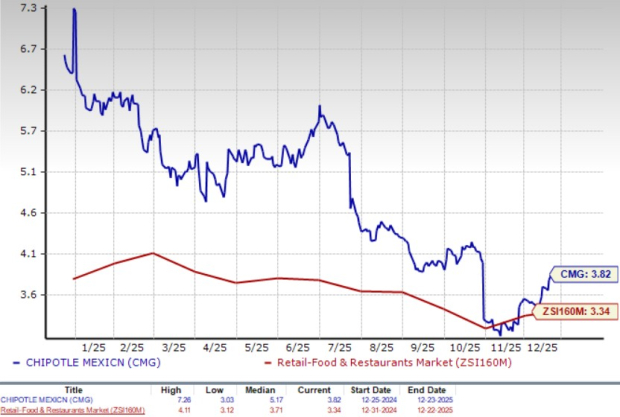
Image Source: Zacks Investment Research
The Zacks Consensus Estimate for CMG’s 2025 and 2026 earnings implies a year-over-year uptick of 3.6% and 4.7%, respectively.

Image Source: Zacks Investment Research
Chipotle currently has a Zacks Rank #4 (Sell).
You can see the complete list of today’s Zacks #1 Rank (Strong Buy) stocks here.
Want the latest recommendations from Zacks Investment Research? Today, you can download 7 Best Stocks for the Next 30 Days. Click to get this free report
Chipotle Mexican Grill, Inc. (CMG): Free Stock Analysis Report
Sweetgreen, Inc. (SG): Free Stock Analysis Report
CAVA Group, Inc. (CAVA): Free Stock Analysis Report
This article originally published on Zacks Investment Research (zacks.com).
Mentioned In This Article
Latest News
| 5 hours | |
| 9 hours | |
| 10 hours | |
| 10 hours | |
| 13 hours | |
| 15 hours | |
| 16 hours | |
| 17 hours | |
| 22 hours | |
| Oct-08 | |
| Oct-08 | |
| Oct-08 | |
| Oct-08 | |
| Oct-08 |
Starbucks Says It Is 'Laser-Focused' on Existing Strategy Following Chipotle Deal Chatter
CMG +6.21%
The Wall Street Journal
|
| Oct-08 |
