|
|
|

|
|||||
|
|
|
Wells Fargo & Company’s WFC shares touched a new 52-week high of $94.68 during yesterday’s trading session, before closing at $94.47. The rally was driven by optimism surrounding the company’s plan to enter the options clearing business, reflecting rising demand from clients as options trading activity increases across markets. The strategic move follows the June 2025 removal of the regulatory asset cap that had constrained Wells Fargo's balance sheet since 2017.
Further, the strength in WFC stock can also be attributed to broader market strength, after economic data showed that the U.S. economy grew well above expectations in the third quarter. This, along with optimism around a stronger growth outlook for 2026, bolstered investors’ sentiments in the banking stocks, including WFC, Bank of America BAC and Citigroup Inc. C.
Over the past year, WFC stock has gained 33.3%, compared with the industry’s growth of 37.5%. Further, shares of the company’s peers, Bank of America and Citigroup, also gained 27.1% and 72.5%, respectively.
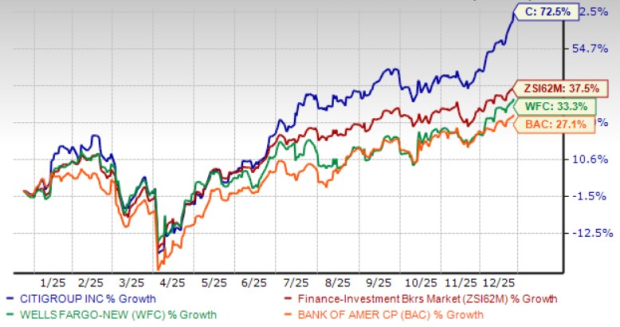
After such a strong rally, investors are now questioning whether Wells Fargo stock has more upside left. Let us find out.
Asset Cap Removal to Support Growth: Wells Fargo reached a key milestone in June 2025 when the Federal Reserve lifted the asset cap imposed in 2018 following the bank’s fake account scandal. The removal eliminates a long-standing constraint on balance-sheet expansion, allowing the company to grow deposits, increase loan balances and expand securities holdings, thereby unlocking its full operating potential.
The regulatory relief also provides WFC with greater flexibility to scale fee-based businesses, including payment services, asset management, and mortgage origination, supporting revenue diversification and long-term top-line growth. With greater strategic flexibility and improved earnings visibility, management raised the company’s medium-term return on tangible common equity (ROTCE) target to 17%–18% from the earlier 15%, indicating stronger profitability prospects over the next few years.
Business Simplification to Strengthen Core Focus: As part of its ongoing strategy to streamline operations and sharpen focus on core banking franchises, Wells Fargo has continued to exit non-core and lower-return businesses. In May 2025, the company agreed to sell its rail lease portfolio to a joint venture of GATX and Brookfield, which aims to free up capital for WFC’s main lending and fee-based businesses. The deal is expected to close around Jan.1, 2026.
Earlier, in March 2025, Wells Fargo completed the sale of its non-agency third-party commercial mortgage servicing business to Trimont, backed by Värde Partners, significantly lowering exposure to operationally complex commercial real estate servicing activities. In September 2023, the company also sold approximately $2 billion of private equity fund investments in Norwest Equity Partners and Norwest Mezzanine Partners to a group of institutional investors, further aligning its investment portfolio with core banking priorities.
Overall, these simplification efforts are expected to lower operational risk, improve capital efficiency and enable WFC to redeploy resources toward higher-return areas.
Fed Rate Cuts to Support NII: Over the past few years, Wells Fargo’s net interest income (NII) has shown steady improvement, posting a three-year CAGR of 10%. In the first nine months of 2025, net interest income (NII) declined 1.9% to $35.15 billion, reflecting some pressure from elevated funding costs.
The Federal Reserve reduced interest rates by 75 basis points in 2025, following a 100-basis-point cut in 2024, and has signaled an additional rate cut in 2026. This is expected to gradually stabilize funding costs and improve loan demand, providing support to Wells Fargo, Bank of America and Citigroup’s NII growth in the upcoming period.
Initiatives to Drive Cost Efficiency: The company has been making progress on various initiatives to achieve cost efficiency. Since the third quarter of 2020, the company has been actively engaging in cost-cutting measures, including streamlining its organizational structure, closing branches and reducing headcount.
The company keeps investing in and optimizing its branch network to reduce costs. By the end of the third quarter of 2025, branches declined 2.1% to 4,108. Although Wells Fargo has reduced its overall footprint over the past decade, it has also invested in branch renovations and new locations as part of a broader growth strategy. The ongoing upgrades aim to foster a more growth-oriented culture. By the end of 2025, slightly more than half of the branch network is expected to be refreshed, with renovations already completed in Charlotte, Miami, Minneapolis, Philadelphia, San Diego, and Washington, D.C., while Los Angeles, San Francisco, and Atlanta are scheduled for 2026.
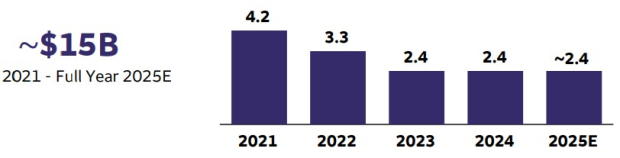
The company headcount was reduced 4.3% year over year to 211 by the end of the third quarter of 2025. At the Goldman Sachs 2025 conference held on Dec. 9, Wells Fargo signaled that its workforce could shrink further in 2026 as part of a broader push to improve efficiency and incorporate artificial intelligence (AI) across its operations. These efforts, along with continued investments in digital infrastructure and process automation, are expected to generate sustained expense savings and enhance overall profitability. By the end of this year, WFC expects to have achieved nearly $15 billion of gross expense savings.
These renovations also combine physical presence with modern digital tools, leveraging Wells Fargo’s wide geographic reach as a competitive advantage.
AI Initiatives to Boost Efficiency: Wells Fargo is advancing its operational transformation through a phased AI rollout, aimed at improving productivity, streamlining workflows, and enhancing customer service. In August 2025, the company expanded its strategic partnership with Google Cloud to deploy generative and agentic AI tools at scale.
The bank also plans to introduce AI gradually over the next year and continue expanding its use beyond 2026. Management characterized the transition as a “positive reality,” suggesting that AI-enabled efficiencies will support long-term operational improvements.
AI adoption has already increased productivity by 30%–35% within the bank’s engineering teams.
Additionally, AI tools are being integrated into commercial banking platforms and customer-facing operations, enabling personalized guidance, faster decision-making and more innovative product offerings. By combining automation with analytics, Wells Fargo aims to optimize workforce allocation, improve service quality and create measurable operational efficiencies throughout its business.
The Zacks Consensus Estimate for WFC’s 2025 and 2026 earnings indicates a 16.7% and 11.9% rise, respectively. Over the past 60 days, the Zacks Consensus Estimate for 2025 and 2026 earnings has been revised upward.

In terms of valuation, WFC stock appears inexpensive relative to the industry. The company is currently trading at a 12-month trailing price-to-earnings (P/E) ratio of 13.50x, which is lower than the industry’s 15.32x.
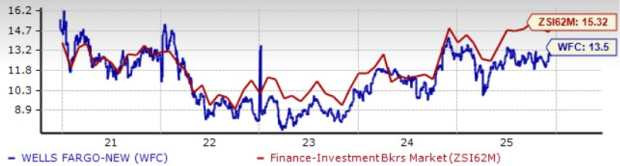
Meanwhile, Citigroup holds a P/E ratio of 11.94X, while Bank of America’s P/E ratio stands at 12.94X.
Wells Fargo’s climb to a new 52-week high underscores growing investor confidence in the bank’s improving fundamentals and strategic reset. The removal of the long-standing asset cap has unlocked balance-sheet growth, while ongoing business simplification, disciplined expense management, and expanding fee-based initiatives—such as entering options clearing—strengthen the company’s earnings profile. Fed rate cuts and a favorable macroeconomic backdrop heading into 2026 further support the outlook. Also, the bank’s ongoing cost-cutting and branch optimization efforts enhance efficiency.
On the capital front, the bank plans to manage its common equity tier 1 (CET1) ratio down to 10-10.5% from more than 11% in each of the past nine quarters, thereby optimizing capital usage and enhancing returns. As such, with disciplined cost management and improved revenue momentum, along with capital management, Wells Fargo anticipates meaningful margin expansion, positioning it well to achieve its ROTCE goal of 17%-18% over the medium term.
Overall, Wells Fargo offers decent upside over the longer horizon. Hence, investors can consider keeping WFC stock on their radar to generate healthy long-term returns.
The company currently carries a Zacks Rank #3 (Hold). You can see the complete list of today’s Zacks #1 Rank (Strong Buy) stocks here.
Want the latest recommendations from Zacks Investment Research? Today, you can download 7 Best Stocks for the Next 30 Days. Click to get this free report
This article originally published on Zacks Investment Research (zacks.com).
| 21 min | |
| 3 hours | |
| 3 hours | |
| 11 hours | |
| Apr-01 | |
| Apr-01 | |
| Apr-01 | |
| Apr-01 | |
| Apr-01 | |
| Apr-01 | |
| Apr-01 | |
| Apr-01 | |
| Apr-01 | |
| Apr-01 | |
| Mar-31 |

Join thousands of traders who make more informed decisions with our premium features. Real-time quotes, advanced visualizations, alerts, and much more.
Learn more about Finviz Elite