|
|
|

|
|||||
|
|
|
Microsoft Corp. (NASDAQ: MSFT) stock is up more than 15% in 2025. Even after the latest slide in technology stocks, the stock is still up about 3% in the last month.
But it doesn’t feel like a great year for MSFT investors. The stock is down about 12% from its 52-week high set in late October. Analyst sentiment is bullish, but short interest is also high, up approximately 27% over the last month and has been weighing on the stock.
The good news for investors is that in the last month, Microsoft stock has appeared to find a floor around $473 per share. However, a concern is that the stock has also found an area of resistance at around $493. This could indicate a healthy consolidation, or it might suggest that investors remain worried about the stock’s valuation amid potential business headwinds.
Even at 37x forward earnings, MSFT stock is only trading at a slight premium to its historical average. But the general sense is that the stock is expensive. One reason for that stems from concerns about the company’s Copilot ambitions. Copilot is the company’s agentic AI solution, which recent headlines suggest may not be gaining the adoption that Microsoft had hoped for.
Microsoft is also experiencing the other side of the coin as it relates to its relationship with OpenAI. This has been a tailwind for the company for much of 2024 and 2025, giving Microsoft a first-mover advantage in AI. But as competition emerges in the space, OpenAI is starting to look more like a liability for Microsoft.
Microsoft is a classic example of a company with a strong competitive moat. Its Windows 365 and Office platforms are deeply embedded in enterprise workflows, and its Azure cloud platform is a core part of global cloud infrastructure. This makes the switching cost extremely high for customers.
In this case, the company’s Windows 365 and Office platforms are already deeply embedded in enterprise workflows. The company’s cloud computing platform, Azure, is a core part of global cloud infrastructure. This makes the switching cost extremely high for customers.
As organizations adopt more of Microsoft’s stack, which now includes Copilot‑branded AI embedded across productivity and business apps, the value proposition increases. Each additional component increases the value of the others, reinforcing network effects and making alternative point solutions look fragmented and harder to justify.
For a modern enterprise, “replacing Microsoft” means re‑platforming identity, productivity, collaboration, data, and increasingly AI. That can take years and cost millions. On top of that, long‑term license commitments and potential penalties, plus the business disruption risk during a migration, make CIOs treat a full-stack switch as a board‑level, career‑risking decision rather than a routine vendor optimization.
Shares of Microsoft stock jumped higher after the belated read on November inflation came in cooler than expected. For now, that has alleviated concerns about an AI bubble. Microsoft is a company at the center of that debate because of the billions of dollars in capital expenditures it has committed to building out data centers to support its artificial intelligence ambitions.
Technical indicators, such as the MACD and the relative strength indicator, are currently neutral. What may be lacking at this point is volume.
The bull case would be for MSFT stock to make a bullish move above its 50-day simple moving average (SMA). On the other hand, if the stock’s 50-day SMA were to cross below its 200-day SMA (i.e., a Death Cross pattern), it could signal more downside to start the year.
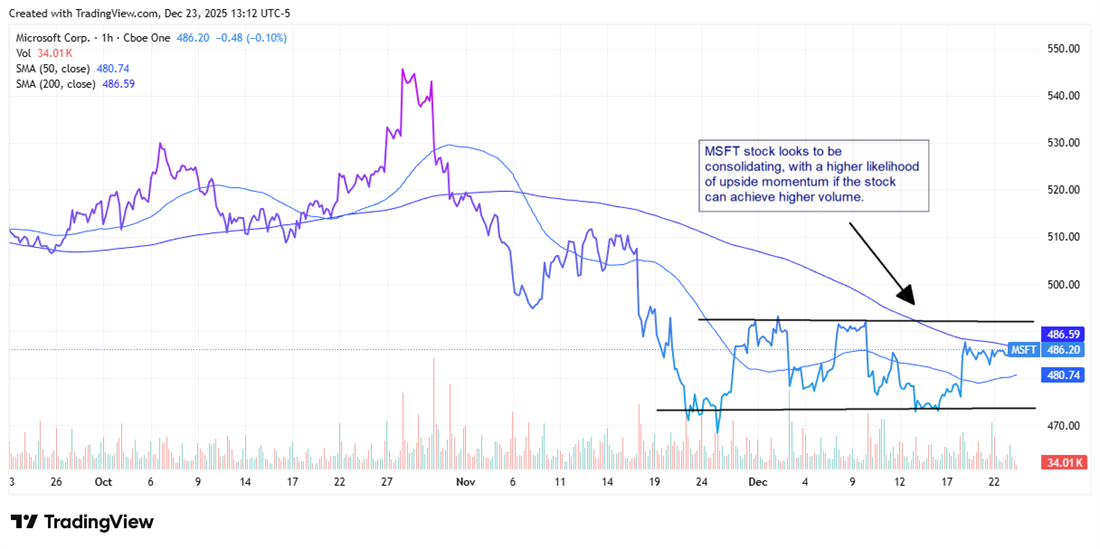
The key will be volume. A Santa Claus rally could bring some upside, but investors will want to wait until the new year to see if those gains are sustainable.
Before you make your next trade, you'll want to hear this.
MarketBeat keeps track of Wall Street's top-rated and best performing research analysts and the stocks they recommend to their clients on a daily basis.
Our team has identified the five stocks that top analysts are quietly whispering to their clients to buy now before the broader market catches on... and none of the big name stocks were on the list.
They believe these five stocks are the five best companies for investors to buy now...
The article "Microsoft May Look Pricey, But Customers Can’t Walk Away" first appeared on MarketBeat.
| 15 min | |
| 1 hour | |
| 4 hours | |
| Apr-01 | |
| Apr-01 | |
| Apr-01 | |
| Apr-01 | |
| Apr-01 | |
| Apr-01 | |
| Apr-01 | |
| Apr-01 | |
| Apr-01 | |
| Apr-01 | |
| Apr-01 | |
| Apr-01 |

Join thousands of traders who make more informed decisions with our premium features. Real-time quotes, advanced visualizations, alerts, and much more.
Learn more about Finviz Elite