|
|
|

|
|||||
|
|
|
Microsoft's MSFT Dynamics 365 suite is emerging as a significant growth driver that could propel the stock higher, with the business applications platform demonstrating robust momentum in the enterprise market. The company's Dynamics 365 revenues surged 21% in constant currency during the first quarter of fiscal 2026, outpacing broader cloud services growth and signaling strong enterprise adoption.
The platform's success stems from its comprehensive integration of customer relationship management and enterprise resource planning capabilities, enhanced by artificial intelligence features through Copilot. Organizations are increasingly adopting Dynamics 365 to streamline operations, with the solution processing more than 10 billion customer interactions monthly across its ecosystem. The business applications segment now serves more than 46,000 organizations globally, reflecting expanding market penetration.
Microsoft's strategic investments in AI-powered automation within Dynamics 365 are differentiating the platform from competitors. Features like Copilot for Sales and Customer Service are reducing manual workflows while improving decision-making accuracy. The company reported that organizations using AI-enhanced Dynamics applications achieved 30% faster case resolution times, driving measurable productivity gains.
The commercial cloud infrastructure supporting Dynamics 365 provides additional upside potential. As enterprises expand their digital transformation initiatives, the platform benefits from network effects and increasing customer lifetime value. With Dynamics 365's growth trajectory exceeding overall commercial cloud expansion and strong renewal rates indicating customer satisfaction, the business applications segment represents a compelling catalyst for Microsoft's stock appreciation. The combination of market share gains, AI integration, and operational leverage positions Dynamics 365 as a sustained revenue growth engine through fiscal 2026.
Oracle ORCL and Salesforce CRM remain formidable competitors in the business applications space. Oracle reported that its Fusion Cloud Applications revenues grew 17% in constant currency during its recent quarter, with Oracle's cloud ERP and HCM solutions gaining traction among large enterprises. Salesforce delivered 8% revenue growth in its latest quarter, though Salesforce's core CRM platform faces pricing pressures. Oracle continues investing heavily in AI capabilities across its applications suite, while Salesforce has integrated Einstein AI features throughout its Service Cloud and Sales Cloud offerings. Both Oracle and Salesforce maintain substantial installed bases, though growth rates vary across their respective product portfolios as market competition intensifies.
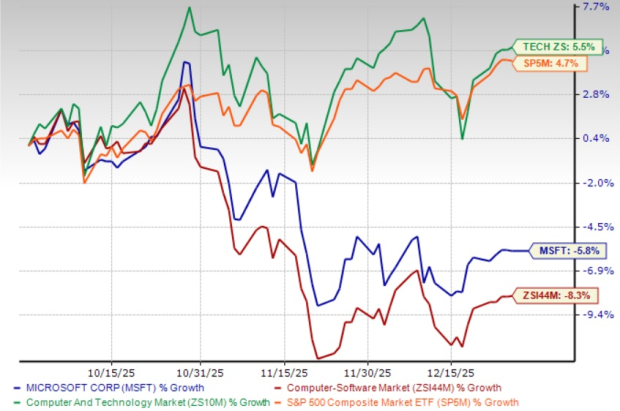
MSFT shares have lost 5.8% in the past three-month period, underperforming the Zacks Computer – Software industry's decline of 8.3% and the Zacks Computer and Technology sector's return of 5.5%.
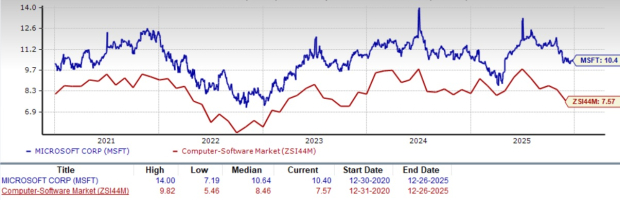
From a valuation standpoint, MSFT stock is currently trading at a forward 12-month Price/Sales ratio of 10.4X compared with the industry’s 7.57X. MSFT has a Value Score of D.
The Zacks Consensus Estimate for MSFT’s fiscal 2026 earnings is pegged at $15.59 per share, up 0.3% over the past 30 days. The estimate indicates 14.3% year-over-year growth.

Microsoft Corporation price-consensus-chart | Microsoft Corporation Quote
Microsoft currently carries a Zacks Rank #3 (Hold). You can see the complete list of today’s Zacks #1 Rank (Strong Buy) stocks here.
Want the latest recommendations from Zacks Investment Research? Today, you can download 7 Best Stocks for the Next 30 Days. Click to get this free report
This article originally published on Zacks Investment Research (zacks.com).
| 6 min | |
| 21 min | |
| 23 min | |
| 46 min | |
| 2 hours | |
| 2 hours | |
| 2 hours | |
| 3 hours | |
| 4 hours | |
| 5 hours | |
| 6 hours | |
| Apr-01 | |
| Apr-01 | |
| Apr-01 | |
| Apr-01 |

Join thousands of traders who make more informed decisions with our premium features. Real-time quotes, advanced visualizations, alerts, and much more.
Learn more about Finviz Elite