Prediction: This Company Is All Set to Hit a $5 Trillion Market Cap in 2026 (Hint: It's Not Nvidia)
Key Points
Alphabet is currently the third-largest company in the world and on track to benefit from the adoption of AI in multiple areas.
Analysts may be underestimating Alphabet's growth potential for 2026.
The company's stock is attractively valued right now but could trade at a premium after a year, thanks to a potential acceleration in its growth.
Nvidia (NASDAQ: NVDA) officially became the first company in the world to hit a $5 trillion market cap in 2025. The chip giant's rise to this milestone has been deserved, as its business has been growing at a remarkable pace on the back of the fast-growing demand for artificial intelligence (AI) accelerator chips deployed in data centers.
However, a few factors have weighed on Nvidia stock since it hit that mark a couple of months ago. The chip designer has lost 8% of its value after hitting a 52-week high on Oct. 29. Investors have been worried about the viability of debt-fueled AI infrastructure investments, as well as the returns that the huge spending on AI could deliver for the key names in this space.
Where to invest $1,000 right now? Our analyst team just revealed what they believe are the 10 best stocks to buy right now. Continue »
The good news is that Nvidia could overcome these headwinds in 2026 and jump significantly. The stock's 12-month median price target of $250 suggests that it can rise 31% from current levels by next year, which will be enough for it to reclaim the $5 trillion market-cap level once again (it currently has a market cap of $4.64 trillion).
Investors, however, would do well to take a closer look at another "Magnificent Seven" stock that looks all set to achieve a $5 trillion market cap in 2026 -- Alphabet (NASDAQ: GOOG) (NASDAQ: GOOGL). Below, I'll look at the reasons this technology giant is capable of hitting that target in the new year.

Image source: Alphabet.
AI is going to be a bigger catalyst for Alphabet in 2026
Alphabet is the third-largest company in the world, as of this writing, with a market cap of $3.8 trillion. The stock, therefore, needs to appreciate by another 32% to reach a $5 trillion market cap. It could easily jump by that much in the new year when you consider its full-stack approach to delivering AI tools and services to customers.
While Nvidia is primarily in the business of selling AI chip systems powered by its graphics processing units (GPUs), Alphabet offers multiple customer-facing AI apps and tools. These include chatbots, AI-equipped search features, advertising solutions, and AI-focused cloud computing tools, powered by both in-house chips and external processors -- such as those from Nvidia.
Alphabet's diversified presence across multiple AI niches means it's better positioned to capitalize on the proliferation of AI. For instance, the adoption of AI in the advertising space is anticipated to grow at 28% a year through 2033, generating almost $82 billion in revenue at the end of the forecast period. Additionally, the overall digital-advertising market that Alphabet serves is likely to cross $1.1 trillion in size by the end of the decade.
Alphabet's AI-focused ad tools should allow it to corner a sizable chunk of this massive addressable market. That's because AI-powered advertising is helping advertisers and brands enjoy higher returns on investment. According to media audience measurement firm Nielsen, AI-enabled video ad campaigns on YouTube are driving a 17% increase in advertisers' returns.
Other AI-enabled advertising tools from Alphabet, such as Performance Max, Broad Match, and Demand Gen, are also driving double-digit growth in advertisers' returns, apart from driving higher conversion rates when compared to manual ad campaigns. As a result, there's a strong possibility of an acceleration in Alphabet's advertising growth in the future.
At the same time, the Google Cloud business is gaining solid traction. That's not surprising, as Alphabet points out that customers using its Google Cloud AI solutions are witnessing a terrific average return of 727% in just three years. Businesses using its cloud AI tools can expect a payback on their investment in around eight months and witness a significant increase in employee productivity.
All this explains why Alphabet's Google Cloud revenue jumped by 34% year over year in the third quarter to $15.2 billion. That was faster than the 28% year-over-year increase in the overall cloud market's revenue in Q3, indicating that the tech giant is now gaining market share. What's more, Google Cloud's backlog increased by a whopping $49 billion on a sequential basis in the previous quarter to $155 billion.
As such, there's a solid chance of Alphabet's growth rate accelerating in 2026, and that should be enough for it to enter the $5 trillion club.
Why a $5 trillion market-cap milestone looks like a possibility
Analysts are expecting a 14% increase in Alphabet's top line in 2025 to $400 billion. That's almost in line with what it reported in 2024. It's worth noting that Alphabet's revenue estimates for 2025 and 2026 have jumped higher of late.
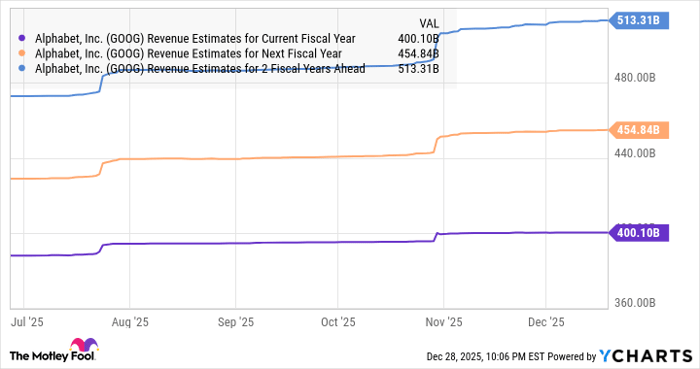
GOOG Revenue Estimates for Current Fiscal Year data by YCharts.
Consensus estimates are projecting another 14% jump in the company's top line in 2026, as evident from the chart above. However, the improving backlog in the cloud business, the growing adoption of its AI offerings such as Gemini, and the boost that advertisers are getting from Alphabet's AI tools could help it grow at a faster pace.
Let's assume Alphabet's revenue growth accelerates to 20% in 2026; its top line could jump to $480 billion. If it maintains its price-to-sales ratio of 10 after a year, its market cap could get close to $5 trillion.
Of course, you may think that Alphabet is falling slightly short of that mark. However, the market could reward it with a higher sales multiple owing to its accelerating growth, which should be enough for it to achieve the $5 trillion milestone.
Should you buy stock in Alphabet right now?
Before you buy stock in Alphabet, consider this:
The Motley Fool Stock Advisor analyst team just identified what they believe are the 10 best stocks for investors to buy now… and Alphabet wasn’t one of them. The 10 stocks that made the cut could produce monster returns in the coming years.
Consider when Netflix made this list on December 17, 2004... if you invested $1,000 at the time of our recommendation, you’d have $507,744!* Or when Nvidia made this list on April 15, 2005... if you invested $1,000 at the time of our recommendation, you’d have $1,153,827!*
Now, it’s worth noting Stock Advisor’s total average return is 983% — a market-crushing outperformance compared to 195% for the S&P 500. Don't miss the latest top 10 list, available with Stock Advisor, and join an investing community built by individual investors for individual investors.
*Stock Advisor returns as of December 30, 2025.
Harsh Chauhan has no position in any of the stocks mentioned. The Motley Fool has positions in and recommends Alphabet and Nvidia. The Motley Fool has a disclosure policy.
Mentioned In This Article
Latest News
| 45 min | |
| Oct-10 | |
| Oct-10 | |
| Oct-10 | |
| Oct-09 | |
| Oct-09 | |
| Oct-09 | |
| Oct-09 | |
| Oct-09 | |
| Oct-09 | |
| Oct-09 | |
| Oct-09 | |
| Oct-09 | |
| Oct-09 | |
| Oct-09 |
