Will the Fed Cut or Pause? These Finance Stocks Can Win Either Way

Will they or won’t they? Stocks have moved higher in the last quarter of 2025 as the Federal Reserve started to cut interest rates. However, investors are wondering what’s next. There are arguments for cutting or for pausing, and even the Federal Reserve is divided on the next move.
There are several arguments for cutting. Looser monetary policy is generally bullish for stocks for a variety of reasons, including lower borrowing costs for businesses. That could also fuel hiring, which would reverse the current trend.
Income investors also find that stocks, particularly dividend stocks, may provide a better return than Treasuries or other fixed-income assets.
There’s also the matter of the national debt. The U.S. Treasury has to refinance over $10 trillion of debt in the next 12 months. There’s no question that it would like to finance that debt at much lower rates.
On the other hand, some analysts choose to look at inflation. The rate of growth is slowing but is still above the Fed’s desired 2% target.
So far, two rate cuts haven’t caused an inflation spike, but it’s too early to call the all clear. That’s because many of the stimulative provisions from the One Big Beautiful Bill kick in for 2026. As investors saw in 2020, when consumers have more money to spend, they generally spend.
Those questions will start being answered at the first Federal Reserve meeting in January. Until then, it’s a good idea to look at stocks that look like solid buys, whether there’s a cut or a pause. Finance stocks will be one area to watch. Here are three candidates.
Built to Monetize Either Side of the Rate Cycle
Bank of America (NYSE: BAC) offers a scaled, diversified banking platform that is built to monetize both sides of the rate cycle. Management has already shown that deposit costs can be controlled without materially destabilizing the franchise. That's important if policy rates drift lower slower than the market once anticipated.
The bank’s technology and AI investments are designed to expand operating leverage over time. This means modest top‑line growth can still translate into attractive earnings and capital returns, supporting a long‑term buy‑and‑hold case.
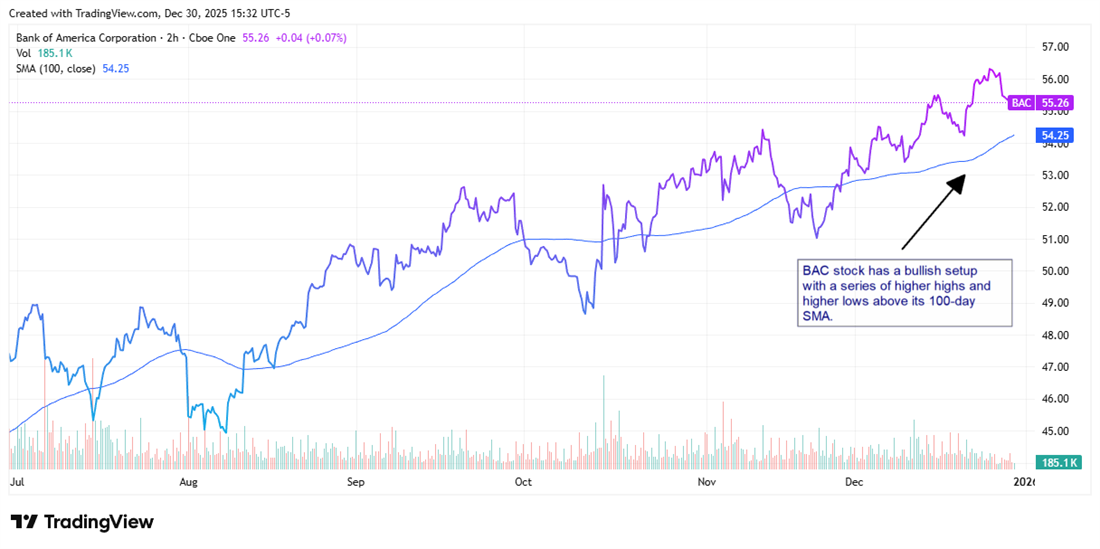
BAC stock is up 25% in 2025, and the chart shows a bullish pattern of higher highs and higher lows, and finding support above its 100-day simple moving average (SMA). Analysts have a consensus price target that allows for about 8% upside. That’s fueled by expectations for earnings growth of around 17% in the next 12 months.
A Fee-Driven Model Over Traditional Lending
Charles Schwab Corp. (NYSE: SCHW) is a different way to bet on strong U.S. households and markets. Unlike big banks, Schwab is less reliant on risky loans. It makes most of its money from interest on client cash, trading fees, and paid advice.
This asset-light business model is easier to grow in different economic conditions. As interest rates calm down and customers get back to normal behavior, Schwab’s profits could become steadier. With more assets coming in and more fee income, Charles Schwab could look more attractive to investors who want a financial company built on fees instead of heavy lending.
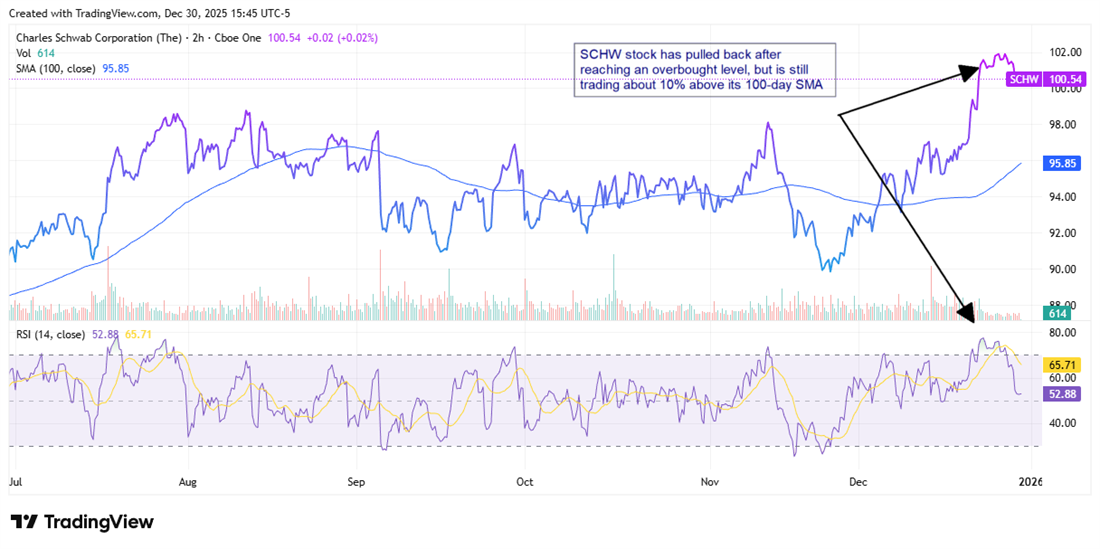
SCHW stock is up 35% in 2025, even after a steep pullback after the company’s third-quarter earnings report, which was a beat on the top and bottom lines. But the stock has recovered from that dip and powered to an all-time high. The stock has pulled back a little after getting overbought. However, analysts remain bullish on the stock, which is supported by expected earnings growth of around 23%.
Defensive Income With Long-Term Growth Tailwinds
Prudential Financial Inc. (NYSE: PRU) gives investors exposure to insurance and retirement services. These areas can do well when long-term interest rates are higher, the population is aging, and more people want products that guarantee income in the future.
Prudential often sees more demand when markets feel uncertain, because customers want stability. It also has a large investment portfolio that can earn better interest rates today than it could in the 2010s. This mix of steady income, protection in tough times, and growth from long-term savings makes Prudential different from banks or brokerage firms.
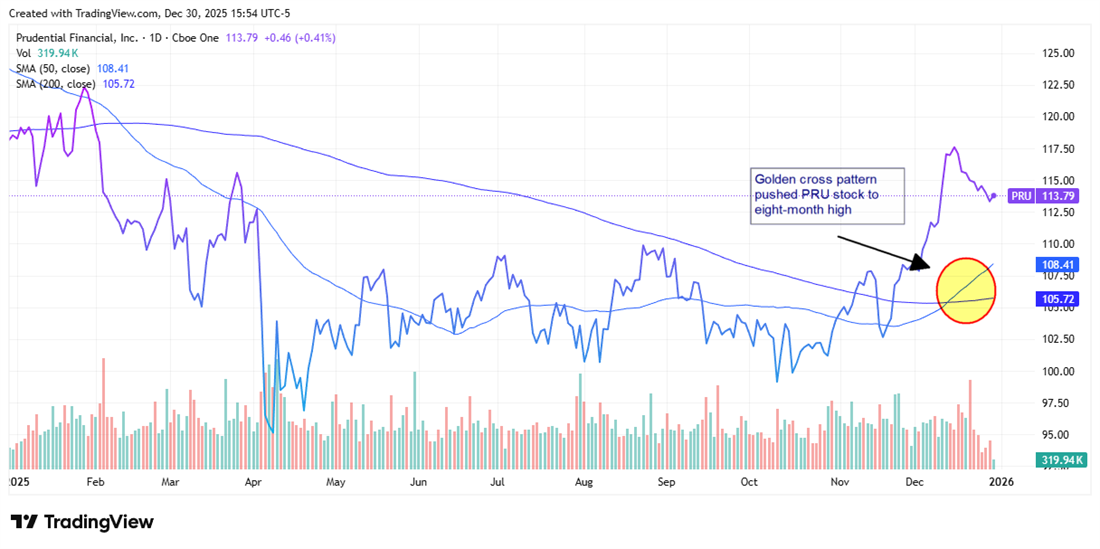
PRU stock is down about 3.9% in 2025, but it’s closing the year on a high note, up about 9.8%, resulting in a golden cross pattern in mid-December. Now investors will want to ensure that the stock stays above its 50-day SMA.
Where Should You Invest $1,000 Right Now?
Before you make your next trade, you'll want to hear this.
MarketBeat keeps track of Wall Street's top-rated and best performing research analysts and the stocks they recommend to their clients on a daily basis.
Our team has identified the five stocks that top analysts are quietly whispering to their clients to buy now before the broader market catches on... and none of the big name stocks were on the list.
They believe these five stocks are the five best companies for investors to buy now...
The article "Will the Fed Cut or Pause? These Finance Stocks Can Win Either Way" first appeared on MarketBeat.
Mentioned In This Article
Latest News
| Oct-08 | |
| Oct-08 | |
| Oct-08 | |
| Oct-08 | |
| Oct-08 | |
| Oct-08 | |
| Oct-08 | |
| Oct-07 | |
| Oct-07 | |
| Oct-06 | |
| Oct-06 | |
| Oct-06 | |
| Oct-06 | |
| Oct-06 | |
| Oct-06 |
