Should You Buy SPDR Gold ETF After Its 64% Rally in 2025? History Says It Could Do This in 2026.
Key Points
Gold outperformed every major U.S. stock index in 2025, as investors used it to hedge against economic uncertainty.
The precious metal has been a widely recognized store of value for thousands of years, which could support further upside.
The SPDR Gold Trust is an ETF that directly tracks the performance of gold, giving investors a simple way to own the yellow metal.
Gold is a shiny yellow metal that sells for a whopping $4,400 per ounce, but it isn't very useful, with very few industrial applications outside the jewelry industry. Instead, most of gold's demand comes from investors who buy it because of its status as one of history's oldest stores of value, which dates back thousands of years.
The SPDR Gold Trust (NYSEMKT: GLD) is an exchange-traded fund (ETF) that directly tracks the performance of gold, and it rocketed higher by 64% during 2025, outperforming every major U.S. stock market index. Political turmoil, economic uncertainty, and soaring government debt were making investors nervous, so they flocked to the safety of the shiny yellow metal.
Where to invest $1,000 right now? Our analyst team just revealed what they believe are the 10 best stocks to buy right now. Continue »
All of those issues are still present in 2026, which leaves the door open for further upside. History suggests annual returns of over 60% certainly aren't normal, so here's what is likely to happen this year instead.

Image source: Getty Images.
Investors are flocking to the safety of precious metals
Gold earned its status as a store of value partly because of its scarcity, with just 216,265 tons extracted from the ground throughout all of human history. For some perspective, roughly 1.7 million tons of silver have been mined, along with billions of tons of other commodities like iron ore and coal.
While gold appreciates in value because of demand from investors, it also benefits from the depreciation of paper currencies. The U.S. used the gold standard up until 1971, which meant the government could only print paper currency if it had an equal amount of physical gold reserves to match. This prevented an unchecked increase in money supply, which kept a lid on inflation.
After abandoning the gold standard in 1971, money supply exploded, causing the U.S. dollar to lose around 90% of its purchasing power. The below chart shows how the price of an ounce of gold typically tracks the increase in money supply (and the debasement of the U.S. dollar).
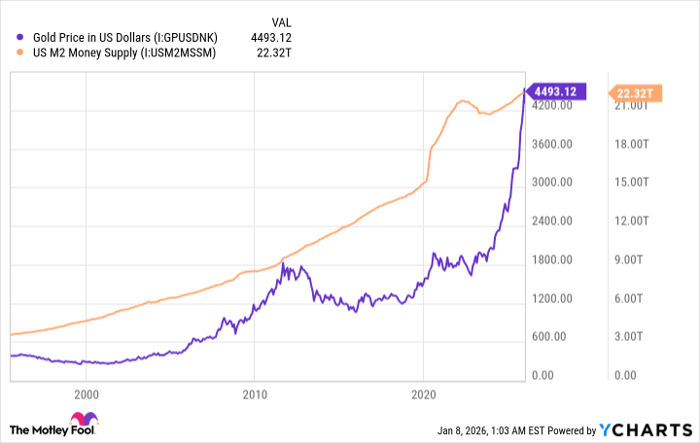
Gold Price in US Dollars data by YCharts
The U.S. government ran a $1.8 trillion budget deficit in fiscal 2025 (ended Sept. 30), catapulting the national debt to a record $38.5 trillion. Another trillion-dollar deficit is likely in fiscal 2026, so investors are increasingly worried that devaluing the U.S. dollar even further by increasing money supply is the only way the government can manage its growing debt pile. As a result, they are flocking to gold as a hedge.
History points to modest returns in 2026
Although the conditions are perfect for more upside in the price of gold during 2026, investors should temper their expectations after its 64% gain in 2025. Over the last 30 years, the shiny metal has averaged an annual gain of just 8%, which is probably a more realistic target.
Gold doesn't generate any revenue or earnings, so it is very tricky to value even with the U.S. dollar trending lower. Historically, the metal has actually underperformed income-generating assets like the stock market; the S&P 500 index, for example, climbed by an average of 11% per year over the last three decades (including dividends), trouncing gold's 8% annual gain.
Gold can still be a very valuable part of a diversified portfolio, especially in the current political and economic environment where it has the potential to occasionally outperform other assets. In fact, hedge fund legend Ray Dalio recently recommended that investors allocate 15% of their portfolios to the shiny yellow metal, precisely because of the U.S. government's mounting debt burden.
Buying physical gold is the surest way to profit from further upside, but this comes with storage and insurance costs. The SPDR Gold ETF offers a more convenient way for most investors to own the yellow metal, because it requires no storage and it can be bought and sold instantly with the click of a mouse through any major investing platform.
The ETF isn't free. It has an expense ratio of 0.4%, which is the proportion of the fund deducted each year to cover management costs. Therefore, an investment of $10,000 would incur an annual fee of $40, but that is likely much cheaper than storing and insuring $10,000 worth of physical metal.
Should you buy stock in SPDR Gold Shares right now?
Before you buy stock in SPDR Gold Shares, consider this:
The Motley Fool Stock Advisor analyst team just identified what they believe are the 10 best stocks for investors to buy now… and SPDR Gold Shares wasn’t one of them. The 10 stocks that made the cut could produce monster returns in the coming years.
Consider when Netflix made this list on December 17, 2004... if you invested $1,000 at the time of our recommendation, you’d have $482,326!* Or when Nvidia made this list on April 15, 2005... if you invested $1,000 at the time of our recommendation, you’d have $1,133,015!*
Now, it’s worth noting Stock Advisor’s total average return is 968% — a market-crushing outperformance compared to 197% for the S&P 500. Don't miss the latest top 10 list, available with Stock Advisor, and join an investing community built by individual investors for individual investors.
*Stock Advisor returns as of January 10, 2026.
Anthony Di Pizio has no position in any of the stocks mentioned. The Motley Fool has no position in any of the stocks mentioned. The Motley Fool has a disclosure policy.
Mentioned In This Article
Latest News
| Oct-05 |
EXCLUSIVE: US May Need AI Boom to Grow Out of Debt Crisis, American Hartford Gold President Says
GLD
Benzinga Prediction Markets
|
| Sep-24 | |
| Sep-23 | |
| Sep-23 | |
| Sep-22 | |
| Sep-21 | |
| Sep-21 | |
| Sep-17 | |
| Sep-15 | |
| Sep-15 | |
| Sep-14 | |
| Sep-09 | |
| Sep-03 | |
| Sep-02 | |
| Sep-02 |
