Trump Issues Iran Ultimatum: Threatens 25% Tariff On Any Country Doing Business With 'Islamic Republic' - Says 'This Order Is Final'
President Donald Trump announced sweeping new tariffs on any nation conducting business with Iran, in a bid to escalate pressure on Tehran amid widespread anti-government protests in the country.
‘Tariffs’ On Countries Doing Business With Iran
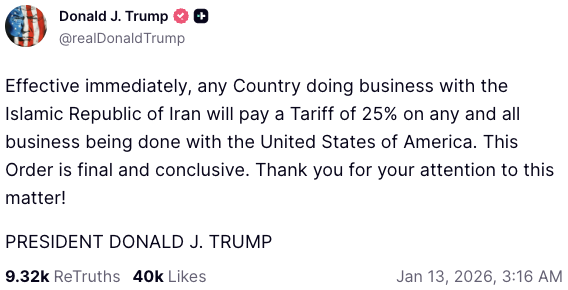
In a Truth Social post on Monday night, Trump said any country doing business with Iran “will pay a Tariff of 25% on any and all business being done with the United States of America,” adding that “this order is final and conclusive.”
This comes following reports of a government crackdown against protestors, which, according to U.S.-based rights group HRANA, has led to the death of 490 civilians, 48 security personnel, and more than 10,800 arrests, with state TV footage showing funerals for security personnel and dozens of body bags at Tehran’s coroner’s offices.
On Friday, Trump said that he would come to the “rescue” of the Iranian people, who are protesting against the regime led by Supreme Leader Ali Hosseini Khamenei.
While speaking to reporters on board Air Force One on Sunday, Trump said, Iranian leaders “want to negotiate,” after he threatened military action against the country, but added that “we may have to act before a meeting.”
Impact On Global Energy Markets
Despite extensive and long-running sanctions against the Islamic Republic, U.S. goods and services trade with the country stood at $838.4 million in 2024, according to the U.S. Trade Representative.
Iran’s biggest trading partners include China, Türkiye, the United Arab Emirates, Iraq and India, with its exports primarily consisting of petroleum and natural gas products, according to the United Nations COMTRADE database on international trade.
Being one of the largest oil and gas producers in the world, with an output of over 4 million barrels per day, Trump’s announcement is set to have a major impact on global energy prices.
Energy markets are also staring down the risk of a potential closure of the Strait of Hormuz, the narrow shipping corridor bordering Iran, the UAE and Oman, through which roughly 20 million barrels of oil flow each day.
Last year, Iran’s parliament voted to authorize a potential closure of the strait following U.S. airstrikes on the nation’s nuclear facilities.
According to Goldman Sachs analysts, in such a scenario, Brent crude prices could spike to $110 a barrel before moderating.
WTI March crude futures are up 0.67% on Monday night, trading at $59.72 per barrel, while February natural gas futures are down 0.42%, at $3.340 per MMBtu or Metric Million British Thermal Unit.
The iShares U.S. Oil & Gas Exploration & Production ETF (BATS:IEO), which tracks the leading U.S. oil and gas producers, was down 0.49% on Monday, closing at $90.60 per share. The fund scores poorly in Benzinga's Edge Stock Rankings, but has a favorable price trend in the long term. Click here for deeper insights into the fund, its peers and competitors.

Photo courtesy: noamgalai from Shutterstock
Mentioned In This Article
Latest News
| Mar-08 | |
| Mar-06 | |
| Mar-05 | |
| Mar-05 | |
| Jan-28 | |
| Jan-12 | |
| Jan-12 | |
| Jan-08 | |
| Nov-28 | |
| Sep-24 | |
| Jul-24 | |
| Jul-18 | |
| Jul-09 | |
| May-19 | |
| May-07 |
