1 Artificial Intelligence (AI) Stock Wall Street Could Be Underestimating in 2026
Key Points
Nvidia's stock performance has lagged the market over the past three months.
The company's revenue and earnings growth are still very strong.
Valuation is reasonable, especially if artificial intelligence (AI) spending increases more than expected in the coming year.
Some stocks are market darlings. No matter what happens to them -- a bad earnings report, a competitor introducing a competing product -- their shares just seem to keep rising.
Other stocks can't seem to catch a break: They regularly post outstanding earnings and improve their financial metrics, only to have the share price stubbornly refuse to budge.
Where to invest $1,000 right now? Our analyst team just revealed what they believe are the 10 best stocks to buy right now, when you join Stock Advisor. See the stocks »
The worst of both worlds (at least, for shareholders) is when a former market darling falls from grace and becomes a market dud. But at least when that happens, it can be a great opportunity for new investors. And it looks like that's what's happening to Nvidia (NASDAQ: NVDA) right now.
Here's why Wall Street could be underestimating this artificial intelligence (AI) leader in 2026.

Image source: Getty Images.
The biggest and the best
It might sound crazy to call Nvidia "underestimated" by the market. After all, it's the largest company in the world, with a $4.5 trillion market cap. Its stock has risen 1,270% over the last five years alone.
But things haven't been so rosy lately. Over the last three months, Nvidia's shares have lagged the market. While the S&P 500 (SNPINDEX: ^GSPC) is up more than 3%, Nvidia's shares have dropped more than 2%. That may not sound like much, but a 5% underperformance is shocking for a company that once could seemingly do no wrong in Wall Street's eyes.
And it doesn't look as though Nvidia has done anything wrong. Its most recent quarterly earnings, released in November, were insanely good. Revenue hit a record $57 billion, up 62% year over year. Net income was also at a record high of $31.9 billion. And Nvidia guided for Q4 revenue of $65 billion, which would be a 65% year-over-year increase.
Still, concerns about an "AI bubble" and potential competition from Alphabet's TPU processors seem to have outweighed these impressive results. So, is Wall Street underestimating Nvidia in 2026?
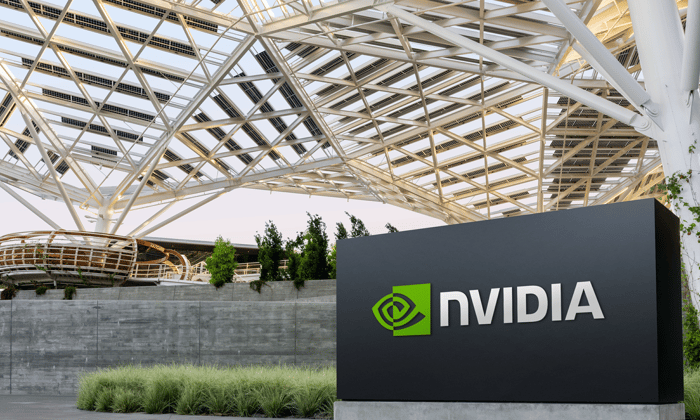
Image source: Nvidia.
Why Nvidia should still win in 2026
Nvidia is massive, it's true. But it still looks reasonably valued.
The company's price-to-earnings (P/E) ratio currently stands at just 46. That's close to its five-year low of 32, and well below its five-year average of 76. Its forward P/E ratio -- which uses expected future earnings -- stands at just 39.6. But even that may not tell the whole story.
Wall Street's consensus estimate for 2026 capital expenditures (capex) spending by AI hyperscalers is currently $527 billion. However, these estimates have consistently been too low, according to research by Goldman Sachs, which suggests $700 billion as a more realistic figure.
Nvidia's guidance implies AI data center revenue of $188.8 billion in its 2026 fiscal year (which ends Jan. 31): just under half of total estimated 2025 AI capex spend. If 2026's AI capex spend indeed hits $700 billion, total revenue for Nvidia's upcoming fiscal year would land at about $372 billion, a roughly 75% increase.
That alone should be enough to make the stock soar, but if Nvidia's profit margins remain constant, its net income in the coming year will be $194 billion, for a forward P/E ratio at today's price of just 23.5. That's an unbelievably low valuation for such a growth powerhouse, and should be a strong incentive for investors to buy Nvidia shares now.
Should you buy stock in Nvidia right now?
Before you buy stock in Nvidia, consider this:
The Motley Fool Stock Advisor analyst team just identified what they believe are the 10 best stocks for investors to buy now… and Nvidia wasn’t one of them. The 10 stocks that made the cut could produce monster returns in the coming years.
Consider when Netflix made this list on December 17, 2004... if you invested $1,000 at the time of our recommendation, you’d have $482,451!* Or when Nvidia made this list on April 15, 2005... if you invested $1,000 at the time of our recommendation, you’d have $1,133,229!*
Now, it’s worth noting Stock Advisor’s total average return is 968% — a market-crushing outperformance compared to 197% for the S&P 500. Don't miss the latest top 10 list, available with Stock Advisor, and join an investing community built by individual investors for individual investors.
*Stock Advisor returns as of January 13, 2026.
John Bromels has positions in Alphabet and Nvidia. The Motley Fool has positions in and recommends Alphabet, Goldman Sachs Group, and Nvidia. The Motley Fool has a disclosure policy.
Mentioned In This Article
Latest News
| 3 hours | |
| 3 hours | |
| 3 hours | |
| 3 hours | |
| 3 hours | |
| 4 hours | |
| 4 hours | |
| 5 hours | |
| 5 hours | |
| 5 hours | |
| 6 hours | |
| 6 hours | |
| 6 hours | |
| 6 hours | |
| 7 hours |
