President Donald Trump Just Paved the Way for a New Oil Boom in Venezuela, but Significant Risks Remain Before U.S. Oil Companies Can Drill
Key Points
Venezuela has the largest reserve of crude oil in the world.
With Nicolás Maduro no longer in charge, President Donald Trump wants U.S. oil companies to go into Venezuela and revitalize the struggling oil industry.
However, there are many risks for U.S. oil companies to consider.
Following an operation that ousted Venezuela President Nicolás Maduro from office and brought him to the U.S. to face criminal charges, President Donald Trump has paved the way for a new oil boom in the South American country. Trump has already said that Venezuela will transport 30 million to 50 million barrels of sanctioned oil to the U.S., which will be sold at market prices. The Wall Street Journal also reported that the U.S. is rolling back some sanctions to make it legal for Venezuela to sell oil in global oil markets.
Trump also plans to persuade U.S. oil companies to go into Venezuela, repair the country's antiquated oil infrastructure, and start doing business in a country believed to hold the world's largest reserve of crude oil, with roughly 300 billion barrels. However, significant risks remain before new U.S. oil companies can start drilling and increase production in the country.
Where to invest $1,000 right now? Our analyst team just revealed what they believe are the 10 best stocks to buy right now, when you join Stock Advisor. See the stocks »
It's a significant investment
Despite having the largest global oil reserves, Venezuela's oil infrastructure is outdated, partly due to government mismanagement and partly because many oil companies left the country after Hugo Chávez essentially nationalized most of the country's oil assets in 2007. To ramp up production, significant upgrades are needed.
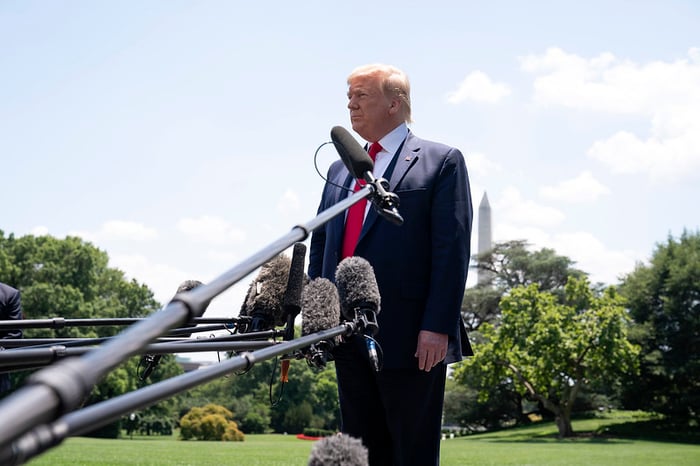
Official White House photo by Joyce N. Boghosian.
Venezuela currently produces between 800,000 and 1 million barrels of oil per day, or roughly 1% of the world's oil production. Forecasts from Wall Street analysts suggest that it could require $100 billion to $200 billion during the next decade to ramp production to 2.5 million barrels per day.
However, fully modernizing the infrastructure could cost $180 billion to $200 billion if companies want to develop upstream projects while maintaining a high level of production growth, according to Hart Research.
The job won't be left to one oil company, but even contributing to this level of capital expenditure is a significant investment. For instance, Chevron, the only U.S. oil company with operations in Venezuela, announced a total capital expenditure budget of as much as $19 billion for 2026. Trump has said the oil companies that invest will be repaid in revenue or by the U.S. government. Regardless, management teams will need to weigh the pros and cons carefully.
Political and geopolitical risks create challenges
The pros and cons that oil companies will need to weigh include the geopolitical and political challenges in both the U.S. and Venezuela, as well as globally.
In the U.S., oil companies may wonder what will happen after Trump leaves office or if the Democrats make gains in the midterm elections. The Democrats are unlikely to be as gung-ho about intervening in Venezuela or backstopping the oil companies' investments in the country. The Senate already voted in favor of legislation that would require Trump to obtain approval from Congress before proceeding with any further military action in Venezuela.
Then there are the complexities that lie within Venezuela. Trump chose to leave Maduro's party in place and led by Acting President Delcy Rodríguez, Maduro's vice president. The rationale is likely that the current party can continue to maintain stability while working with the Trump administration to advance its own agenda.
However, no one knows what the future holds. Rodríguez will have to walk a tightrope in appeasing the Trump administration while also demonstrating to Venezuelans that she has the country's best interests at heart. There's also the chance that Rodríguez cannot maintain control and another leader or party comes to power.
I doubt the Trump administration would want to launch any type of large-scale ground invasion in the country. A strong cohort of lawmakers in Washington already appears to be opposed to further military action, and it would likely be unpopular politically. So, if there is a change in leadership, how do the oil companies ensure they can expand or launch operations in the country? There's also a whole host of other concerns, like the drug cartels in Venezuela, which also have immense power and could destabilize the country as well.
There are also other countries to consider, including Venezuela's oil customers, such as China, Iran, Russia, and Cuba. Trump has already told Rodríguez to cut ties with all of these countries. Oil companies are going to be left to contend with a number of outcomes, many of which are difficult to predict.
What if they invest tens of billions in Venezuela's oil operations and infrastructure, and then there is a regime change in Venezuela that prevents them from doing business, and a new president in Washington that has no interest in reimbursing them?
This is why entering the country is so risky for many oil companies, especially given current low oil prices and numerous other investment options available, such as the Permian Basin in the U.S. or Venezuela's neighbor, Guyana, which has become a new and attractive international oil hub. The stock most likely to benefit from a revamped Venezuela oil sector remains Chevron, which already has about 3,000 employees in the country and produces roughly a fifth of Venezuela's oil.
Where to invest $1,000 right now
When our analyst team has a stock tip, it can pay to listen. After all, Stock Advisor’s total average return is 968%* — a market-crushing outperformance compared to 197% for the S&P 500.
They just revealed what they believe are the 10 best stocks for investors to buy right now, available when you join Stock Advisor.
*Stock Advisor returns as of January 14, 2026.
Bram Berkowitz has no position in any of the stocks mentioned. The Motley Fool has positions in and recommends Chevron. The Motley Fool has a disclosure policy.
Mentioned In This Article
Latest News
| 2 hours | |
| Oct-08 | |
| Oct-08 | |
| Oct-08 |
Hurricane Isaias Could Threaten The U.S. Oil Supply. Gulf Shutdowns Add Pressure to Already Soaring Energy Prices.
CVX
International Business Times
|
| Oct-08 | |
| Oct-08 | |
| Oct-08 |
Trump's Portfolio Invested Tens of Millions in Debt of Two of The World's Largest Companies, Disclosure Shows
CVX
International Business Times
|
| Oct-08 | |
| Oct-08 | |
| Oct-08 | |
| Oct-08 | |
| Oct-08 | |
| Oct-08 | |
| Oct-08 | |
| Oct-08 |
