Should You Buy Advanced Micro Devices (AMD) Stock After Its 21% Correction?
Key Points
AMD supplies chips for some of the world's most popular consumer electronics, but it's also becoming a big player in the data center market.
In 2026, AMD will launch its most powerful data center chips ever, which will be in high demand from AI developers.
The company is still trying to catch up to Nvidia in this space, but its financial opportunity is enormous even if it doesn't.
Advanced Micro Devices (NASDAQ: AMD) supplies chips that power some of the world's most popular electronics, from Sony's PlayStation 5 to the infotainment systems in Tesla's electric vehicles. But AMD is quickly becoming a major player in the market for data center graphics processing units (GPUs), which are the primary chips used in artificial intelligence (AI) development.
Nvidia (NASDAQ: NVDA) remains the clear leader in this space, but AMD is gearing up to launch a new lineup of GPUs this year, which will bring it a step closer to leveling the playing field.
Where to invest $1,000 right now? Our analyst team just revealed what they believe are the 10 best stocks to buy right now. Continue »
AMD's stock price soared 77% last year because of its progress in the AI space, but it's currently down 21% from its recent all-time high. Does this present a great buying opportunity ahead of the company's new lineup of data center chips?
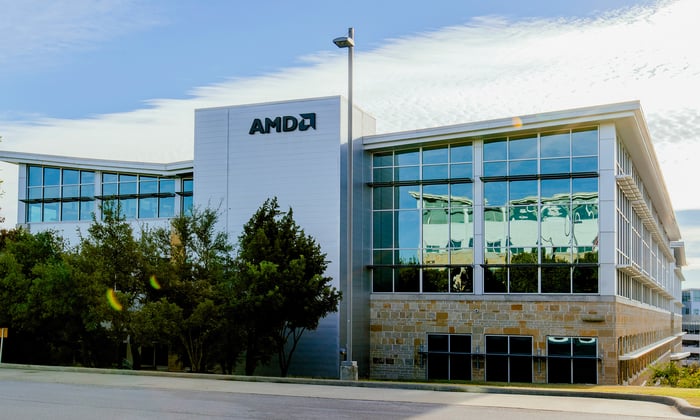
Image source: Advanced Micro Devices.
A potential tenfold increase in performance
AMD's most powerful data center GPU for AI development is currently the MI355X. It was built on the company's Compute DNA (CDNA) 4 architecture, which was designed to rival Nvidia's industry-leading Blackwell architecture. Some of the tech industry's largest data center operators are buying the MI355X, including Oracle, which ordered over 131,000 of them last year.
But AMD plans to start shipping an entirely new lineup of GPUs called the MI450 Series later this year, which can be combined with new specialized software and hardware to form a fully integrated data center rack called Helios. The company says MI450 chips can deliver up to 36 times more performance in this configuration compared to its previous generation of GPUs (like the MI355X).
Therefore, the MI450 Series will almost certainly be more powerful than Nvidia's Blackwell GPUs. But the industry leader isn't standing still. During the second half of this year, Nvidia plans to start shipping a lineup of GPUs based on an entirely new architecture called Rubin, which is expected to reset the benchmark for the industry.
This game of cat and mouse will continue for as long as AI developers demand more performance from their data center infrastructure, but there is no question that AMD's hardware is closer than ever to matching Nvidia's hardware in terms of performance.
AMD's data center segment is eyeing a $100 billion opportunity
AMD generated $24.3 billion in total revenue during the first three quarters of 2025 (ended Sept. 27). The data center segment was the largest of the company's three core business units, bringing in $11.2 billion in revenue on its own, led by AI GPU sales. AMD will report its fourth-quarter results on Feb. 4, which will round out its biggest-ever year in the data center market.
Looking ahead, AMD believes its data center business could generate up to $100 billion in revenue over the next few years, thanks partly to a major deal it signed with leading AI start-up OpenAI last October. Under the partnership, AMD will supply up to 6 gigawatts of GPU capacity by 2030, starting with shipments of the MI450 Series in the second half of 2026.
The OpenAI deal certainly isn't perfect, but working with the AI industry's leading software start-up is essential if AMD wants to expand its market share in the data center space.
AMD stock isn't cheap, but it could be a great long-term investment
AMD generated adjusted (non-GAAP) earnings of $3.73 per share over the last four reported quarters. Based on its stock price of $207.69 as of the close on Jan. 12, its price-to-earnings (P/E) ratio is 55.6.
That means AMD is more expensive than Nvidia, which is trading at a P/E ratio of 45.6 as I write this. That is difficult to justify given Nvidia's data center business is not only significantly larger than AMD's, but is also growing more quickly.
With that said, Wall Street's consensus estimate (provided by Yahoo! Finance) suggests AMD's earnings could grow to $6.49 per share in 2026, placing its stock at a forward P/E ratio of just 32. Therefore, even if you think its P/E ratio is expensive right now, the stock would still have to climb by 42% this year just to match Nvidia's current P/E ratio of 45.6 (assuming Wall Street's estimate is accurate).
Longer term, if AMD's data center business does generate $100 billion in revenue over the next few years, then its stock is probably a bargain at the current price. Therefore, its recent 21% dip might be a great buying opportunity for investors.
Should you buy stock in Advanced Micro Devices right now?
Before you buy stock in Advanced Micro Devices, consider this:
The Motley Fool Stock Advisor analyst team just identified what they believe are the 10 best stocks for investors to buy now… and Advanced Micro Devices wasn’t one of them. The 10 stocks that made the cut could produce monster returns in the coming years.
Consider when Netflix made this list on December 17, 2004... if you invested $1,000 at the time of our recommendation, you’d have $477,544!* Or when Nvidia made this list on April 15, 2005... if you invested $1,000 at the time of our recommendation, you’d have $1,122,686!*
Now, it’s worth noting Stock Advisor’s total average return is 952% — a market-crushing outperformance compared to 195% for the S&P 500. Don't miss the latest top 10 list, available with Stock Advisor, and join an investing community built by individual investors for individual investors.
*Stock Advisor returns as of January 15, 2026.
Anthony Di Pizio has no position in any of the stocks mentioned. The Motley Fool has positions in and recommends Advanced Micro Devices, Nvidia, Oracle, and Tesla. The Motley Fool has a disclosure policy.
Mentioned In This Article
Latest News
| 25 min | |
| 47 min | |
| 51 min | |
| 1 hour | |
| 1 hour | |
| 1 hour | |
| 2 hours | |
| 2 hours | |
| 3 hours | |
| 3 hours | |
| 3 hours |
Nvidia's Subtle Change to How It Counts Cash Flow Has Big Implications for Buybacks
NVDA
The Wall Street Journal
|
| 4 hours | |
| 6 hours | |
| 6 hours | |
| 6 hours |
