Where Will Rivian Be in 1 Year?
Key Points
The electric vehicle maker has built a high-end truck that has been very well received.
Now, Rivian is attempting to build a mass-market truck, which will help broaden its customer base.
The company's long-term future depends heavily on the success of the lower-priced truck.
Rivian Automotive (NASDAQ: RIVN) is still building out its electric vehicle business. That's not to suggest that the company hasn't already made impressive achievements, which it has. The problem is that building cars is a capital-intensive endeavor, and Rivian has yet to achieve sustainable profitability. Despite its success, 2026 is poised to be a pivotal year for the business. Here's what you need to know.
What does Rivian do?
At the most basic level, Rivian is an automaker. However, that's not the full picture, because the company only makes electric vehicles (EVs). That's the same wedge that allowed Tesla (NASDAQ: TSLA) to break into the highly competitive automotive industry, a sector long dominated by a small number of very large companies.
Where to invest $1,000 right now? Our analyst team just revealed what they believe are the 10 best stocks to buy right now, when you join Stock Advisor. See the stocks »
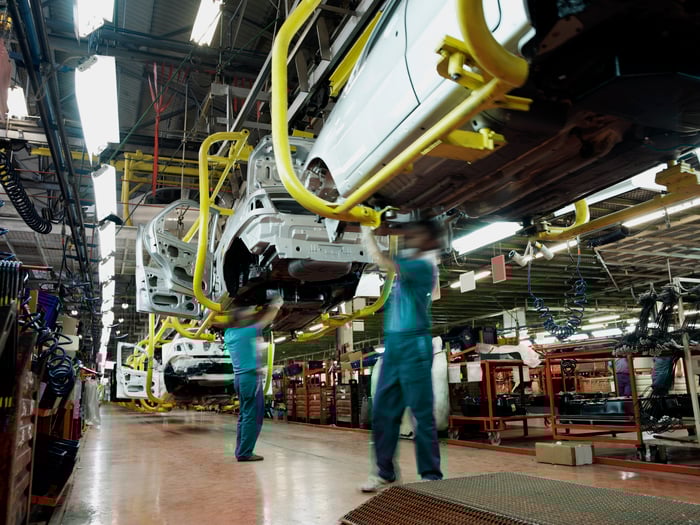
Image source: Getty Images.
What Tesla achieved is a bit different from what Rivian is trying to do. Essentially, Tesla created the EV market. Rivian is attempting to follow the path that Tesla has already blazed. The big difference now is that all of the major automakers are building EVs today. Additionally, there are large EV manufacturers that have already followed Tesla's lead and established substantial businesses. Simply put, Rivian faces significantly more competition in an industry that requires substantial capital investments just to gain entry.
So far, Rivian has done an impressive job of building its business. It has well-respected delivery trucks that are used by Amazon and an award-winning high-end truck for the consumer market. It also has a key partnership with auto industry giant Volkswagen that's providing it with cash and, potentially, could lead to Volkswagen being the first customer for Rivian's EV technology.
Why 2026 is so important
Rivian still needs to gain scale in the consumer market if it hopes to be a long-term competitor in the auto sector. To that end, it's working on a new truck, called the R2, which will be lower in cost and targeted at the mass market. The game plan is to have production of the truck begin in mid-2026.
Rivian ended the third quarter of 2025 with roughly $7 billion of cash and short-term investments on its balance sheet. It's highly likely that it will get the R2 to market with little to no problem. The real issue will be how the market receives the R2.
It will take a few quarters to get a feel for how well the R2 is selling. If sales are brisk, Rivian's future as a business will look a lot more promising. If the buying is weak, however, Rivian could struggle to survive as a stand-alone entity. Given the relationship with Volkswagen, it wouldn't be surprising to see Rivian be acquired by another company. Volkswagen would be the most obvious buyer, but it might not be the only one interested in Rivian's technology.
The next year will tell investors a lot about Rivian's business. The problem is that the expiration of U.S. subsidies for EV buyers could be a significant headwind, even for lower-cost EVs. In Q3 2025, ahead of the end of the subsidies, Rivian produced 10,720 vehicles and delivered 13,201. In the fourth quarter of 2025, after the expiration of the subsidies, the company produced 10,974 vehicles and delivered 9,745.
There was likely a pull forward of demand in Q3, so it isn't yet clear how bad the Q4 delivery numbers are. For investors, it will be important to monitor the delivery trends as they unfold in the first half of 2026. If demand remains weak, the future of the R2 may not be as positive as the company is hoping it will be.
Rivian is not for the risk-averse
The next year could be an important turning point for Rivian's business. Currently, it remains a money-losing start-up that is incurring significant expenses to build out its business. If the R2 doesn't succeed as hoped, Rivian will struggle to turn a profit sustainably. With a mid-year launch, the R2 is the next significant hurdle that investors need to monitor. Given the stakes involved, all but the most aggressive investors should probably remain safely on the sidelines.
Should you buy stock in Rivian Automotive right now?
Before you buy stock in Rivian Automotive, consider this:
The Motley Fool Stock Advisor analyst team just identified what they believe are the 10 best stocks for investors to buy now… and Rivian Automotive wasn’t one of them. The 10 stocks that made the cut could produce monster returns in the coming years.
Consider when Netflix made this list on December 17, 2004... if you invested $1,000 at the time of our recommendation, you’d have $474,578!* Or when Nvidia made this list on April 15, 2005... if you invested $1,000 at the time of our recommendation, you’d have $1,141,628!*
Now, it’s worth noting Stock Advisor’s total average return is 955% — a market-crushing outperformance compared to 196% for the S&P 500. Don't miss the latest top 10 list, available with Stock Advisor, and join an investing community built by individual investors for individual investors.
*Stock Advisor returns as of January 18, 2026.
Reuben Gregg Brewer has no position in any of the stocks mentioned. The Motley Fool has positions in and recommends Amazon and Tesla. The Motley Fool recommends Volkswagen Ag. The Motley Fool has a disclosure policy.
Mentioned In This Article
Latest News
| 8 hours | |
| Oct-10 | |
| Oct-10 | |
| Oct-09 | |
| Oct-09 | |
| Oct-09 | |
| Oct-09 | |
| Oct-09 |
Tesla's China Retail Sales Fall 9% Even as Shanghai Exports Surge 58%
TSLA
Benzinga Prediction Markets
|
| Oct-09 | |
| Oct-09 | |
| Oct-09 | |
| Oct-09 | |
| Oct-09 | |
| Oct-09 | |
| Oct-09 |
