Is Novo Nordisk's Oral Wegovy Driving Strong Early US Demand Already?
Shares of Novo Nordisk NVO rose 9.1% on Friday after the company reportedly recorded strong early prescription trends just one week following the early-January U.S. launch of the oral version of its blockbuster GLP-1 therapy, Wegovy (semaglutide). The pill, approved in late December for obesity and cardiovascular risk reduction, is reportedly seeing robust initial demand, signaling an encouraging early uptake in the U.S. market.
The available prescription data reportedly reflects only retail channel activity and excludes volumes from Novo Nordisk’s direct-to-consumer online pharmacy, NovoCare. As a result, the actual first-week sales performance could be meaningfully higher, underscoring the potential strength of the oral Wegovy launch trajectory.
Please note that the Wegovy pill is the first oral GLP-1 drug to be approved in the United States, ushering in a new era of obesity treatment. The pill includes the same active ingredient — semaglutide — contained in NVO’s Wegovy and Ozempic injections (for type II diabetes). It has priced oral Wegovy at $149 per month (without insurance).
Eli Lilly LLY is Novo Nordisk’s arch-rival in the obesity space, which markets its tirzepatide (GLP-1) injections as Mounjaro (for type II diabetes) and Zepbound (for obesity). LLY has also filed a regulatory application seeking FDA approval for its oral GLP-1 drug, called orforglipron, for obesity. However, last week, the FDA reportedly delayed its decision on orforglipron to April 10 from the prior expectation of late March.
Daily oral obesity pills are expected to emerge as a more convenient and potentially lower-cost alternative to once-weekly injectables, such as Lilly’s Zepbound and Novo Nordisk’s Wegovy, lowering treatment burden and expanding patient adoption. With scalable manufacturing and broader appeal, Goldman Sachs estimates oral GLP-1 pills could generate about $22 billion in sales by 2030, or roughly 25% of a projected $95 billion global obesity drug market. Against this backdrop, Novo Nordisk’s launch of oral Wegovy gives it a first-mover advantage in the oral GLP-1 segment, positioning the company to regain market share from Lilly and drive incremental revenues. While analysts had expected Eli Lilly to close the gap quickly following a potential FDA approval of orforglipron in 2026, the latest delay puts LLY a step behind in the obesity pill race and gives Novo Nordisk additional time to strengthen its foothold in the oral obesity market.
Additionally, the regulatory body in the United Kingdom announced on Friday the approval of a 7.2 mg dose of Wegovy injection, which Novo Nordisk claims provides an option for “greater weight loss potential” than what is being offered by the available doses. This also likely contributed to the stock price gain as the improved efficacy profile could prompt physicians and patients to reconsider treatment choices, potentially shifting demand away from Lilly’s Zepbound toward the higher-dose Wegovy. Similar filings are also currently being reviewed in the United States and the EU. Favorable outcomes could improve NVO’s growth trajectory in the injectable treatment franchise.
Competition Heating Up in the Obesity Space
Eli Lilly is Novo Nordisk’s fierce competitor in the obesity space. Like NVO, Lilly is investing broadly in obesity and has several new molecules currently in clinical development with a range of oral and injectable medications with different mechanisms of action. Apart from orforglipron, LLY’s late-stage pipeline includes retatrutide, a GGG triagonist, as well as mid-stage candidates, including bimagrumab, eloralintide and mazdutide.
The obesity space has garnered much of the spotlight over the past year due to the sizeable and still underpenetrated market opportunity. Smaller biotech firms, like Viking Therapeutics VKTX, are also advancing GLP-1–based therapies to challenge the incumbents. Viking Therapeutics is developing its dual GIP/GLP-1 RA, VK2735, both as oral and subcutaneous formulations for the treatment of obesity. Last year, VKTX started two late-stage studies evaluating the subcutaneous formulation of VK2735. While one of these studies completed enrolment in November 2025 at a rapid pace, Viking Therapeutics expects to complete enrolment in the other study by the end of this quarter.
NVO Stock’s Price, Valuation & Estimates
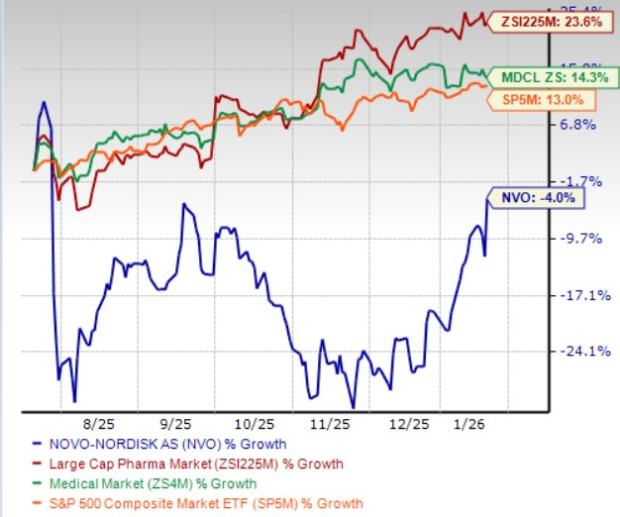
In the past six months, Novo Nordisk shares have lost 4% against the industry’s 23.6% growth. The company has also underperformed the sector and the S&P 500 during the same time frame, as seen in the chart below.
NVO Stock Underperforms the Industry, Sector & the S&P 500
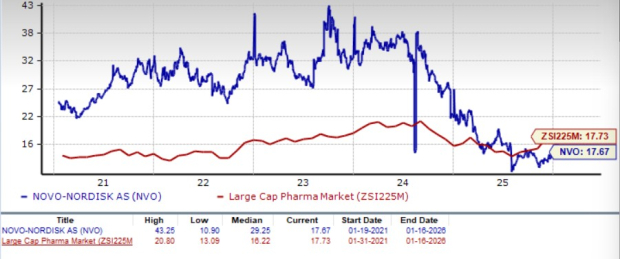
Novo Nordisk is trading at a discount to the industry, as seen in the chart below. Going by the price/earnings ratio, the company’s shares currently trade at 17.67 forward earnings, which is marginally lower than 17.73 for the industry. The stock is trading much below its five-year mean of 29.25.
NVO Stock Valuation
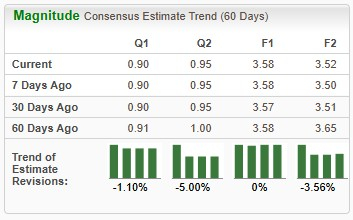
Earnings estimates for 2025 have remained constant at $3.58 per share over the past 60 days. During the same time frame, Novo Nordisk’s 2026 earnings estimates have declined from $3.65 to $3.52.
NVO Estimate Movement
Novo Nordisk currently carries a Zacks Rank #4 (Sell).
You can see the complete list of today’s Zacks #1 Rank (Strong Buy) stocks here.
Want the latest recommendations from Zacks Investment Research? Today, you can download 7 Best Stocks for the Next 30 Days. Click to get this free report
Novo Nordisk A/S (NVO): Free Stock Analysis Report
Eli Lilly and Company (LLY): Free Stock Analysis Report
Viking Therapeutics, Inc. (VKTX): Free Stock Analysis Report
This article originally published on Zacks Investment Research (zacks.com).
Mentioned In This Article
Latest News
| Oct-09 | |
| Oct-09 | |
| Oct-09 | |
| Oct-09 | |
| Oct-09 | |
| Oct-09 | |
| Oct-09 | |
| Oct-08 | |
| Oct-08 | |
| Oct-08 | |
| Oct-08 | |
| Oct-08 | |
| Oct-08 | |
| Oct-07 | |
| Oct-07 |
