Why It's Time to Start Thinking of Walmart as a Tech Stock
Key Points
The shares are up handily since the announcement that they'll be listed on the Nasdaq.
Walmart was late to e-commerce, but it's determined not to repeat that mistake with AI.
There are three reasons why the giant retailer qualifies as a full-fledged tech titan today.
Shares of Walmart (NASDAQ: WMT) are up 12% since the Bentonville, Arkansas-based retail giant announced in November that it would be transferring the listing of its common shares from the New York Stock Exchange to the Nasdaq. In the press release, Walmart said the move reflected the "tech-powered approach to our long-term strategy."
The Nasdaq is often referred to as "tech-heavy." While it certainly has a higher concentration of tech companies than the other major indexes, it also includes some consumer staples companies like Kraft-Heinz and Starbucks, as well as the hospitality giant Marriott International. Even the fast-food company Wendy's is listed there, having moved in 2011 to save on listing fees.
Where to invest $1,000 right now? Our analyst team just revealed what they believe are the 10 best stocks to buy right now. Continue »
But in Walmart's case, there's good reason to think of the move as marking an official transformation. The brick-and-mortar retailer that was caught flat-footed by Amazon in the 2000s is now a tech titan in its own right. Here are three reasons why.
1. Its e-commerce business is now profitable
In the company's first-quarter earnings call last May, CEO Doug McMillon announced that its e-commerce business was "crossing the threshold of profitability" after growing by 22% globally.
The company has come a long way since 1998, when then-CEO David Glass reportedly dismissed e-commerce by saying online sales would never amount to more than the company's single largest Sam's Club store. As recently as 2018, Walmart shares plunged 10% in one day when the company reported slowing online sales growth in an earnings call.
But there's no sign of weakness in Walmart's e-commerce game now. Since its historic earnings call in May, the company has reported further e-commerce growth of 27% in Q3, with each segment up over 20% year over year.
2. Nearly 80% of digital orders in China arrive in under an hour
In October, McMillon visited China, where Walmart has 60 Sam's Clubs, with "a healthy pipeline" coming. In his Q3 earnings remarks, he noted that China is a more advanced frontier in digital retail than anywhere else Walmart operates.
So it's notable that half of Walmart's business in China is now digital retail, compared to around 33% in the United States. And of Walmart's $6.1 billion in net sales in China last quarter, more than half came from e-commerce, which surged 32%.
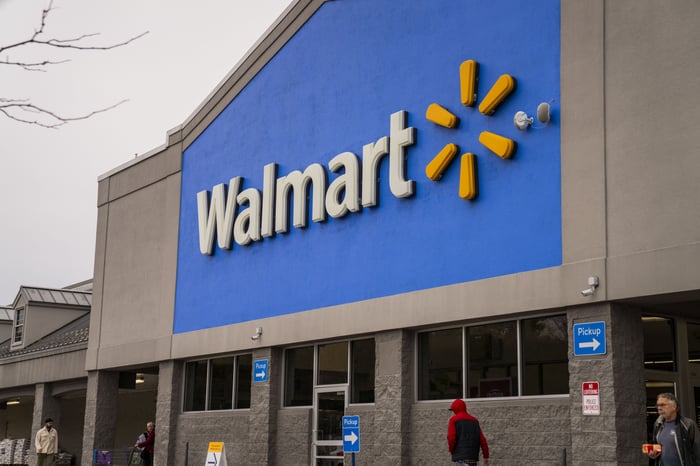
Image source: Getty Images.
With nearly 80% of Walmart's digital retail purchases in China arriving in under an hour, its China success holds big implications for America, where 90% of people live within 10 miles of a Walmart store.
3. Walmart is playing offense in the age of AI
Traumatized by its slow recognition of the internet's commercial potential (and by the consequences of that, with Walmart shares staying flat between January 2000 and March 2012 while Amazon's rose), management is clearly determined to avoid a repeat in the $15.7 trillion global artificial intelligence (AI) revolution.
Earlier this month, Walmart's incoming CEO John Furner shared a stage with Alphabet CEO Sundar Pichai, offering details on how the two companies plan to work together to redefine how retailers sell products. His plans for "the Age of AI" include incorporating AI into every step of the shopping experience, from the first search for an item to checkout.
Massive tech investments have been paying off for Walmart for a while now. As far back as 2024, over half of its fulfillment call center volume was automated, compared to 25% in 2023, a move that slashed U.S. net delivery costs by 40%. And in January 2025, Walmart announced it would invest $520 million in an AI-powered robotics and delivery platform to enhance delivery fulfillment systems. That August, Walmart reported a monster 50% leap in U.S. store-fulfilled delivery sales, with about 6% of orders arriving in 30 minutes or less.
In July, Walmart rolled out its plans for four AI-powered "super agents" that it envisions will become the main means by which people engage with the company. These "super agents" will be powerful enough to recommend grocery lists through a view of a shopper's fridge, and they'll also change the way workers and staff perform tasks. In the words of Walmart's chief technology officer, Suresh Kumar, "Agents can help automate and simplify pretty much everything we do."
Most people may still think of Walmart as a brick-and-mortar retailer, but it's transformed in recent years. The company that was founded in 1962 by Sam Walton, who said he would "never be a whiz-bang computer guy," is now a global leader in tech and AI innovation. Investors should take note.
Should you buy stock in Walmart right now?
Before you buy stock in Walmart, consider this:
The Motley Fool Stock Advisor analyst team just identified what they believe are the 10 best stocks for investors to buy now… and Walmart wasn’t one of them. The 10 stocks that made the cut could produce monster returns in the coming years.
Consider when Netflix made this list on December 17, 2004... if you invested $1,000 at the time of our recommendation, you’d have $460,340!* Or when Nvidia made this list on April 15, 2005... if you invested $1,000 at the time of our recommendation, you’d have $1,123,789!*
Now, it’s worth noting Stock Advisor’s total average return is 937% — a market-crushing outperformance compared to 194% for the S&P 500. Don't miss the latest top 10 list, available with Stock Advisor, and join an investing community built by individual investors for individual investors.
*Stock Advisor returns as of January 22, 2026.
William Dahl has positions in Starbucks. The Motley Fool has positions in and recommends Amazon, Starbucks, and Walmart. The Motley Fool recommends Kraft Heinz and Marriott International. The Motley Fool has a disclosure policy.
Mentioned In This Article
Latest News
| Oct-09 | |
| Oct-09 |
Richest Americans Gained 19% in Wealth as Poorest Lost 56% Since 2022
WMT
Benzinga Prediction Markets
|
| Oct-09 | |
| Oct-09 | |
| Oct-08 |
For Walmart, Replacing Humans With Robots Is a Multibillion-Dollar Struggle
WMT
The Wall Street Journal
|
| Oct-08 | |
| Oct-08 | |
| Oct-08 | |
| Oct-08 | |
| Oct-08 | |
| Oct-08 | |
| Oct-08 | |
| Oct-08 | |
| Oct-07 | |
| Oct-07 |
