1 Glorious Growth Stock Down 81% to Buy on the Dip in January
Key Points
Docusign's contract management tools helped businesses continue making deals at the height of the pandemic.
Demand faded when social conditions returned to normal in 2022, which sent the company's stock plummeting.
Docusign launched a new AI-powered agreement platform last year, which could spark a recovery in the stock.
Docusign (NASDAQ: DOCU) was originally a leading developer of e-signature technologies but moved on to create a whole suite of software tools that help businesses manage the entire contract lifecycle, which includes drafting, negotiating, closing, and renewing. These products experienced red-hot demand at the height of the COVID-19 pandemic because they allowed businesses to continue closing deals, despite lockdowns and social restrictions.
This catapulted Docusign stock to an all-time high of $310 in late 2021. However, it reversed soon after as social conditions returned to normal and currently sits 81% below its peak.
Where to invest $1,000 right now? Our analyst team just revealed what they believe are the 10 best stocks to buy right now, when you join Stock Advisor. See the stocks »
Last year, Docusign launched an entirely new platform called Intelligent Agreement Management (IAM), which uses artificial intelligence (AI) to make contract management even simpler. It's experiencing very strong demand already and could be the catalyst for a turnaround in Docusign stock. Here's why now might be a great time to buy.

Image source: Getty Images.
IAM unlocks incredible value for businesses
Based on a study by global consulting firm Deloitte, businesses waste over 55 billion hours every year due to inefficient contract management processes, which equates to $2 trillion in lost economic value. IAM was designed to help businesses break this "agreement trap."
One of its flagship features is a digital repository for storing contracts called Navigator. It uses AI to extract key information from every document, and makes it discoverable through a basic search function. This means employees no longer need to manually dig through thousands of pages to find what they're looking for, which alone is a massive timesaver.
Then there's AI-Assisted Review, which can uncover potential risks and opportunities in every contract and be trained to meet the specific standards of any business. Plus, to get deals closed even faster, Docusign overhauled its flagship eSignature product for IAM in January. Using AI, it can now quickly summarize a contract so the signer knows what they're getting into, and it can answer questions about specific clauses on the spot.
At the end of Docusign's fiscal 2026 third quarter (ended Oct. 31), over 25,000 businesses had already adopted IAM, which was a whopping 150% increase from April, just six months earlier.
Modest revenue growth but surging profits
Docusign's fiscal 2026 will end on Jan. 31, and management's most recent guidance points to total revenue of $3.2 billion for the year. It would be an increase of 8% from fiscal 2025, which is a modest growth rate, compared to what the company was producing at the height of the pandemic. However, that's because management's priorities have shifted.
During the first three quarters of fiscal 2026, Docusign delivered a profit based on generally accepted accounting principles (GAAP) of $218 million. If we rewind to the same period in fiscal 2022 (ended Oct. 31, 2021), the company lost $102 million.
Furthermore, on an adjusted (non-GAAP) basis, which excludes one-off and non-cash expenses like stock-based compensation, Docusign's profit doubled to $597 million between the first three quarters of fiscal 2021 and the first three quarters of fiscal 2026, despite revenue increasing by just 28% over the same period.
Management achieved this by spending money more cautiously, often ensuring that total operating costs didn't grow faster than revenue. With more money coming in and less money going out, profits have soared. There is a trade-off, however, because spending less aggressively in areas like marketing resulted in the slower revenue growth I highlighted above.
With that said, now that Docusign is consistently profitable, management can choose to increase costs where appropriate to attract more customers and fuel faster growth.
Docusign stock is trading at an attractive level
Docusign stock is trading at a price-to-sales ratio (P/S) of just 3.8 as I write this, which is a 70% discount to its long-term average of 12.5 dating back to its initial public offering (IPO) in 2018. From that perspective, Docusign stock looks cheap.
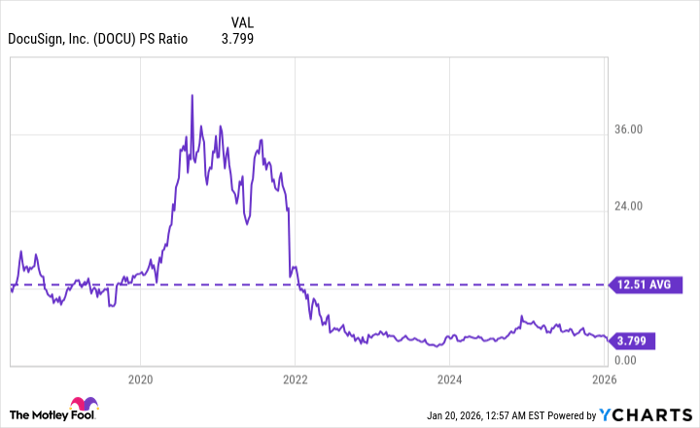
DOCU PS Ratio data by YCharts.
The company's trailing-12-month GAAP earnings of $1.43 per share places the stock at a price-to-earnings ratio (P/E) of 39.6, which is a premium to both the S&P 500 and the Nasdaq-100 indexes. Therefore, it might be considered expensive on that basis. However, given that the company grew its adjusted earnings by 33% in the most recent quarter, it likely won't be long before its P/E is at an attractive level.
Given the significant momentum in Docusign's IAM platform, I think now could be a great time to buy the stock. Investors who are willing to hold it for the next three years (or more) could reap significant rewards as demand grows for AI-powered tools in the contract management space.
Should you buy stock in Docusign right now?
Before you buy stock in Docusign, consider this:
The Motley Fool Stock Advisor analyst team just identified what they believe are the 10 best stocks for investors to buy now… and Docusign wasn’t one of them. The 10 stocks that made the cut could produce monster returns in the coming years.
Consider when Netflix made this list on December 17, 2004... if you invested $1,000 at the time of our recommendation, you’d have $460,340!* Or when Nvidia made this list on April 15, 2005... if you invested $1,000 at the time of our recommendation, you’d have $1,123,789!*
Now, it’s worth noting Stock Advisor’s total average return is 937% — a market-crushing outperformance compared to 194% for the S&P 500. Don't miss the latest top 10 list, available with Stock Advisor, and join an investing community built by individual investors for individual investors.
*Stock Advisor returns as of January 22, 2026.
Anthony Di Pizio has no position in any of the stocks mentioned. The Motley Fool has positions in and recommends Docusign. The Motley Fool has a disclosure policy.
Mentioned In This Article
Latest News
| Oct-08 | |
| Sep-23 | |
| Sep-16 | |
| Sep-14 | |
| Sep-14 | |
| Sep-04 | |
| Sep-04 | |
| Sep-04 | |
| Sep-04 | |
| Sep-04 | |
| Sep-04 | |
| Sep-03 | |
| Sep-03 | |
| Sep-03 | |
| Sep-03 |
