Rivian vs. NIO: Which EV Manufacturer Stock Is Worth Buying?
Rivian Automotive, Inc. RIVN and NIO Inc. NIO are both EV manufacturers. Rivian markets and delivers its electric trucks, SUVs and vans nationwide in the United States via a direct-to-consumer online sales model. It also operates in Canada. In contrast, NIO generates most of its sales in China, its home market, where it offers a range of electric models across multiple brands. Since 2021, NIO has been steadily expanding into Europe. It is also planning to roll out vehicles in Asian countries.
NIO currently offers lower-priced EV options overall than Rivian, mainly because Rivian’s lineup, so far, has been positioned in the mid-to-premium range, while NIO, especially with ONVO & Firefly, includes more affordable models. ONVO targets families and competes in the mid-range EV segment, while Firefly focuses on budget-conscious buyers and low-cost urban EVs. Rivian’s trucks are on the higher end of the market, making demand sensitive to economic conditions.
Over the last six months, NIO shares have lost 1.5%, while Rivian’s shares have risen 16.9%. Both players have underperformed the Zacks auto sector.
6-MonthPrice Performance Comparison
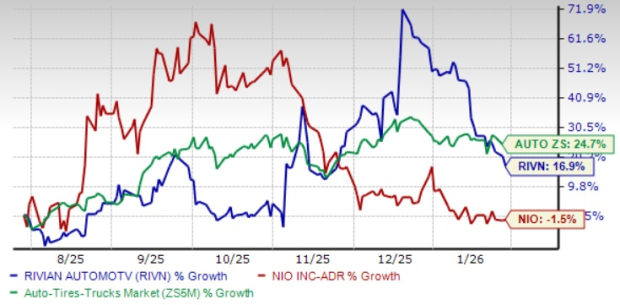
Image Source: Zacks Investment Research
The Case for RIVN Stock
Rivian delivered 42,247 vehicles in 2025, down from 51,579 in 2024, while production totaled 42,284 units, down from 49,476 a year earlier. In the fourth quarter, the company produced 10,974 vehicles at its Normal, IL, plant and delivered 9,745 units. Both quarterly and full-year results were in line with Rivian’s expectations.
The automaker has begun producing validation units of its much-anticipated R2 electric SUV, a more affordable, higher-volume vehicle designed to take the brand beyond its premium R1T and R1S lineup, at its Normal, IL, plant. The company remains on schedule to begin customer deliveries in the first half of the year. Validation builds represent the final step before vehicles become ready for sale. When it was first revealed, Rivian projected that the R2 would start at roughly $45,000.
Rivian views the R2 as a key growth driver, citing major cost efficiencies in both materials and manufacturing. The company anticipates the R2’s launch will accelerate its path to profitability and help reduce fixed costs per unit across all vehicles produced at its Normal, IL, plant due to higher production volumes.
Rivian’s deal with Volkswagen is a major catalyst. The German auto giant will invest up to $5.8 billion in Rivian and their joint venture (JV) by 2027. So far, it has received $3.3 billion and expects to receive another $2.5 billion. The partnership focuses on developing Rivian’s next-generation electrical architecture and software, starting with the R2 model. The JV will leverage Rivian’s existing technology to support the launch of the R2 in the first half of 2026.
The company is benefiting from engineering optimizations, supply chain savings and lower commodity costs. The second-generation R1 models are expected to reduce material costs by 20%, while operational efficiencies at the Normal plant further support cost-cutting efforts. R2 model's material costs are expected to be nearly 50% lower than R1’s, and other production costs are also halved.
However, Rivian’s cash balance declined to $7.1 billion at the end of the third quarter of 2025, down from $7.7 billion in 2024, as the company continues to burn cash while pursuing long-term growth. Additionally, the company's high capex forecast of $1.8-$1.9 billion is likely to further strain near-term financials and cash flows.
The Zacks Consensus Estimate for RIVN’s 2025 sales and EPS implies year-over-year growth of 7.9% and 34.9%, respectively.
The Case for NIO Stock
NIO appears poised for a robust growth phase, fueled by an expanding vehicle portfolio and strategic initiatives. NIO's strong vehicle lineup, including ES6, ET5T, ES8, EC6, ES7, ET5, ET7, EP9, EVE, ET9 and EC7 models, is aiding the company’s deliveries growth. In 2025, NIO delivered 326,028 vehicles, rising 46.9% year over year. Fourth-quarter deliveries reached a new high of 124,807 vehicles, up 71.7% from the prior year.
Recently, NIO and Contemporary Amperex Technology Co., Ltd. have entered into a long-term strategic partnership under a new five-year agreement focused on advanced long-life battery technologies. As first announced in 2024, the two companies will jointly develop batteries with extended lifespans, reinforcing their shared commitment toward innovation and ecosystem development in the new energy vehicle sector. Long-lasting batteries are expected to reduce ownership costs for customers while improving durability, a factor that will attract buyers.
Due to volume ramp-up, new launches, and component and supply chain cost optimization, NIO’s vehicle margins are improving. The metric increased to 14.7% in the third quarter of 2025 from 13.1% in the third quarter of 2024. The company plans to launch three new large SUV models in 2026, all positioned at the high end of their segments. NIO expects these models to deliver strong margin contributions. They will also benefit from cost synergies with the current All-New ES8 and L90. Collectively, these vehicles are expected to help the company achieve a 20% vehicle margin overall.
However, NIO has been bearing the brunt of operational inefficiency. In the last reported quarter, SG&A expenses were up 1.8% on a year-over-year basis. The trend is expected to continue amid an increase in sales and marketing activities associated with new product launches. High operating expenses are likely to weigh on margins.
The Zacks Consensus Estimate for NIO’s 2025 sales and EPS implies year-over-year growth of 37.9% and 31.8%, respectively.
Financial Strength
NIO’s total debt-to-capitalization ratio is 79.8%, while Rivian’s is just 46.6%. This makes Rivian far less leveraged and financially sturdier.
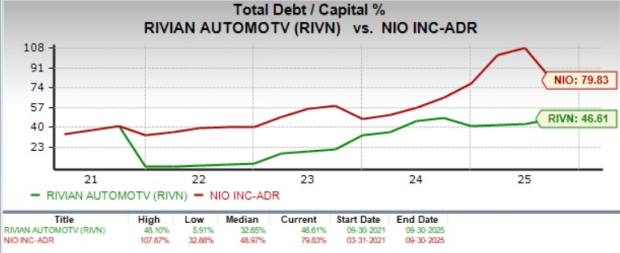
Image Source: Zacks Investment Research
Valuation Check: RIVN vs. NIO
On a valuation basis, NIO trades at a more attractive price-to-sales multiple than RIVN. This suggests that NIO stock is priced more reasonably.
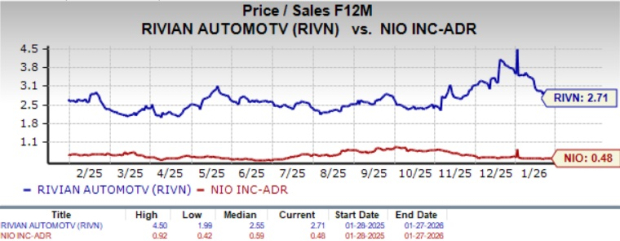
Image Source: Zacks Investment Research
Conclusion
Despite near-term cash burn and higher capital spending, Rivian stands out as the more compelling investment opportunity compared with NIO. RIVN offers a clearer path to profitability through its upcoming R2 launch, which targets a broader, higher-volume segment with dramatically lower material and production costs. The Volkswagen partnership further strengthens Rivian’s outlook, providing both substantial capital support and validation of its technology and software capabilities. Importantly, Rivian maintains a significantly stronger balance sheet, with far lower leverage than NIO, reducing financial risk in a capital-intensive industry.
While NIO is delivering strong volume growth, it remains heavily exposed to the highly competitive Chinese EV market, rising operating expenses, and elevated debt levels. Rivian’s improving cost structure, strategic partnerships, and focus on scalable U.S.-based manufacturing position it to benefit disproportionately as EV demand normalizes.
While both NIO and RIVN carry a Zacks Rank #3 (Hold) at present, for investors prioritizing financial resilience, strategic clarity, and long-term margin expansion, Rivian represents the stronger choice today.
You can see the complete list of today’s Zacks #1 Rank (Strong Buy) stocks here.
Want the latest recommendations from Zacks Investment Research? Today, you can download 7 Best Stocks for the Next 30 Days. Click to get this free report
NIO Inc. (NIO): Free Stock Analysis Report
Rivian Automotive, Inc. (RIVN): Free Stock Analysis Report
This article originally published on Zacks Investment Research (zacks.com).
Mentioned In This Article
Latest News
| Oct-09 | |
| Oct-08 | |
| Oct-08 | |
| Oct-08 | |
| Oct-08 | |
| Oct-08 | |
| Oct-08 | |
| Oct-08 | |
| Oct-07 | |
| Oct-06 | |
| Oct-05 | |
| Oct-05 | |
| Oct-05 | |
| Oct-05 | |
| Oct-05 |
