SoundHound's Agentic AI Push Could Be Right-Even if the Chart Isn't
SoundHound AI Inc. (NASDAQ: SOUN) got off to a strong start in 2026. The company launched new features to its Amelia 7 agentic AI platform at the Consumer Electronics Show (CES) in Las Vegas. This will allow the company to press its advantage in conversational AI to include artificial intelligence (AI) agents that can perform tasks such as ordering food, making dinner reservations, paying for parking, and booking travel.
This is a significant move for a company that has already been posting strong year-over-year revenue growth. However, a lead doesn’t constitute a moat. These new features help build that moat, particularly in the growing autonomous vehicle sector.
But, for now, SoundHound AI presents investors with a case of two plausible things being true at the same time. Of all the stocks competing for attention in the artificial intelligence (AI) universe, SoundHound AI has a compelling story backed up by real, and growing, revenue.
On the other hand, SoundHound AI isn’t profitable and has a price-to-sales (P/S) ratio of around 48x. It’s overvalued at a time when investors are becoming less comfortable paying a premium for speculative stocks.
From April through October of 2025, SOUN stock was one of the best-performing technology stocks. However, since then, the stock has been in a bearish pattern marked by lower highs and lower lows. And even with the launch of these new capabilities, SOUN stock is down over 8% in the first month of 2026.
That has more to do with a broader rotation away from technology stocks. But if SOUN stock is being mispriced, it could be an opportunity.
Agentic AI Is Where the Sector Is Moving
Generative AI (i.e., chatbots and directed content generation) is so 2024, and stocks are being priced accordingly. It's not that generative AI is going away. Rather, AI, like many technologies before it, is evolving rapidly.
The next wave is agentic AI. That’s where AI agents can operate autonomously, performing tasks with little to no human supervision. It’s about execution, not conversation. That means it focuses on turning intent into action across multiple systems.
Amelia Expands SoundHound’s Agentic Capabilities
SoundHound AI’s acquisition of Amelia, announced in November 2024 and completed in early 2025, meaningfully broadened its vision for conversational AI. Amelia brings enterprise-grade AI agents designed for customer service, IT support, and internal business workflows.
These agents can reason through complex requests, access structured enterprise data, and execute tasks across backend systems. In other words, Amelia moves SoundHound beyond voice-first interactions and into full-stack agentic AI for enterprises.
That positions the company not just as a voice-AI provider, but as an action layer for agentic AI. This is a critical role as companies look to move AI from experimentation to production.
Why This Matters for Investors
Agentic AI favors platforms that can operate reliably in real-time environments like cars, restaurants, call centers, and enterprise systems. SoundHound already operates at scale in these settings, generating revenue today rather than promising it tomorrow.
While valuation remains a legitimate concern, the Amelia acquisition strengthens SoundHound’s total addressable market and aligns the company with where AI spending is heading next. If agentic AI adoption accelerates as expected, SoundHound’s recent pullback may prove to be less about a broken story—and more about investors temporarily looking the other way.
Sentiment on SOUN Stock Is Mixed
SoundHound won’t report earnings until late February. So, investors will have to wait before getting a read on how these new features are being accepted.
Analyst sentiment is mixed. The consensus price target for SOUN stock is $16.07, which would be a 61% gain from the stock’s closing price on Jan. 27. Yet, the SoundHound analyst forecasts on MarketBeat also show two analysts giving the stock a Sell rating in January.
SoundHound AI’s daily chart is currently skewed to the downside. The shares trade below both the 50‑day and 200‑day moving averages, reinforcing a negative trend structure as prior rallies have been sold rather than sustained. Price has also slipped beneath a “death cross,” where the 50‑day average sits under the 200‑day, signaling that medium‑term momentum has rolled over.
From a price‑action standpoint, SOUN stock has retreated sharply from its 52‑week high near 22 and continues to register a sequence of lower highs and lower lows, a classic downtrend definition. Volume spikes on selloffs have not yet been followed by durable accumulation days, suggesting buyers remain tentative.
Oversold oscillators hint that a short‑term bounce is possible, but without a higher low and a decisive move back above the 50‑day average, those would be counter‑trend rallies rather than a confirmed bullish reversal.
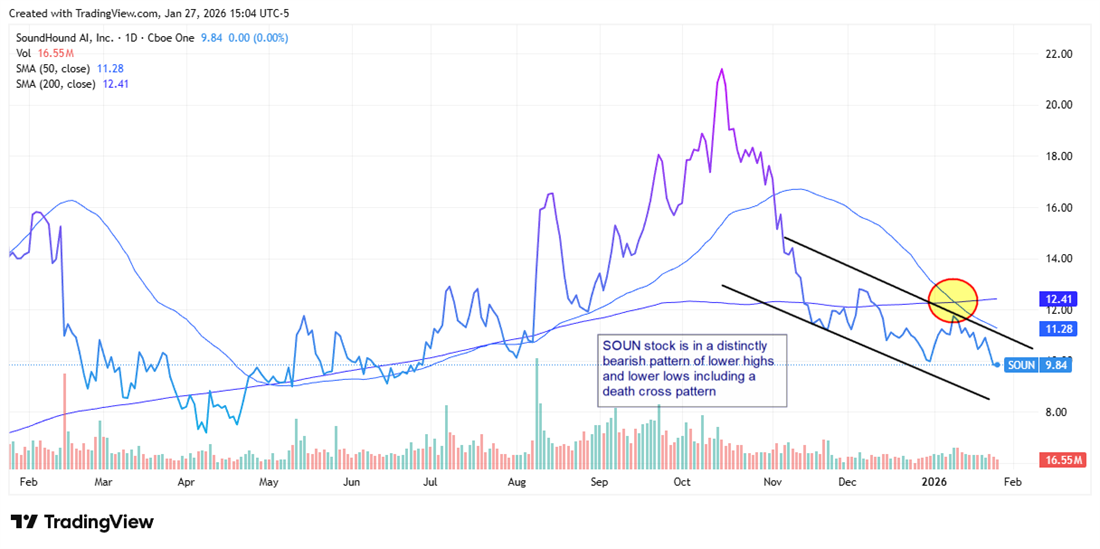
This highlights the fact that less than 20% of SOUN stock is owned by institutions, and there is over 29% short interest. That’s a recipe for volatility, which means that investors should have a high risk tolerance and a sufficient timeline before getting involved with SOUN stock.
Where Should You Invest $1,000 Right Now?
Before you make your next trade, you'll want to hear this.
MarketBeat keeps track of Wall Street's top-rated and best performing research analysts and the stocks they recommend to their clients on a daily basis.
Our team has identified the five stocks that top analysts are quietly whispering to their clients to buy now before the broader market catches on... and none of the big name stocks were on the list.
They believe these five stocks are the five best companies for investors to buy now...
The article "SoundHound’s Agentic AI Push Could Be Right—Even if the Chart Isn’t" first appeared on MarketBeat.
Mentioned In This Article
Latest News
| Sep-30 | |
| Sep-24 | |
| Sep-21 | |
| Sep-11 | |
| Sep-04 | |
| Sep-04 | |
| Sep-02 | |
| Sep-02 | |
| Aug-21 | |
| Aug-18 | |
| Aug-12 | |
| Aug-11 | |
| Aug-07 | |
| Aug-07 | |
| Aug-06 |
