3 Vanguard ETFs to Buy With $1,000 and Hold Forever
Key Points
The Vanguard S&P 500 ETF can serve as a core holding for betting on the U.S. economy's future growth.
The Vanguard Dividend Appreciation ETF owns stocks with at least 10 straight years of dividend increases.
The Vanguard Total International Stock ETF lets you invest in companies from developed and emerging markets.
Although they don't get the same attention as individual stocks, exchange-traded funds (ETFs) are a great way to invest. Instead of spending time researching companies, you can simply invest in an ETF and get exposure to dozens, hundreds, and even thousands of companies at once.
Investing in ETFs doesn't have to mean sacrificing gains, either. They can be just as lucrative in many cases, with less risk. If you have $1,000 available to invest, there are three Vanguard ETFs in particular to consider investing in for the long haul.
Where to invest $1,000 right now? Our analyst team just revealed what they believe are the 10 best stocks to buy right now. Continue »
I wouldn't expect to double that $1,000 in a few years, but it's bound to go a long way for you in the long term.
Image source: Getty Images.
1. Vanguard S&P 500 ETF
The S&P 500 tracks around 500 of the largest American companies on the stock market, so it's often considered a way to invest in the U.S. economy. The stock market and economy aren't directly tied, but these companies have a large impact on the U.S. economy, so they tend to move in the same direction over time.
The Vanguard S&P 500 ETF (NYSEMKT: VOO) is a low-cost way to invest in the S&P 500. In past years, the S&P 500 was more diversified, but the tech sector has become a large part as the valuations of big tech stocks have surged. Even still, it contains companies from every major sector. And since these companies are in the S&P 500, you know you're getting blue-chip stocks and companies that are leaders in their respective industries.
Over the long term, the S&P 500 has averaged around 10% annual returns. It might not jump off the page like some of the gains we've seen from high-flying growth stocks, but it can build wealth over time. Even if it continued to average that, your investment would double in around 7.2 years.
2. Vanguard Dividend Appreciation ETF
Simply looking at its yield, the Vanguard Dividend Appreciation ETF (NYSEMKT: VIG) doesn't stand out among other popular dividend ETFs. Its average yield over the past year is only 1.7%, nearly 1% less than Vanguard's popular dividend ETF, the Vanguard High Dividend Yield ETF.
However, investing in VIG is about dividend growth and the future. As the name hints, VIG focuses on companies that consistently increase their annual dividends. To be considered, you must have increased your annual dividend for at least 10 consecutive years.
Investing in dividend stocks or ETFs that routinely increase their payouts is a three-in-one benefit: the (hopeful) stock price appreciation, present-day dividend payout, and the promise of higher payouts as time goes on.
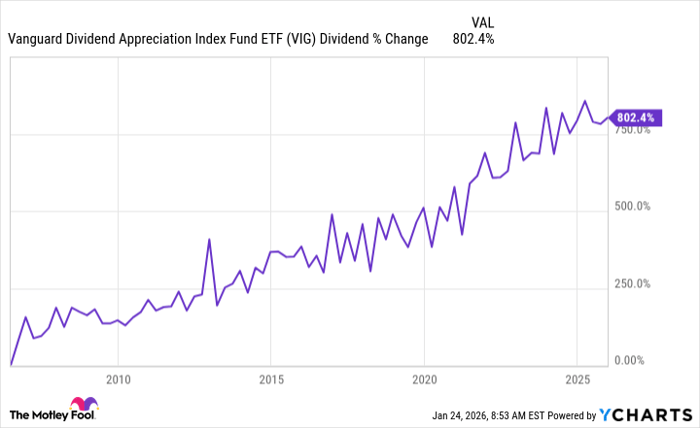
VIG's latest dividend payout was $0.8844 (as of December 2025). The payout fluctuates since the companies VIG holds pay out dividends at different times, but it's much higher than the ETF's payout in previous years.
VIG Dividend data by YCharts.
3. Vanguard Total International Stock ETF
I wouldn't have a large portion of my portfolio in international stocks, but having a diversified international ETF can be a great hedge when the U.S. economy is stagnant or slumping. That's where the Vanguard Total International Stock ETF (NASDAQ: VXUS) comes in handy. VXUS holds over 8,600 stocks from most regions across the globe:
- Europe: 38.2%
- Emerging Markets: 26.8%
- Pacific: 25.6%
- North America: 8.1%
- Middle East: 0.8%
- Other: 0.5%
Holding this many companies from different regions means VXUS covers both developed and emerging markets. The trade-off between the two is similar to the trade-off between investing in established companies and start-ups. Developed markets generally offer greater stability and reliability, while emerging markets offer greater risk and growth opportunities.
By investing in VXUS, you don't have to think too much about region-specific risks (currency, political, etc.) because of how diversified and broad it is. It's a very efficient way to get exposure to the non-American business world.
Should you buy stock in Vanguard S&P 500 ETF right now?
Before you buy stock in Vanguard S&P 500 ETF, consider this:
The Motley Fool Stock Advisor analyst team just identified what they believe are the 10 best stocks for investors to buy now… and Vanguard S&P 500 ETF wasn’t one of them. The 10 stocks that made the cut could produce monster returns in the coming years.
Consider when Netflix made this list on December 17, 2004... if you invested $1,000 at the time of our recommendation, you’d have $461,527!* Or when Nvidia made this list on April 15, 2005... if you invested $1,000 at the time of our recommendation, you’d have $1,155,666!*
Now, it’s worth noting Stock Advisor’s total average return is 950% — a market-crushing outperformance compared to 197% for the S&P 500. Don't miss the latest top 10 list, available with Stock Advisor, and join an investing community built by individual investors for individual investors.
*Stock Advisor returns as of January 28, 2026.
Stefon Walters has positions in Vanguard S&P 500 ETF and Vanguard Total International Stock ETF. The Motley Fool has positions in and recommends Vanguard Dividend Appreciation ETF, Vanguard S&P 500 ETF, Vanguard Total International Stock ETF, and Vanguard Whitehall Funds-Vanguard High Dividend Yield ETF. The Motley Fool has a disclosure policy.
Mentioned In This Article
Latest News
| Oct-19 | |
| Oct-15 | |
| Oct-07 | |
| Oct-05 | |
| Sep-30 | |
| Sep-22 | |
| Sep-21 | |
| Sep-21 | |
| Sep-14 | |
| Sep-11 | |
| Sep-09 | |
| Sep-09 | |
| Sep-09 | |
| Sep-09 | |
| Sep-09 |
