ASML Earnings Clear the Way for More Gains in 2026
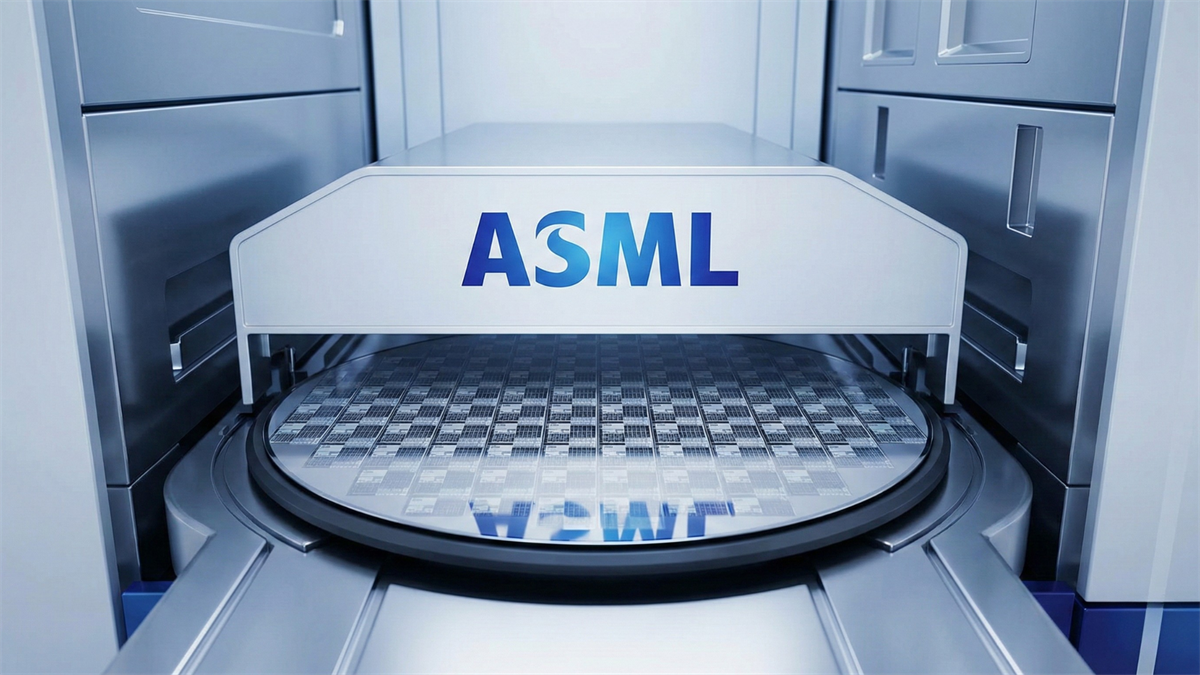
Would you invest in a company that sells only about 40 units of its product annually? If it's a large defense contractor selling jets to the government, that is a substantial sales quota. But what about a machine that shoots lights onto semiconductors? That might not seem impressive at first, but you could buy a squadron of F-35Bs from Lockheed Martin Corp. (NYSE: LMT) for the price of a single Extreme Ultraviolet (EUV) lithography machine. And like the F-35B, there’s only one company on the planet making EUV machines: ASML Holdings N.V. (NASDAQ: ASML). Today, we’ll look at how this company has become Denmark’s most powerful tech firm and one of the linchpins holding the entire semiconductor industry together.
Monopolizing a Crucial Area of Chip Development
Perhaps someday there will be a competitor to the mammoth EUV machines that ASML produces every year. After all, the company does little offensively to keep regulators at bay or to smother new entrants. Rather, ASML has a monopoly because no one else can do what it does: blasting silicon with high-intensity light to construct the most sophisticated and detailed chips in the semiconductor space.
It works by focusing lasers onto small pieces of tin, igniting them to extremely high temperatures that generate a wave of ultraviolet light. This light bounces off a precise layout of mirrors to create a pattern that’s embedded into silicon wafers. Light of this magnitude doesn’t occur naturally, and ASML has a tight agreement with Carl Zeiss ZMT, the world’s only supplier of the refractive mirrors.
It may sound like a Rube Goldberg machine, but EUV units cost between $200 million and $400 million. The machines are so complex that competitors simply can’t afford the R&D required to develop their own model.
Even the shipping process is complicated, requiring 40 different shipping containers and on-site assembly by a platoon of ASML engineers. In 2026, the company also hopes to begin producing its new High-Numerical Aperture (NA) EUV machines, which increase the aperture size to enhance resolution. These new machines will reduce process complexity and cost more than $400 million per unit.
Strong 2025 Earnings and Guidance Raise for 2026
ASML closed out its fiscal year 2025 with a flourish during its Jan. 28 earnings release. Fourth quarter revenue came in at 9.7 billion euros (approx. $11.5 billion), putting the company’s full year sales figure at €32.7 billion (approx. $38.8 billion), a 16% year-over-year (YOY) increase. Gross margins for 2025 were 52.8%, and the company earned €24.73 per share (approx. $29.3) on the year.
ASML was able to shake off concerns about a slowdown in China and raised its 2026 revenue guidance to €34 billion to €39 billion (approx. $40.3 billion to $46.2 billion). One area to watch moving forward will be the company’s margins, which were updated to a range of 51% to 53%. This mild margin projection reflects the introduction of new High-NA EUV machines onto the market, which will likely carry lower margins as manufacturing and supply chains are optimized. However, management reiterated its goal of achieving a 56%-60% gross margin by 2030.
The stock currently trades at 45 times forward earnings, which is a premium valuation but not necessarily outlandish, given the multiples of some AI-adjacent companies in the tech sector. ASML also has a backlog of more than €38 billion (approx. $45 billion), which eclipses the lower end of the company’s 2026 revenue projections. Having a full year of revenue in the backlog provides a solid floor under the stock, allowing it to absorb any disruptions from implementing the new High-NA machines. Additionally, the company announced a dividend increase and a plan to buy back more than €12 billion (approx. $14.2 billion) in shares before the end of 2028.
Chart Shows Bullish Momentum Reaching Overbought Territory
Management, investors, and analysts are all optimistic about ASML’s 2026 prospects, and perhaps that excitement has gotten a little over the top. The stock is already up more than 30% in January, boosted by multiple analyst upgrades and price target increases. The long-term trend clearly has plenty of bullish momentum, with the price soaring above the 50-day and 200-day simple moving averages (SMAs) and the 50-day SMA acting as support during periods of volatility.
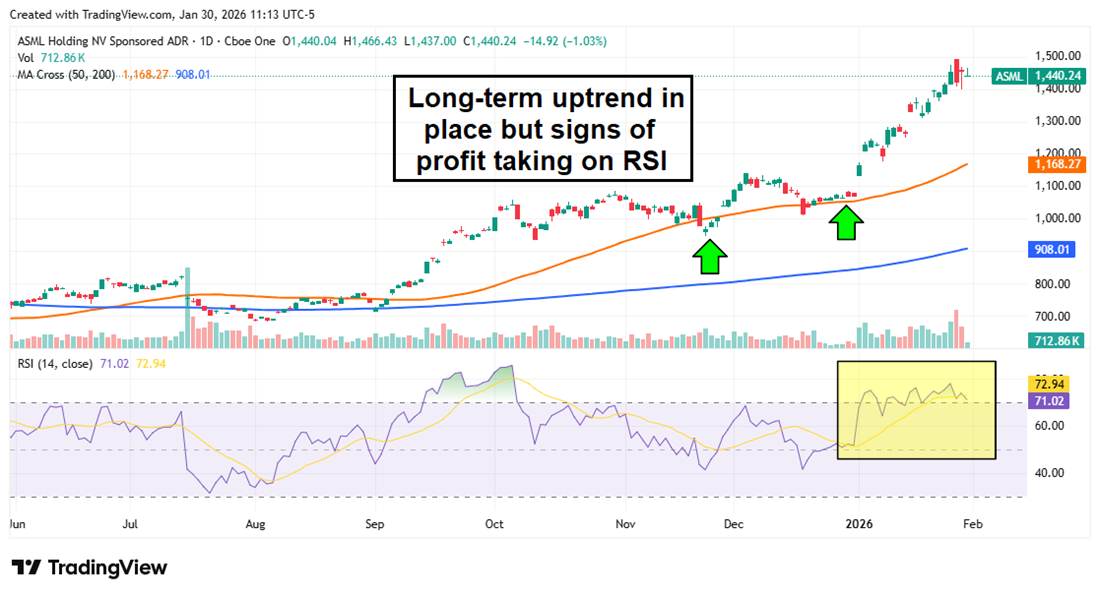
Despite strong fundamentals and a bullish technical trend, evidence is emerging that this rally is becoming unsustainable. Wide daily ranges are becoming more common as the stock elevates further and further from the 50-day SMA. Additionally, the Relative Strength Index (RSI) has been in Overbought status since before the ball dropped on New Year’s Eve. It wouldn’t be surprising to see investors take profits here following the strong earnings report and series of analyst upgrades, so a brief pullback could be on the horizon. The 50-day SMA could be an ideal entry point for new positions, so keep an eye on this chart in the days and weeks ahead.
Where Should You Invest $1,000 Right Now?
Before you make your next trade, you'll want to hear this.
MarketBeat keeps track of Wall Street's top-rated and best performing research analysts and the stocks they recommend to their clients on a daily basis.
Our team has identified the five stocks that top analysts are quietly whispering to their clients to buy now before the broader market catches on... and none of the big name stocks were on the list.
They believe these five stocks are the five best companies for investors to buy now...
The article "ASML Earnings Clear the Way for More Gains in 2026" first appeared on MarketBeat.
Mentioned In This Article
Latest News
| Oct-09 | |
| Oct-08 | |
| Oct-07 | |
| Oct-05 | |
| Oct-05 | |
| Oct-05 | |
| Oct-02 | |
| Oct-02 | |
| Oct-02 | |
| Sep-30 | |
| Sep-30 | |
| Sep-29 | |
| Sep-29 | |
| Sep-29 | |
| Sep-29 |
