3 Warning Signs That the Stock Market Today Is in an Artificial Intelligence (AI) Bubble
Key Points
Tech companies are investing incredible amounts of capital in artificial intelligence (AI) infrastructure.
Many are entering into complex financial deals to secure the funding for those buildouts.
There's a possibility that the profit potential for AI is being overhyped.
The Invesco QQQ Trust, which tracks the tech-heavy Nasdaq-100 index, has generated a fantastic total return of 117% in the past three years (as of Jan. 28). That performance was driven mainly by the success and rising popularity among the investment community of the "Magnificent Seven" stocks. These tech-centric businesses, and others betting big on artificial intelligence (AI) ventures, have powered an outsized share of the broader market's apparently ever-increasing value.
Investors and industry experts can be bullish on the longer-term prospects of AI. But it's important to see how matters stand in the present clearly. Here are three warning signs that the stock market today is in an AI bubble.
Where to invest $1,000 right now? Our analyst team just revealed what they believe are the 10 best stocks to buy right now. Continue »
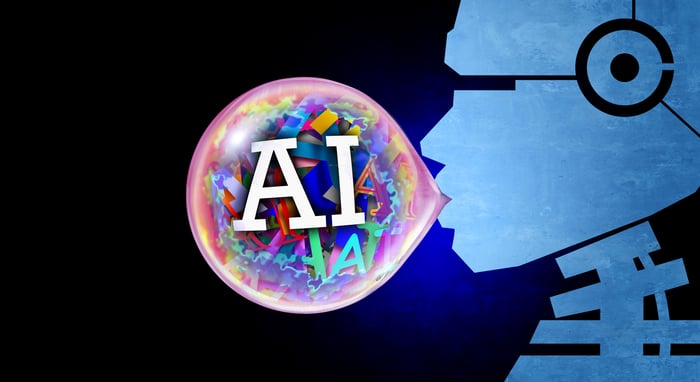
Image source: Getty Images.
1. Enormous capital outlays
The hyperscalers, a group of large data center operators that includes companies like Amazon, Microsoft, and Alphabet, spent hundreds of billions of dollars collectively on capital expenditures last year, mostly for AI-related projects. These massive sums are driving a surge in investment activity among these businesses compared to prior years.
OpenAI, whose launch of the ChatGPT chatbot a few years ago set off this craze, might face a funding gap before this decade ends. The company says it plans to spend a jaw-dropping $1.4 trillion on computing resources over the next eight years. OpenAI reached $20 billion in annualized revenue last year, so where will the money come from?
2. Unique financial engineering
Even companies that generate robust net income and free cash flow are tapping the capital markets to raise money to fund all of this infrastructure spending. And there is no shortage of financial engineering going on.
For instance, a $27 billion joint venture between Meta Platforms and Blue Owl Capital allows the social media giant to keep that debt off its balance sheet.
So-called circular financing arrangements are also in place. These occur when one company purchases a stake in a target company that turns around and uses the capital it received to buy products and services from the original investor.
It's clear that there is a lot of interconnectedness between the various entities leading the AI sector. If one business starts to struggle in any capacity, the domino effect could lead to troubles across the space.
3. Uncertain long-term returns
In November, OpenAI said that ChatGPT had 800 million weekly users. Alphabet's Gemini app had 650 million monthly active users in Q3. The rapidness of society's adoption of these AI tools has been impressive.
But research by Menlo Ventures suggests that only 3% of AI users pay for premium-tier access to those services. This calls into question whether the returns on all this AI capital spending will be adequate to justify it.
This leads me to another point: There's a chance AI will end up being only incrementally beneficial to the economy and society, providing less dramatic improvements than were delivered by previous innovations like PCs, mobile devices, and cloud computing.
As such, the people who are hoping that this technology will fundamentally change civilization or solve all the world's problems -- and who are bidding up the share prices of the companies involved accordingly -- might wind up disappointed.
Should you buy stock in Invesco QQQ Trust right now?
Before you buy stock in Invesco QQQ Trust, consider this:
The Motley Fool Stock Advisor analyst team just identified what they believe are the 10 best stocks for investors to buy now… and Invesco QQQ Trust wasn’t one of them. The 10 stocks that made the cut could produce monster returns in the coming years.
Consider when Netflix made this list on December 17, 2004... if you invested $1,000 at the time of our recommendation, you’d have $450,256!* Or when Nvidia made this list on April 15, 2005... if you invested $1,000 at the time of our recommendation, you’d have $1,171,666!*
Now, it’s worth noting Stock Advisor’s total average return is 942% — a market-crushing outperformance compared to 196% for the S&P 500. Don't miss the latest top 10 list, available with Stock Advisor, and join an investing community built by individual investors for individual investors.
*Stock Advisor returns as of February 2, 2026.
Neil Patel has positions in Invesco QQQ Trust. The Motley Fool has positions in and recommends Alphabet, Amazon, Meta Platforms, and Microsoft. The Motley Fool has a disclosure policy.
Mentioned In This Article
Latest News
| 1 hour | |
| Oct-09 | |
| Oct-09 | |
| Oct-09 | |
| Oct-09 | |
| Oct-09 | |
| Oct-08 | |
| Oct-08 | |
| Oct-08 | |
| Oct-07 | |
| Oct-07 | |
| Oct-07 | |
| Oct-07 | |
| Oct-06 | |
| Oct-06 |
