Key SPX Levels to Monitor After Rally Above 7,000
Last week brought about a plethora of headlines, including the Federal Open Market Committee (FOMC) meeting, in which the central bank held interest rates steady after three consecutive rate decreases since September.
Shortly after the FOMC meeting, President Donald Trump nominated Kevin Warsh, who was viewed as a hawk during his time as Fed governor, as the next Fed chairman. Though he is on the record saying he thinks interest rates should be lower, stocks, gold, silver, the U.S. dollar, and bonds reacted to the news as if traders were disappointed that the nominee doesn’t have more of a dovish (lower rate) lean.
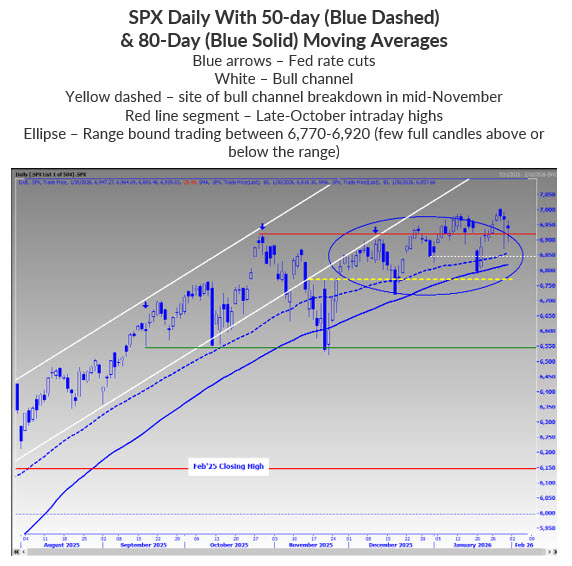
The S&P 500 Index (SPX – 6,939.03) touched the 7,000-millennium mark for the first time in its history last week, hitting an intraday high of 7,002 before closing back below the 7,000 level and not touching it again through Friday’s close.
This was set upon many meg-cap technology companies reporting earnings, which gave investors a little more clarity on AI spending and whether there’s a chance for a return on investments soon.
The results were a mixed bag, with Meta Platforms (META) surging after earnings, but remaining nearly 10% below last year’s peak. Meanwhile, Microsoft (MSFT) gapped significantly lower after its report, hitting a multi-month low and crossing below its 2024 peak, a level that was supportive in November and December.
“...there have been 39 trading sessions since the SPX rallied back above 6,770 after the initial breakdown below the lower boundary of the bullish channel. In only six of those trading sessions, the SPX’s full daily candle (its open, high, and low) was outside the 6,770 level, and its late October intraday high of 6,920. The latter level acted as resistance on a closing basis both Thursday and Friday. In all cases, the full candles outside the 6,770-6,920 range were above 6,920. As of Friday’s close, the SPX has made no headway relative to its late October former all-time highs, while the RUT has rallied more than 10%.”
- Monday Morning Outlook, Jan. 26, 2026
Since the SPX’s mid-November break below the lower boundary of a bull channel, it remains a grind that has favored the bulls. There have now been 44 trading sessions since the SPX rallied back above the level of the lower boundary channel break (6,770), and nine full candles (high, low, and close) outside the range between 6,770 and the late-October intraday high of 6,920.
Three of the nine full candles occurred last week, with Thursday and Friday lows within the 6,770-6,920 range. For what it’s worth, the 6,770 level is roughly 10% above the February 2025 all-time closing high around 6,150. If this level is breached again, those with double-digit percentage profits that bought the June breakout above the February 2025 high might become profit-takers, as they see double-digit percentage gains evaporated.
The good news for bulls is that the SPX reached another all-time high, and all daily closes last week were above the important 6-770-6,920 range. But the frustrating part is that the index cannot seem to shake 6,920 in a sustainable fashion, despite touching it twice last week after the rally to 7,000.
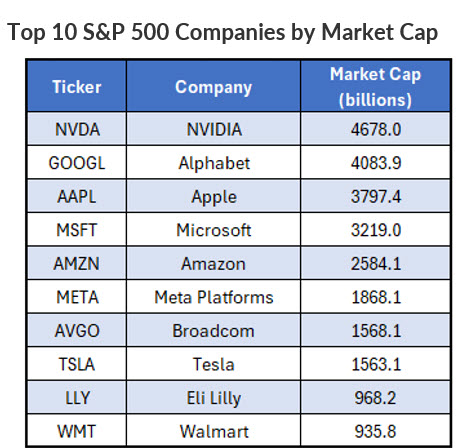
To better understand sentiment regarding SPX names, I asked our Senior Quantitative Analyst Rocky White to look at the buy-to-open put/call volume ratio for the top 10 SPX components, as listed immediately below, compared to “all others.”
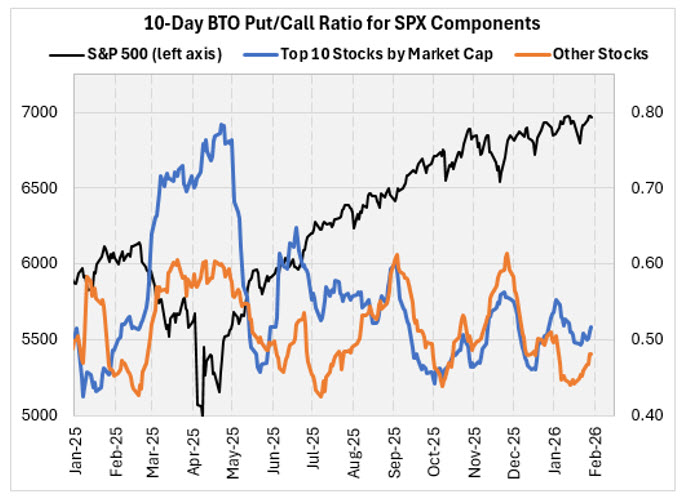
I found that the direction of the ratios is generally correlated, but sentiment can vary. In October 2025, for example, note how the “all others” category of smaller-weighted stocks within the SPX hit an extreme level of pessimism (high ratio), whereas the mega-cap names were far below 2025s pessimistic extreme. That said, traders seem to get more nervous when mega caps sell off, creating a higher pessimism value at extremes.
At present, both mega-cap weighted stocks and “all others” are neither in extreme optimism nor extreme pessimism, but traders are reacting more to mega-cap underperformance, as the buy-to-open put/call volume ratio is higher than “all others.”
A potential concern from the chart below is that the “other stocks” ratio recently hit an extreme low and is headed higher, implying traders are becoming less enthusiastic on names in the SPX that were supporting the index as mega caps floundered and, to some extent, continue to flounder.
This could mean the potential for a sharp pullback like those we saw in 2025, when option buyers on stocks outside the SPX’s top 10 weighted names moved from extreme enthusiasm to less enthusiasm.
You can see this in the chart below, after the “other stocks” buy-to-open put/call volume ratio moved higher from extreme lows in February and October. The July period was different, as mega-caps held the index up from a better technical condition overall, and as option buyers were still unwinding a period of negative sentiment on the mega-cap names.
Finally, small caps as measured by the Russell 2000 Index (RUT – 2,613.74) underperformed their large-cap rivals last week. Both the RUT and SPX are sitting on their rising 30-day moving averages, which has been more significant on the RUT than the SPX in recent months. The RUT’s low last week was the site of its December high.
We still like small caps. Like SPX components, short interest is very high, and they have outperformed the mega-cap names the past few months.
Todd Salamone is Schaeffer's Senior V.P. of Research
Continue Reading:
Mentioned In This Article
Latest News
| 2 hours | |
| Sep-27 | |
| Sep-27 | |
| Sep-27 | |
| Sep-27 | |
| Sep-27 | |
| Sep-27 | |
| Sep-27 | |
| Sep-27 | |
| Sep-27 | |
| Sep-27 | |
| Sep-27 | |
| Sep-27 | |
| Sep-27 | |
| Sep-27 |
